Oil on canvas · Exhibited 1844 · The National Gallery
Rain, Steam and Speed: Turner's 1844 Great Western Railway Painting
A locomotive comes head-on out of the weather across a bridge on the Thames. Turner was sixty-nine, the line was almost new, and he painted the machine as the fastest thing in the picture.
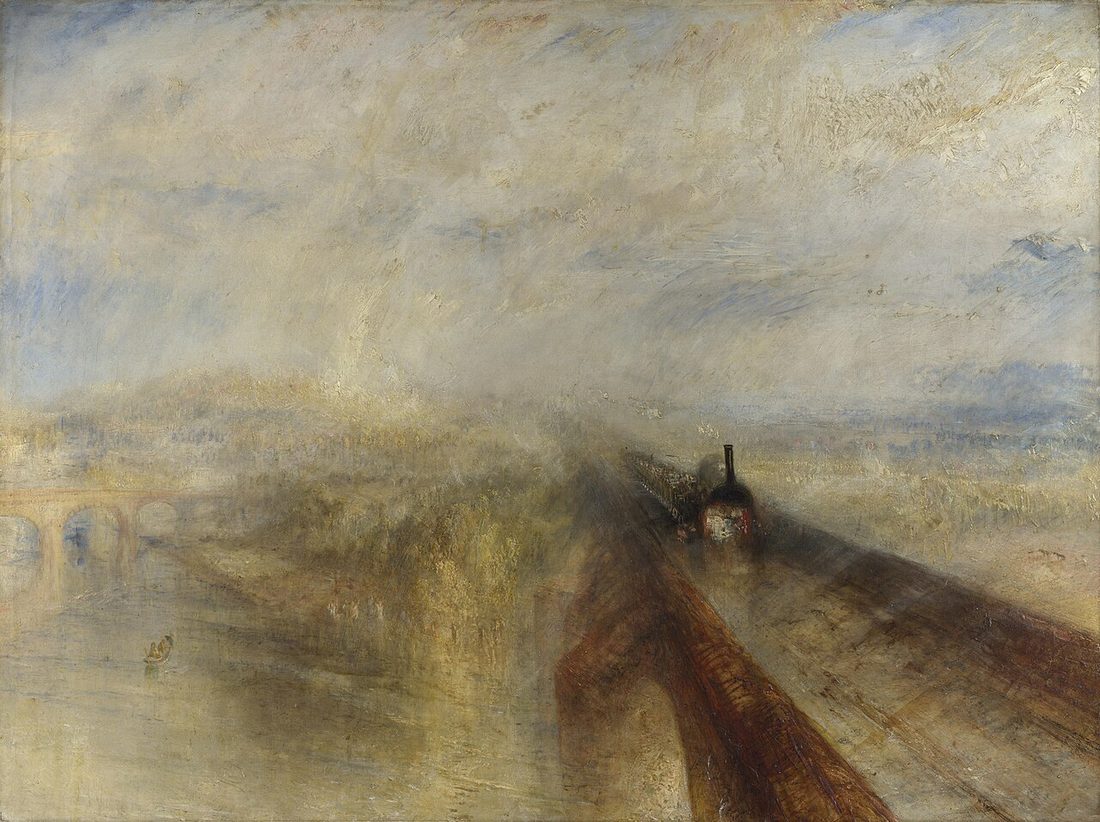

What Rain, Steam and Speed shows
A train crosses a bridge towards the viewer, its dark boiler and firebox the only hard-edged thing in a canvas otherwise dissolved into rain and light. The bridge runs at a steep diagonal from the lower right. To the left, a second and older bridge is just readable through the downpour, and a small boat sits on the river below.
| Artist | Joseph Mallord William Turner (1775–1851) |
|---|---|
| Date | 1844 |
| Exhibited | Royal Academy, 1844 |
| Medium | Oil paint on canvas |
| Dimensions | 910 x 1218 mm |
| Collection | The National Gallery, London |
| Accession number | NG538 |
Almost nothing else holds a firm edge. The rain is scrubbed into the sky, the far bank is a suggestion, and the paint thins to bare ground in places. Turner gives the locomotive enough definition to read as iron and heat, then lets everything around it come apart, so the engine outruns the picture itself.
The Great Western Railway bridge at Maidenhead
The setting is identifiable. It is the Great Western Railway crossing the Thames on Isambard Kingdom Brunel's Maidenhead bridge, completed in 1838 and notable for the flattest brick arches then built. The older structure to the left is the road bridge. Turner names the company in his title, which was unusual for him and dates the scene precisely.
The railway was six years old when he exhibited. The Great Western had opened through to Maidenhead in 1838 and reached Bristol in 1841, and its speeds were a matter of public discussion instead of routine experience. Turner was painting something his first audience had mostly read about and in many cases had not yet done.
The hare
Ahead of the locomotive, on the track and very faintly painted, a hare is running. It is easy to miss and often is. Once seen it reframes the picture, setting the fastest animal most viewers would have known against the machine that had just overtaken it, without Turner having to state the comparison in the title.
How critics received it in 1844
Reviews in 1844 were mixed and a good deal of the commentary was mocking, which was by then normal for late Turner. His handling had been drawing complaints for a decade, and critics who wanted a finished surface found the canvas unresolved. Others recognised what he was doing with speed and weather and said so plainly.
The painting's reputation rose steadily afterwards. It is now read as one of the earliest serious attempts by a major painter to treat industrial machinery as a proper subject and not an intrusion, and as evidence that Turner's late manner was a deliberate instrument and not the failing eyesight his detractors liked to suggest.
Turner and steam, five years after the Temeraire
Turner had exhibited The Fighting Temeraire in 1839, and the two paintings are often set against each other. In the earlier picture the steam tug is small, black and unromantic, and the sailing ship carries the light. Here the positions are reversed, and the locomotive gets the drama while the older world sits quietly to one side.
The pairing is a useful corrective to the idea that Turner mourned the passing of sail. He painted steam repeatedly across his last two decades and did not settle into a single attitude towards it. What stayed constant was his interest in what moving power looks like in bad weather, which both canvases are really about.
Where to see it
The painting is in the National Gallery in London, part of the Turner Bequest. It hangs in the same building as Dido Building Carthage and The Fighting Temeraire, which makes it straightforward to see Turner's classical ambition, his elegy for sail and his response to the railway within a few minutes of each other.
Questions
What bridge is in Rain, Steam and Speed?
It is Isambard Kingdom Brunel's railway bridge at Maidenhead, carrying the Great Western Railway over the Thames. Completed in 1838, it was known for having the flattest brick arches built up to that point. The older structure visible through the rain on the left of the canvas is the road bridge that already crossed the river there.
Is there really a hare in the painting?
Yes. A hare is running on the track ahead of the locomotive, painted very faintly and easy to overlook entirely. It sets the fastest animal a nineteenth-century viewer was likely to have seen against the machine that had just outpaced it, and it makes the comparison without Turner needing to put anything of the kind in his title.
How did critics react in 1844?
The response was mixed and often mocking, which was by then usual for Turner's late exhibits. Reviewers who expected a finished surface thought the canvas unresolved, and his handling had been attracting that complaint for a decade. Other writers understood what he was doing with speed and weather, and the painting's standing rose steadily after his death.
How does it relate to The Fighting Temeraire?
The two are frequently compared because they reverse each other. In the 1839 painting the steam tug is small, dark and unlovely while the sailing ship carries all the light; here the locomotive takes the drama. Together they show that Turner had no fixed attitude to steam and was not simply mourning the age of sail.