Oil on mahogany · Exhibited 1833 · Tate
Bridge of Sighs, Ducal Palace and Custom-House, Venice: Turner, 1833
Turner had visited Venice twice and shown nothing from it. In 1833 he exhibited this panel, and named a rival painter in the title while he was at it.
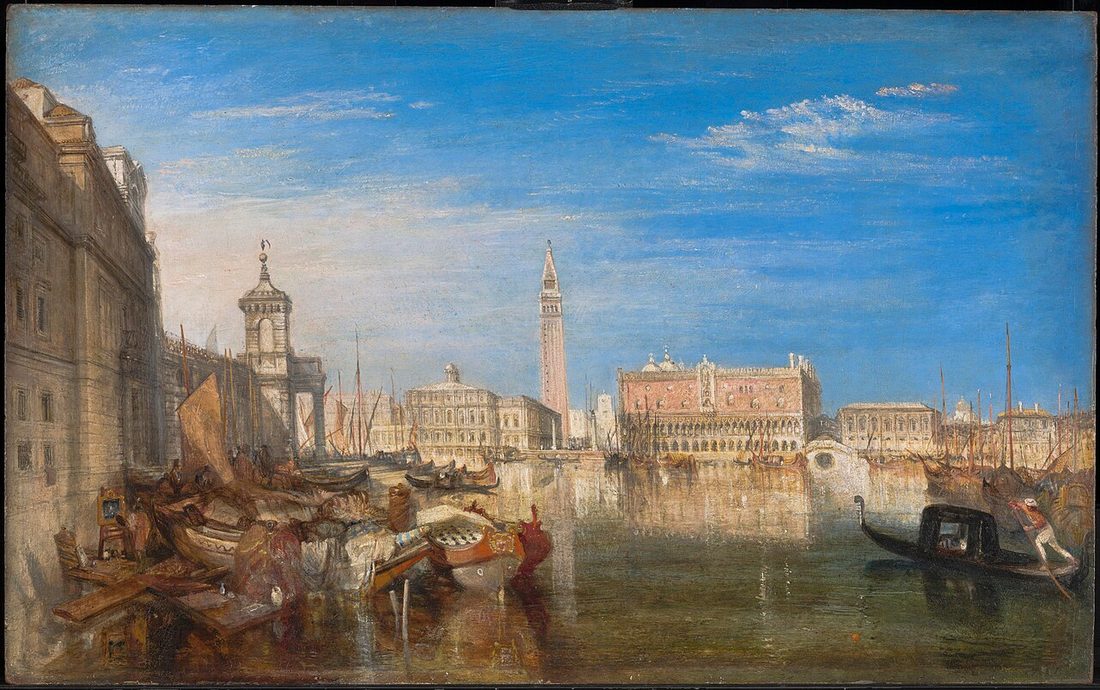

The view
The picture takes the standard tourist prospect from the water: the Doge's Palace along the left, the Bridge of Sighs behind it, the Dogana closing the composition on the right, and the mouth of the Grand Canal opening in between. Gondolas and larger craft fill the foreground, and the light comes flat off the lagoon.
| Artist | Joseph Mallord William Turner (1775–1851) |
|---|---|
| Date | 1833 |
| Exhibited | Royal Academy, 1833 |
| Medium | Oil paint on mahogany |
| Dimensions | support: 511 x 816 mm |
| Collection | Tate, London |
| Accession number | N00370 |
| Credit line | Presented by Robert Vernon 1847 |
What separates it from the eighteenth-century view painters is the handling of that light. The architecture is described accurately enough to be identified building by building, but the stone is not solid: it is pale, chalky and slightly dissolved at every edge, as though the humidity of the lagoon has got into the paint.
The Canaletti joke
Turner's full exhibition title ended with the words Canaletti painting, and a small figure of the painter at work appears in the left foreground. Antonio Canal, known as Canaletto, had died in 1768 and was by then the definitive painter of Venice for British collectors, most of whom had bought him on the Grand Tour.
Including him was both homage and challenge at once, and the choice of an eighteenth-century rival follows exactly the same pattern as Turner's lifelong argument with Claude Lorrain. He tended to declare his competition and not conceal it, and the declaration usually appeared in the catalogue entry where buyers would be sure to read it.
Painted on mahogany
The support is a mahogany panel instead of canvas, which is unusual for an exhibited Turner of this date and gives the surface a particular smoothness. The rigid ground let him work thin, wet paint without the weave breaking it up, and the result holds detail in the architecture that a canvas would have coarsened.
Why Venice arrived so late
Turner first saw Venice in 1819 and returned in 1833, but exhibited nothing from the city for fourteen years. Whether he was waiting for his handling to catch up with the subject or simply for the market to want Venetian pictures is not documented, and both explanations have been argued for at length.
What is clear is that once he started he did not stop. Venetian oils appeared at the Royal Academy repeatedly through the following decade and sold consistently well, and the subject turned out to suit his late manner better than anything else he painted. This panel is where that long sequence begins.
The gondolas
One detail separates Turner's Venice from the view painters he was competing with. His gondolas are marks instead of vessels: a dark stroke for the hull, a hook for the ferro, and no attempt at the rigging or the passengers a tourist print would itemise. They establish scale and nothing else.
Where to see it
The painting is at Tate in London, part of the Turner Bequest, so he kept it himself instead of selling it. Several of the later Venetian oils are more widely dispersed, which makes Tate the best place to see the beginning and the middle of the sequence in one visit and not two.
Questions
Who is Canaletti in the painting's title?
Antonio Canal, known as Canaletto, the eighteenth-century painter whose Venetian views most British collectors had bought on the Grand Tour. He died in 1768. Turner ended his exhibition title with the words Canaletti painting and put a small figure of him at work in the left foreground, as both homage and challenge.
Why is it painted on mahogany and not canvas?
The rigid panel gave him a smoother ground than canvas, which let him work thin, wet paint without the weave breaking it up. That is why the architecture in this picture holds more fine detail than a comparable canvas of the same date would, and the support is unusual for an exhibited Turner of the 1830s.
Why did Turner wait so long to exhibit a Venice picture?
He first saw the city in 1819 and showed nothing from it until 1833, a gap of fourteen years that is not explained in any surviving document. Both possibilities have been argued: that his handling had not yet caught up with the subject, and that he was waiting for collectors to want Venetian pictures.