Collections · United Kingdom and abroad
Where Can I See J.M.W. Turner's Paintings? A Guide to the Collections
Most of what Turner owned when he died went to the nation in one bequest. The rest is spread across a dozen collections, and the split is worth understanding before you travel.
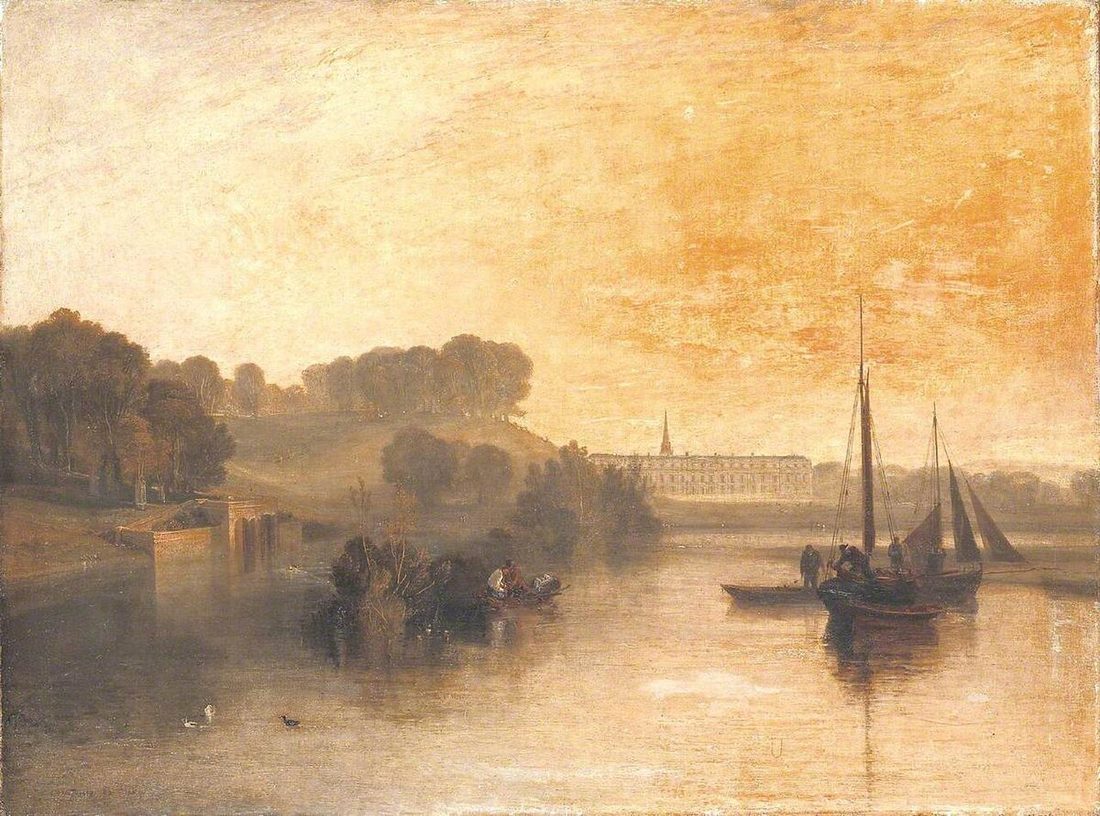
_-_Petworth,_Sussex,_the_Seat_of_the_Earl_of_Egremont,_Dewy_Morning_-_T03880_-_Tate.jpg)
Tate, London
Tate holds the Turner Bequest, which is the great majority of what was in his studio at his death: some thirty-nine thousand items, mostly drawings, watercolours and sketchbook pages, along with a large number of oils he never sold. It is by a wide margin the most important Turner collection anywhere.
The Clore Gallery at Tate Britain was built specifically to house it and opened in 1987. Because works on paper cannot be permanently exposed to light, the watercolours are shown in rotating displays instead of hung continuously, so what is on view changes and a specific sheet may not be out.
The National Gallery, London
The National Gallery has a much smaller group, but it includes several of the most famous canvases of all: The Fighting Temeraire, Rain, Steam and Speed, Dido Building Carthage, Sun Rising through Vapour and Ulysses Deriding Polyphemus. These hang on more or less permanent display, which makes it the more reliable visit of the two.
It is also where Turner's own condition on his bequest is honoured. Two of his paintings hang beside two by Claude Lorrain, as his will required, so the comparison he wanted can be made in front of the four canvases rather than from reproductions. Nothing else in the collection is arranged that way.
Elsewhere in Britain
Petworth House in West Sussex still retains its Turners in the very setting they were painted for, since the third Earl of Egremont was a major patron and Turner worked there repeatedly over many years. The Wallace Collection, the Ashmolean, the Fitzwilliam and several municipal galleries in the north also hold significant works.
Outside Britain
The Slave Ship is in the Museum of Fine Arts in Boston, and the two versions of the burning of Parliament are in Philadelphia and Cleveland. The Metropolitan Museum and the Frick Collection in New York, the Getty in Los Angeles and the National Gallery of Art in Washington all hold Turners.
The dispersal happened mostly through the market rather than by any bequest. Works Turner had sold in his own lifetime, together with the collection Ruskin later broke up, moved steadily to American buyers across the later nineteenth and early twentieth centuries, which is why the United States now holds so many major examples.
The Turner Prize is unrelated
One point of frequent confusion: the Turner Prize, awarded annually for contemporary British art, is named after the painter but has nothing to do with the collections that hold his work. Visitors occasionally arrive at Tate Britain expecting the two to be connected in some way, and they are not.
Before you go
Check the collection's own website for what is actually on display before setting out. Loans, rotations and rehangs all mean that a painting listed in a catalogue may not be on the wall, and this is especially true of the watercolours at Tate, where the displayed selection changes by design rather than by accident.
Whether you are someone who plans whole trips around galleries or you are usually rather more inclined to stay at home playing online blackjack, the late watercolours in particular are worth the effort of seeing in person, because they lose far more in reproduction than almost anything else he ever made.
Questions
Where is the largest collection of Turner's work?
Tate in London, which holds the Turner Bequest of roughly thirty-nine thousand items left to the nation at his death. It is housed in the Clore Gallery at Tate Britain, built for the purpose and opened in 1987. Works on paper are shown in rotating displays because they cannot be permanently exposed to light.
Which gallery has The Fighting Temeraire?
The National Gallery in Trafalgar Square, London, which received it as part of the Turner Bequest. The same building holds Rain, Steam and Speed, Dido Building Carthage and Ulysses Deriding Polyphemus, and these major oils are on more or less permanent display rather than rotated like the works on paper.
Can I see Turner's paintings outside the UK?
Yes, and some of the most important ones of all. The Slave Ship is in Boston, the two burning-of-Parliament canvases are in Philadelphia and Cleveland, and there are significant Turners in New York at both the Metropolitan Museum and the Frick Collection, as well as in Washington and Los Angeles.