Index · Themes
Turner's Themes: The Subjects That Group the Individual Paintings
Individual pictures make more sense in company. These pages draw the paintings into the groups Turner himself kept returning to over six decades.
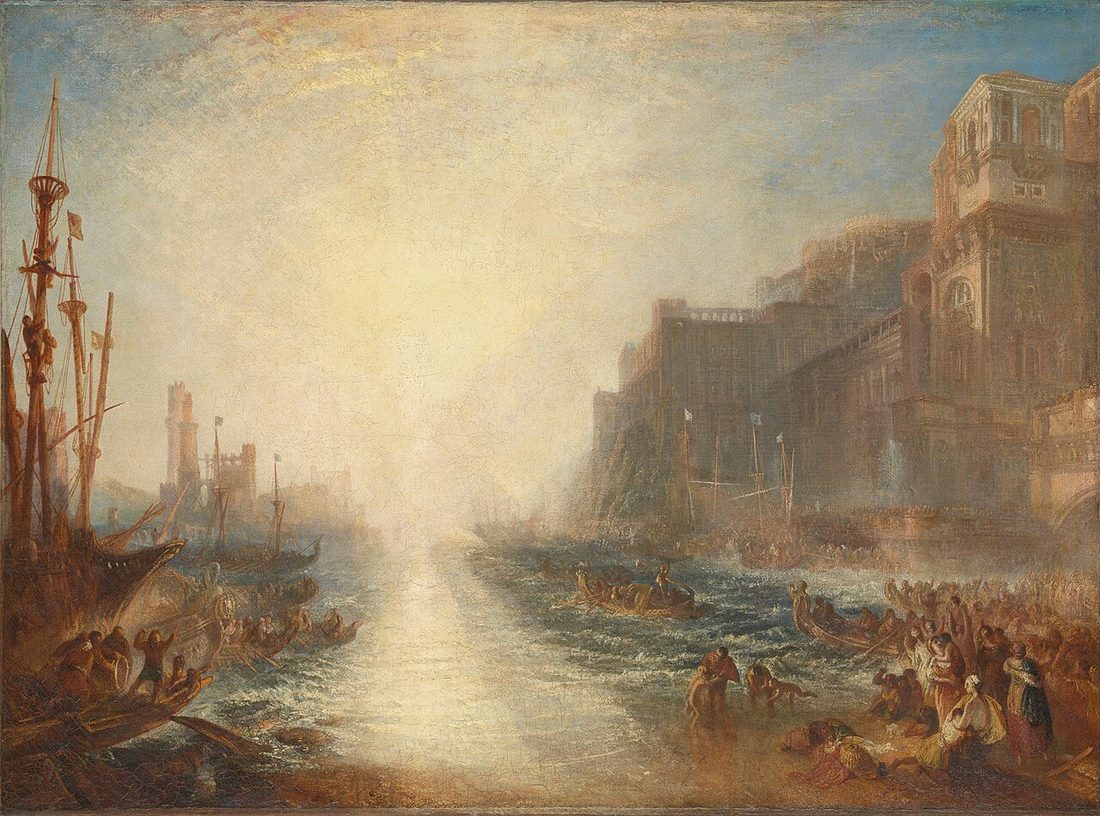

Turner went back to the same problems for decades: how water actually moves, how light behaves at the edge of legibility, and what happens to solid architecture seen at a distance through humid air. The theme pages follow those preoccupations instead of the chronology.
The marine subjects run the whole length of the career and are the clearest place to watch the method change. An early sea is built from modelled waves and described spray; a late one is built from the direction of the paint, and still reads as a vessel in trouble because the few marks Turner leaves are the ones a seaman would need.
Colour is the second thread, and it is partly a material story. Turner adopted new pigments as they became available, including chrome yellow, and some of what he used has not survived on the canvas. Where a picture now looks unbalanced towards yellow the imbalance may belong to the material and not the intention, and any argument about his colour has to allow for a surface that has changed since it left the studio.
The castles and abbeys come first and paid for much of what followed. Topographical work was a trade, and drawing ruins for the engravers taught him how a building sits in weather and light. The subject also gave an ambitious landscape painter a history he could stand in front of without leaving Britain, which is why he was still returning to Norham fifty years after he first drew it.
Venice is a case of its own. He went three times and the pictures are almost entirely about water, light and architecture seen through humid air; the markets, trades and ordinary streets a tourist print would itemise barely appear at all.
Switzerland appears twice, forty years apart, and the two visits produce different painters. The Alps of 1802 are threat and scale, painted by a man who had just seen them for the first time. The Swiss watercolours of the 1840s are distance, haze and still water, made by one with nothing left to prove about danger.
The working methods are unusually well documented, which is why they get a page and not a footnote. Turner left more than three hundred sketchbooks and a large number of unfinished canvases to the nation, and that studio material shows how a finished picture was actually arrived at.
The Academy is the institution behind most of it. Turner entered the schools at fourteen, taught perspective there for decades, and used the varnishing days before each exhibition to finish canvases on the wall, in front of colleagues who wrote down what they saw. Several pictures now treated as complete statements were brought in barely begun.
After the middle 1830s the work stops describing objects and starts describing what light does to them. His own audience read that as failing powers. The unfinished canvases argue otherwise, because the same stage appears underneath pictures he did go on to finish, which makes it a method and not a decline.
The Romantic label fits the storms and the small figures in large landscapes, and fits the biography less well. Turner reached the sublime from a drawing office and a topographical trade, and he kept the habits of both long after the subjects had turned apocalyptic.
Two pages hold the frame the others hang on. One covers the Bequest itself, the thirty-nine thousand or so works Turner left the nation and the lawsuit his relatives brought against the will. The other is a dated outline of the career, which is the quickest way to place a single picture against what he was doing in the same year.
- Light and Sunrise in Turner’s Late Work
- The Turner Bequest
- Turner Chronology
- Turner and Romanticism
- Turner and the Royal Academy
- Turner in Switzerland
- Turner in Venice
- Turner on Varnishing Days
- Turner’s Castles and Abbeys
- Turner’s Marine Painting
- Turner’s Methods and Materials
- Turner’s Sketchbooks
- Turner’s Use of Colour
Questions
What are the main themes in Turner's work?
Marine subjects, colour, the Venetian pictures, the castles and abbeys of the early topographical years, and the late work in which colour takes over the structural job that drawing had done. Each has its own page here.
Why does the archive group paintings by theme as well as by date?
Because Turner returned to the same problems for decades. An individual picture makes more sense beside the others that attack the same question than beside whatever he painted in the same year.
Is Turner's colour today what he painted?
Not entirely. Some of his pigments have faded or shifted, so a surface can now read differently from how it was exhibited. The methods page covers what is known about which materials moved.
What are the varnishing days?
Days set aside at the Royal Academy before an exhibition opened, intended for varnishing and minor adjustment. Turner used them to finish pictures on the wall, and contemporaries recorded colleagues gathering to watch.