1775–1851 · English painter
JMW Turner: The Paintings, the Life and a Complete Archive
Joseph Mallord William Turner exhibited for sixty years, is represented at Tate by some thirty-nine thousand catalogued works, and changed what a landscape painting could be about.

Who JMW Turner was
Joseph Mallord William Turner, known to most people as JMW Turner, was born in Covent Garden in 1775 and entered the Royal Academy Schools at fourteen. He exhibited his first oil at twenty-one, was elected a full Academician at twenty-six, and went on showing work almost every year until shortly before his death in 1851.
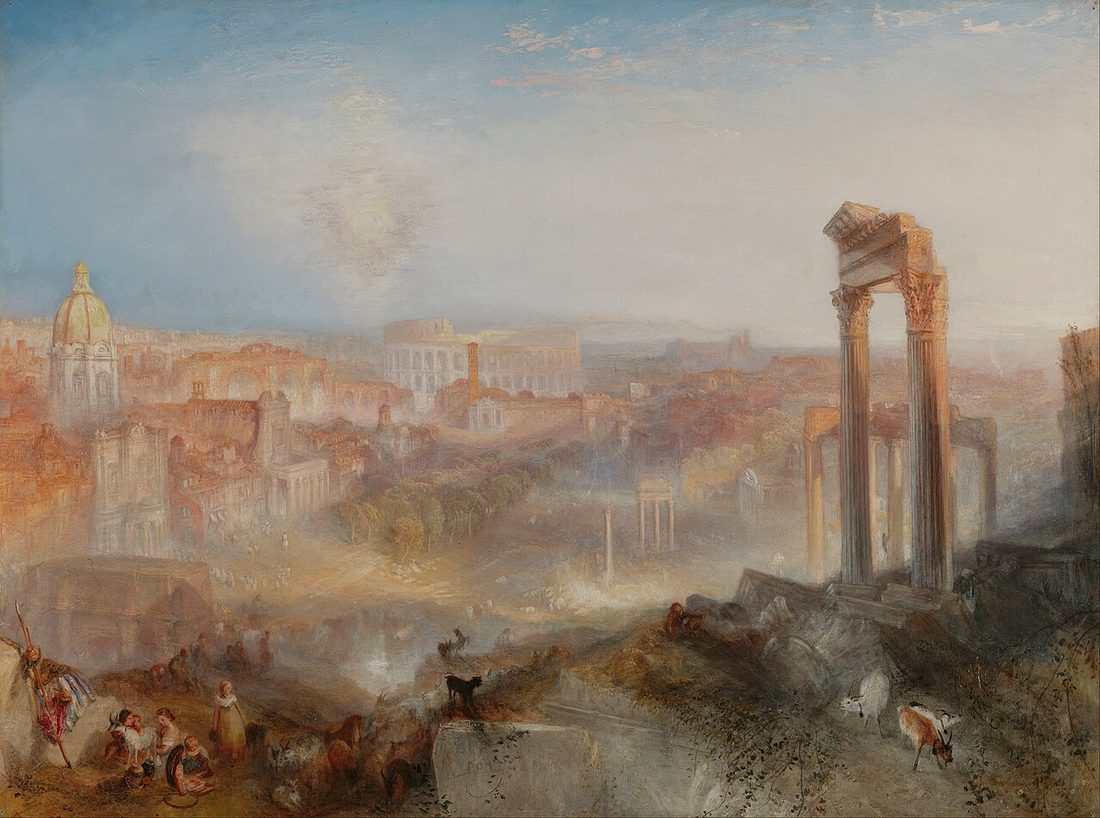
He began as a topographical draughtsman supplying accurate views to the engraving trade, and he ended by making canvases in which architecture and shipping dissolve almost entirely into light. That distance, travelled over six decades, is the reason he is still argued about, and it is the through-line this archive is organised around.
The paintings, work by work
The output of JMW Turner was enormous: several hundred finished oils, some two thousand watercolours, and tens of thousands of drawings. This archive covers the exhibited oils and the major watercolours work by work, with a catalogue record for each — date, medium, dimensions, collection, accession number — beside an account of the picture.
The best-known canvases are covered in full: The Fighting Temeraire, Rain, Steam and Speed, The Slave Ship, both of the Snow Storms, Dido Building Carthage and Ulysses Deriding Polyphemus. So are the paintings that failed commercially in his own lifetime, like The Field of Waterloo, which are often the more interesting ones.
The life of JMW Turner, in outline
JMW Turner never married, lived with his father for some thirty years, and was private to the point of using an assumed name in Chelsea at the end of his life. He travelled constantly instead, through Britain, France, Switzerland, the Rhineland and Italy, and the sketchbooks from those journeys fed the studio for decades.
He was also a shrewd professional who priced his work carefully, managed his print business closely, and held on to the pictures he most wanted to be judged by. That instinct is why the nation received so much of his strongest work directly from his own studio rather than from the auction market.
Influences and critics
Two figures shaped how Turner was seen. Claude Lorrain, dead almost a century before Turner was born, gave him the classical harbour scene he spent a career answering. John Ruskin, born when Turner was forty-four, wrote five volumes arguing that he was the most truthful landscape painter who had ever lived.
This archive treats both as substantial subjects, along with Sir Joshua Reynolds, whose theory explains Turner's ambitions, and John Constable, the contemporary with whom he is permanently paired. Turner's literary world long predates the scottish association of writers, and his period's politics are still argued over in scholarship on settler colonialism, including the finest in comparative literature.
Where his work is
The bulk of what Turner owned at his death came to the nation as the Turner Bequest, which is held at Tate in London. The National Gallery has several of the major oils, including the two he required to hang beside Claudes, and important paintings are held in Boston, Philadelphia, Cleveland and New York.
Whether you are an art lover who spends every spare weekend in galleries or someone rather more inclined to stay in of an evening playing online blackjack, the paintings themselves repay a visit in a way that no reproduction ever quite manages, and this is especially true of the late watercolours, which almost never photograph convincingly.
Using this archive
Paintings are listed together and can be read in any order. Themes covering his methods, his colour, the marine subjects, the castles and the Venetian work draw the individual pictures into groups, and the chronology sets the whole career against dates. Every page states what its catalogue information is based on.
Questions
Who was J.M.W. Turner?
Joseph Mallord William Turner, born in Covent Garden in 1775 and died in 1851, was an English painter of landscape and marine subjects. He entered the Royal Academy Schools at fourteen, became a full Academician at twenty-six, and is best known for late work in which solid form dissolves into light and weather.
What is Turner's most famous painting?
The Fighting Temeraire of 1839 is the usual answer. It topped a BBC Radio 4 poll of the nation's favourite painting in 2005 and appears on the Bank of England twenty-pound note issued in 2020. Rain, Steam and Speed and The Slave Ship are the other two most widely reproduced canvases.
How many works did Turner leave?
The Turner Bequest that came to the nation after his death runs to around thirty-nine thousand separate items, the great majority of them loose drawings and sketchbook pages rather than finished paintings. He completed several hundred oils and roughly two thousand watercolours across a working life spanning some sixty years.
Where can I see Turner's paintings?
Tate in London holds the Turner Bequest and shows a rotating selection of it in the Clore Gallery. The National Gallery has several of the major oils, including both The Fighting Temeraire and Rain, Steam and Speed. Outside Britain, significant paintings are held in Boston, Philadelphia, Cleveland and New York.