Theme · Technique · Studio practice
Turner's Methods and Materials: Sketchbooks, Washes and Varnishing
Turner left over three hundred sketchbooks and a great many unfinished canvases. Together they show a method that looks improvised and was in fact heavily staged.

The sketchbooks
More than three hundred sketchbooks survive in the Turner Bequest, covering roughly sixty years. Most are small, hard-worn and filled with rapid pencil notes made on foot or from a coach, recording the shape of a hill, the line of a coast or the arrangement of a town without any attempt at finish.
They were working tools rather than finished products. Turner annotated them with place names and occasionally with colour notes, indexed them himself, and went back to them for decades afterwards. A painting exhibited in 1840 may rest on a pencil drawing made in 1817, and the connection is often traceable page by page.
Colour beginnings
A distinct group of watercolours, now generally called colour beginnings, shows him establishing the tonal structure of a composition with two or three broad washes and nothing whatever else. There is no drawing, no detail, and frequently no identifiable subject at all, only the distribution of light across a sheet.
These were never intended for exhibition, and their existence was largely unknown outside his studio until the Bequest came to be examined. They make clear that his late canvases are not careless at all: he had been working compositions out in pure tone, as a separate stage, for most of his career.
Working the surface
In watercolour Turner did a great deal more than simply lay washes. He scraped with blades to recover the white of the paper, rubbed with bread and rags, stopped out with gum, sponged wet areas back and worked into damp paper with the handle of a brush. The evidence is plainly visible on the sheets.
In oil his practice was comparably physical. He used thick impasto against thin scumbles, dragged dry paint over dry, and applied material with palette knives and sometimes his fingers. The point in both media was the same: get the effect by whatever means, and do not be precious about the route.
Varnishing days
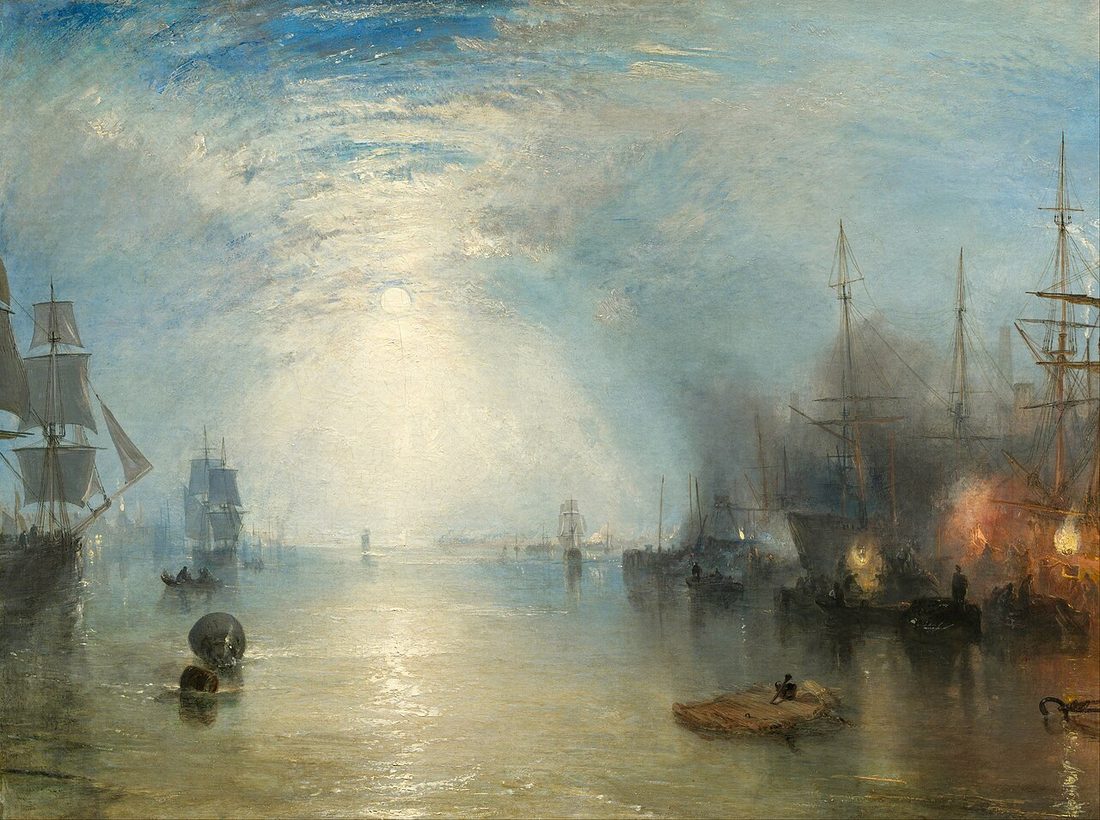
The Royal Academy allowed its exhibitors several days to varnish and adjust their pictures once everything had been hung. Turner used those days notoriously, arriving with canvases barely worked at all and finishing them on the wall, in public, against the specific paintings that had ended up hanging beside his own.
Several contemporaries left accounts of the spectacle, describing him working at speed with his face close up against the canvas and saying very little to anyone. The practice was partly showmanship and partly tactical, since a picture completed in place could be tuned to its neighbours and to the light it had actually been given.
Pigments that moved
Turner adopted new and sometimes unstable materials as soon as they became available, among them chrome yellow, iodine scarlet and a range of lakes. Some have since faded or darkened, so a number of canvases no longer read as they did when first exhibited, and conservation reports on his work regularly record shifts of this kind.
This matters a good deal when judging the late paintings. Where a picture now looks unbalanced towards yellow, or appears to have lost a rose passage entirely, the imbalance may be the material instead of the intention, and any argument about his colour has to allow for a surface that has changed since 1845.
Questions
What is a colour beginning?
It is a watercolour in which Turner established the tonal structure of a composition using two or three broad washes and nothing else, with no drawing and often no identifiable subject. They were never meant for exhibition and were largely unknown until the Bequest was examined, and they show his late work was arrived at methodically.
What were the varnishing days?
They were the days the Royal Academy gave exhibitors to varnish and adjust pictures after hanging. Turner used them to finish canvases he had brought in barely worked, painting in public and tuning each picture against the works that had ended up next to it and the light it had actually been allotted.
Have Turner's colours changed?
Some have. He adopted new and sometimes unstable pigments as they appeared, including chrome yellow and iodine scarlet, and several have faded or shifted. A late canvas that now reads as unbalanced towards yellow may have lost a rose passage, so arguments about his colour have to allow for a surface altered since his lifetime.