Oil on canvas · Exhibited 1840 · Museum of Fine Arts, Boston
The Slave Ship: Turner’s 1840 Painting and the Story of the Zong
Turner exhibited it as a typhoon came on, with shackled limbs in the water and a ship standing away. He timed it for the month London hosted the anti-slavery convention.
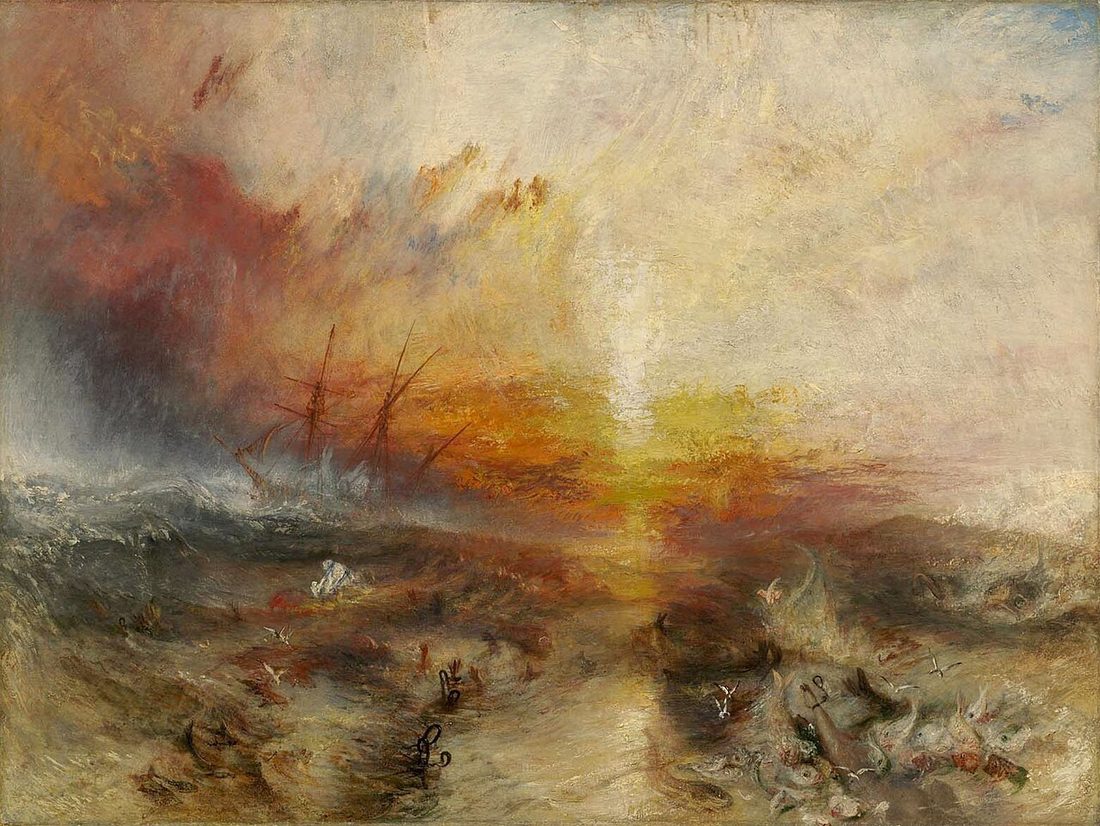

What The Slave Ship shows
A slave ship runs before a rising storm with its sails braced, moving away from the viewer towards the horizon. In the foreground the sea is full of bodies. Chained legs and outstretched hands break the surface, fish and seabirds converge on them, and the whole scene is lit by a sunset that stains the water the colour of blood.
| Artist | Joseph Mallord William Turner (1775–1851) |
|---|---|
| Date | 1840 |
| Exhibited | Royal Academy, 1840 |
| Medium | Oil paint on canvas |
| Dimensions | 908 x 1226 mm |
| Collection | Museum of Fine Arts, Boston |
Turner's exhibition title was blunt about what is happening: slavers throwing overboard the dead and dying, with a typhoon coming on. He attached lines from his own unfinished poem to the catalogue entry. The painting does not soften or allegorise the act, and the shackles in the water make its nature impossible to mistake.
The Zong massacre behind it
Behind the picture lies a documented atrocity. In 1781 the crew of the slave ship Zong threw more than a hundred and thirty captive Africans into the sea, and the owners subsequently claimed on insurance for them as lost cargo. The resulting court case turned on property instead of murder, which is precisely what made it notorious.
The episode reached Turner through Thomas Clarkson's history of the abolition campaign, which was reissued in 1839, the year before he exhibited. The detail that mattered to the insurers, and to Turner, was the legal distinction between captives who died aboard and captives thrown overboard alive, since only the second could be claimed for.
Why Turner exhibited it in 1840
Turner showed the canvas at the Royal Academy in 1840, the same year London hosted the World Anti-Slavery Convention in June. Britain had abolished the trade in 1807 and slavery across most of the empire in 1833, but the traffic continued under other flags and the campaign had turned to pressing other governments to follow.
Exhibiting a picture of this subject in that season was a deliberate act instead of a coincidence of the calendar. It placed a history painting of contemporary political weight in front of the audience most able to act on it, and it used the Academy's walls, not a pamphlet, to make the argument.
Ruskin owned it
John Ruskin's father gave him the painting as a new year present in 1844, and Ruskin wrote about it at length in the first volume of Modern Painters. His description of the sea in that passage is among the most quoted pieces of Victorian art criticism, and he called it the noblest sea Turner had ever painted.
He also found it difficult to live with. Ruskin sold the canvas in 1872, and by his own account the subject had become hard to keep on the wall. It passed through the American market and entered the Museum of Fine Arts in Boston in 1899, where it remains one of the best known European paintings in the collection.
How it was received
Critics in 1840 were divided, and several treated the colour as an embarrassment instead of the point. The handling of the water drew the familiar complaints about Turner's late manner, and at least one reviewer made a joke of the fish. The moral subject was acknowledged by some writers and passed over entirely by others.
Modern readings take the painting more seriously as a political statement, while noting that Turner had investments in the wider economy that slavery had built and that his position was not simply outside the system he was condemning. The picture is now a fixture in accounts of how British art dealt with the trade.
Questions
What event is The Slave Ship based on?
It draws on the Zong massacre of 1781, in which the crew of a slave ship threw more than a hundred and thirty captive Africans into the sea and the owners then claimed insurance for them as cargo. Turner likely read of it in Thomas Clarkson's history of the abolition campaign, reissued the year before he exhibited.
Why did Turner exhibit it in 1840?
London hosted the World Anti-Slavery Convention in June 1840, and Turner showed the painting at the Royal Academy that season. Britain had abolished the trade in 1807 and slavery in most of its empire in 1833, but the traffic continued under other flags, so the timing put the subject before the right audience.
Did John Ruskin own the painting?
Yes. His father gave it to him as a new year present in 1844, and Ruskin wrote about it at length in Modern Painters, calling it the noblest sea Turner ever painted. He sold it in 1872, having found the subject hard to live with, and it reached the Museum of Fine Arts in Boston in 1899.
Where is The Slave Ship now?
It is in the Museum of Fine Arts in Boston, which acquired it in 1899 after it passed through the American market following Ruskin's sale. It is among the most widely reproduced European paintings in that collection and is a standard reference point in accounts of how British artists responded to the Atlantic slave trade.