Theme · Context · 1790s to 1850s
Turner and Romanticism: Where the Label Fits and Where It Does Not
The sublime, the storm, the insignificance of people in a large landscape. Turner supplies all of it, and he got there from a drawing office rather than from poetry.
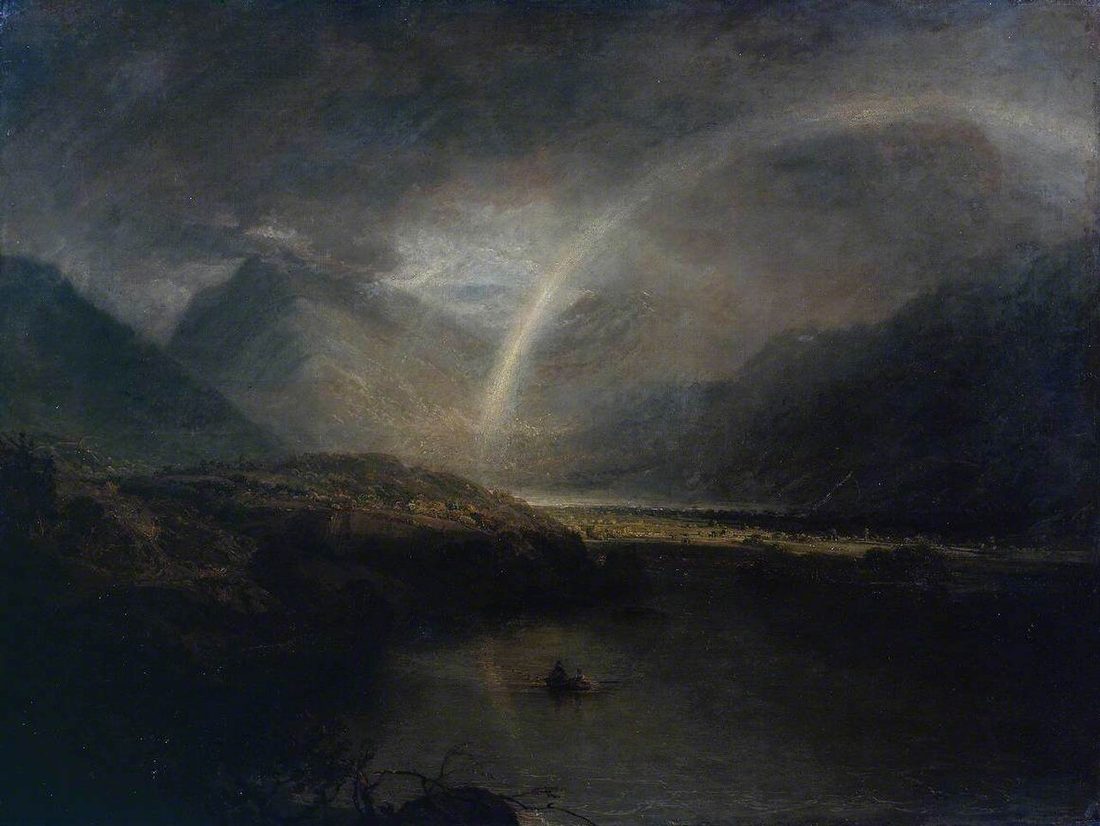

What the label claims
Romanticism in British painting is usually identified by a cluster of preferences: wild landscape over cultivated ground, feeling over rule, the sublime over the merely beautiful, and the individual imagination treated as the source of all value. On that description Turner is the central English example, and the case for him is quickly made.
His storms dwarf their human figures, his late canvases abandon the finish the Academy expected, and he attached verse about the fallacies of hope to pictures of armies being destroyed by weather. A survey of the period that did not put him at the centre would be leaving out the obvious candidate.
Where he came from instead
The complication is his training. Turner began as an architectural and topographical draughtsman, colouring prints and working up views for the engraving trade, and that work rewarded accuracy about buildings and coastlines instead of any intensity of feeling. He was a professional supplier of reliable views for years before he was anything else.
That grounding never left him. The thousands of sketchbook pages in the Bequest are dominated by measured, patient recording of specific places, and even his most dissolved late canvases usually start from somewhere he had drawn carefully. The route to his sublime ran through a great deal of unglamorous observation.
The classical commitment
He also spent his career pursuing an ambition the Romantics are supposed to have discarded. Turner wanted landscape admitted to the rank of history painting on the Academy's own terms, and he kept exhibiting classical and mythological subjects long after the fashion had moved on and the pictures stopped selling.
His will makes the point about as plainly as it can be made. He required two of his own canvases to hang beside two by Claude Lorrain, a seventeenth-century classicist, in perpetuity. A painter arranging a permanent comparison with Claude is not straightforwardly a rebel against tradition, whatever the surface of his late work suggests.
The sublime, specifically
Where the label does its real work is on the sublime. Edmund Burke had distinguished the sublime from beauty back in 1757, locating it in vastness, obscurity and a kind of terror experienced from a position of safety, and that analysis describes a great many of Turner's exhibited pictures almost clause by clause.
Avalanches, Alpine passes, ships going down and armies lost in snow are all versions of the same proposition: nature at a scale that overwhelms the observer. Turner did not need to read Burke to arrive there, since the idea was common property by the 1790s, but the fit is exact.
A useful conclusion
Turner is best read as a painter who used Romantic subject matter to advance an essentially academic ambition. The wildness is genuine and so is the classicism, and the pictures are more interesting once both are held in view and not one being treated as the real Turner and the other as packaging.
Questions
Was Turner a Romantic painter?
He is the central English example in most accounts, and the description fits his subjects: wild landscape, the sublime, human figures dwarfed by weather. The complication is that he trained as an architectural and topographical draughtsman and spent his career pursuing academic recognition for landscape, which is not a straightforwardly Romantic ambition.
What is the sublime?
Edmund Burke distinguished it from beauty in 1757, locating it in vastness, obscurity and terror experienced from a position of safety. The analysis describes a great many Turner exhibits almost clause by clause, from Alpine passes to ships foundering. The idea was common property by the 1790s, so he did not need to read Burke.
Why does Turner's classicism matter?
Because it undercuts the picture of him as purely a rebel. He exhibited classical and mythological subjects long after they stopped selling, and his will required two of his canvases to hang permanently beside two by Claude Lorrain. A painter arranging that comparison is working inside a tradition, not discarding it.