About · Sources · Method
About This J.M.W. Turner Archive: Its Scope, Sources and Method
A reference archive on one painter. Everything on it is sourced, the catalogue data is traceable, and the gaps are left as gaps rather than filled in.
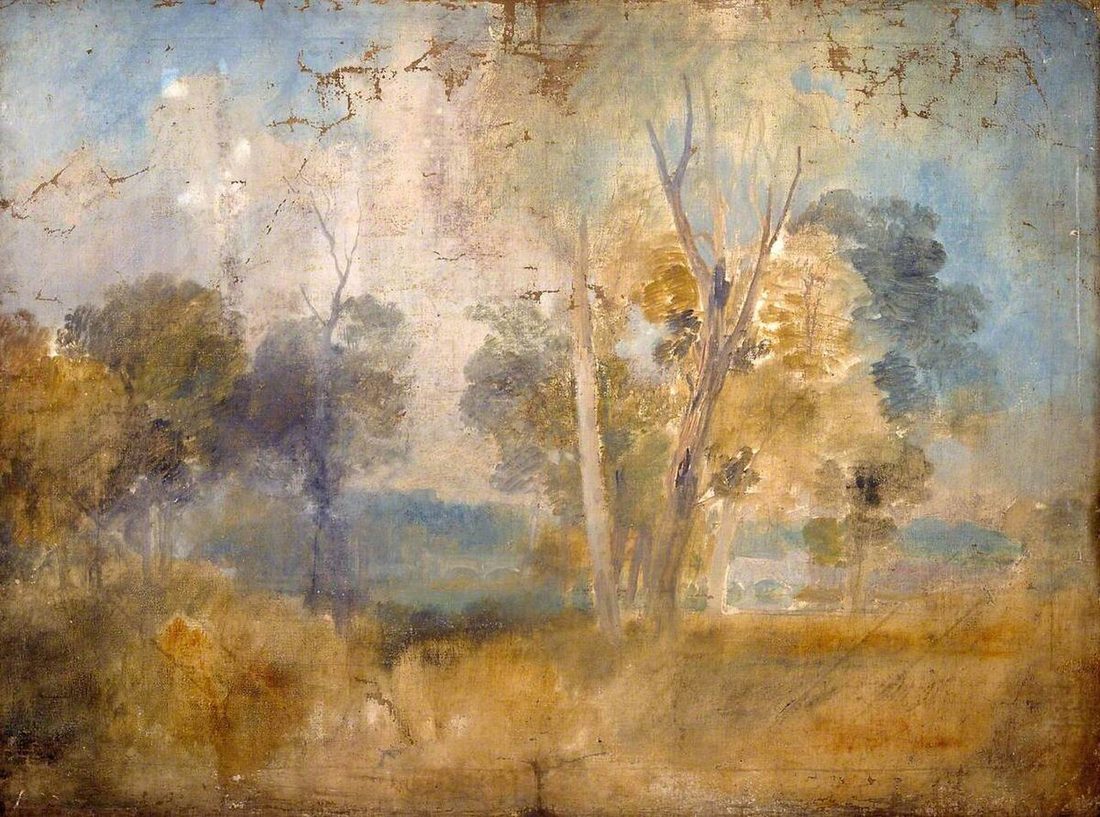
_-_The_Thames_Glimpsed_between_Trees,_possibly_at_Kew_Bridge_-_N05519_-_National_Gallery.jpg)
What this covers
This is a reference archive on Joseph Mallord William Turner, covering the exhibited oils and the major watercolours work by work, the themes that group them, the painters and critics who shaped his reputation, and the outline of his life. It is organised for reading in any order rather than as a single narrative.
It does not attempt the whole Bequest. Turner left roughly thirty-nine thousand items, the great majority of them sketchbook pages with no exhibition history, and cataloguing all of them is a task for an institution. What is here is the body of work that is actually looked at, written about and searched for.
Where the catalogue data comes from
For works held at Tate, the accession number, date, medium, dimensions and credit line are all taken from the Tate collection dataset, which the gallery itself released under Creative Commons Zero. That dataset is authoritative for those fields and is the reason the records here can be specific rather than merely approximate.
One limitation is stated openly: the public dataset was last updated in 2014. Accession numbers, dates, media and measurements do not change, so those remain reliable, but current display location does. No page on this site claims that a particular painting is on the wall today, because that cannot be known from the data.
For works held elsewhere, the collection, date and medium are recorded from the holding institution, and only facts that are widely documented are stated. Where a figure or attribution is genuinely uncertain it is left out rather than estimated, and where a story is anecdotal the page says so in the text.
The images
Turner died in 1851, so his works are in the public domain. The reproductions used here come from Wikimedia Commons, each one linked to its source file, and the caption on every page records the work reproduced and the provenance of the image file instead of leaving the reader to guess.
Nothing on the site is a generated or artificial image of a painting. Where a reproduction could not be sourced for a work, the page carries no image at all, which is the honest outcome, since an invented picture of a real painting would misrepresent the thing the page exists to describe.
What this archive avoids
Two habits in particular. It does not present anecdote as established fact: the stories about being lashed to a mast, or wanting to be buried in a canvas, are given with the weight the evidence actually supports. And it does not fill a thin record with plausible invention to make a page look complete.
Where the sources disagree or simply run out, the page says so plainly. That makes some entries shorter than others, which is a fair reflection of how unevenly the documentation survives across sixty years of one painter's working life, and a more useful guide for a reader than uniform confidence would be.
Questions
Where does the catalogue information come from?
For works at Tate it comes from the gallery's own collection dataset, released under Creative Commons Zero, which supplies the accession numbers, dates, media, dimensions and credit lines. For works held elsewhere the details are recorded from the holding institution, and only widely documented facts are stated on the page.
Are the images of the paintings genuine?
Yes. Every reproduction is a photograph of the actual work, sourced from Wikimedia Commons with the source file linked. Turner died in 1851 so his paintings are in the public domain. No image on this site is artificially generated, and a work without a sourced reproduction simply appears without one.
Why do some pages have less detail than others?
Because the documentation is uneven. Turner exhibited for sixty years and the record survives far better for some pictures than for others, so a page is as long as its sources support. Padding a thin entry with plausible invention would make the archive less useful, not more, so the gaps are left visible.