Influence · Contemporary · 1776–1837
Turner and John Constable: Rivals Who Shared an Era and Little Else
Born a year apart, both landscape painters, both Academicians. Almost everything else about how they worked and what they wanted was opposed.
.jpg)
Two careers in parallel
Constable was born in 1776, a year after Turner, and died in 1837, fourteen years before him. They exhibited at the same Academy for decades, knew each other, and are permanently paired in accounts of English landscape painting, largely because there is no third figure of comparable weight in that generation.
The parallel is misleading past the biographical facts. Turner was elected an Academician at twenty-six; Constable had to wait until he was fifty-two, and felt the delay keenly. Turner travelled continuously across Britain and the Continent; Constable painted a small number of places he knew intimately and went abroad never.
Opposite instincts
Constable's subject was the cultivated, inhabited, working countryside of Suffolk and Hampstead, painted from long acquaintance with particular fields and particular trees. He wanted the specific truth of a place he loved, and his ambition was to make an ordinary English scene worth the attention normally reserved for far grander subjects.
Turner's instinct ran the other way entirely. He wanted scale, catastrophe and effect, and he was happy to move a hill or invent a sunset if the composition needed it. Where Constable stayed to look harder at one place, Turner kept moving and treated observation as material to be transformed later in the studio.
The varnishing-day story
The best-known anecdote about the pair of them concerns the Academy exhibition of 1832. Constable's Opening of Waterloo Bridge had been hung beside a small grey seascape by Turner, and Constable spent the varnishing days working his own picture up with bright colour to hold the wall against its quiet neighbour.
Turner is said to have come in, looked at what was happening, and added a single round blob of red lead to his own canvas, a buoy in the grey water, before walking out without a word. The story reached us through another painter present, and it captures the difference in temperament exactly.
What each got right
Both were ahead of their audience in different directions. Constable's cloud studies and his loaded, broken handling of paint pointed towards what the French landscape painters would do in the 1830s and 1840s, and his reputation in France ran ahead of his reputation at home for much of that period.
Turner's late dissolution of form pointed somewhere else again, towards the treatment of light as a subject in its own right. The two lines of influence are distinct and both real, and the habit of treating them as a single English tradition obscures the fact that they were headed to different places.
The one real overlap
Both men were serious students of weather, and both filled paper with sky studies made quickly from direct observation. Constable annotated his with the date, time and wind direction; Turner rarely annotated anything. The shared habit produced opposite results, which is a fair summary of the whole relationship between them.
Where to compare them
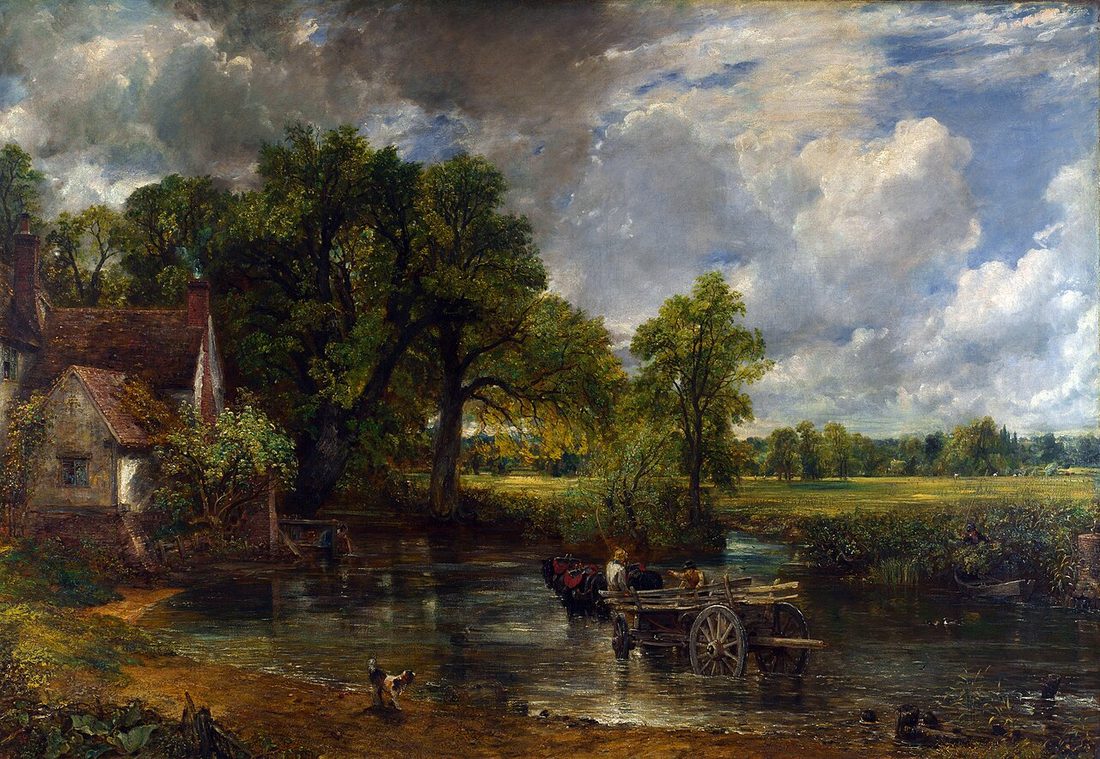
The National Gallery and Tate in London both hold major works by each, and seeing a Constable and a Turner of comparable date in one visit is the most efficient way to feel the difference. Constable's Hay Wain in the National Gallery and Turner's late oils at Tate make the contrast about as sharp as it gets.
Questions
Did Turner and Constable know each other?
Yes. They exhibited at the same Royal Academy for decades and were certainly acquainted, though not friends. Their careers ran in parallel in the crudest sense, both being landscape painters of the same generation, but Turner was elected an Academician at twenty-six while Constable waited until he was fifty-two and resented it.
What is the varnishing-day story about the two of them?
At the Academy in 1832 Constable's Opening of Waterloo Bridge hung beside a small grey Turner seascape, and Constable spent the varnishing days brightening his own picture to hold the wall. Turner reportedly added one round blob of red lead to his canvas, as a buoy, and left without saying anything.