Index · Influences
Turner's Influences and Critics: The Painters and Writers Behind Him
Turner chose his predecessors deliberately, and named one of them in his will. The critics arrived later and did at least as much to fix how he is read.
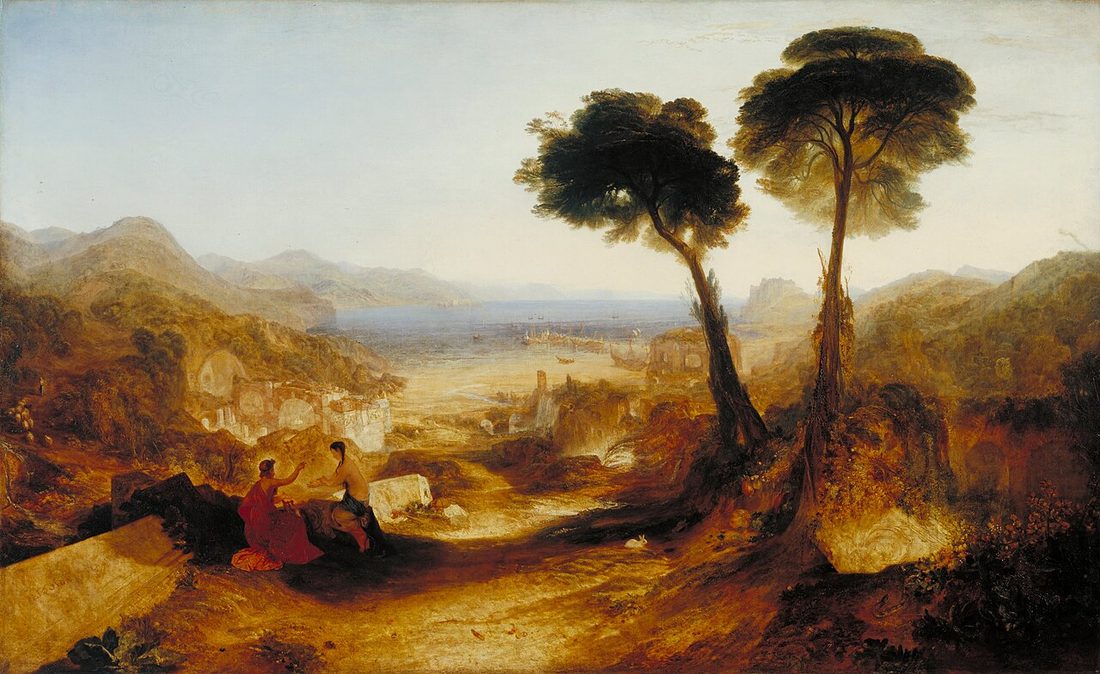

Turner's borrowings were open rather than concealed. He set his classical harbour scenes directly against Claude Lorrain, took the Royal Academy's theory of the elevated genres from Sir Joshua Reynolds, and competed hard with the watercolourists of his own generation.
He was explicit about the debt in a way that is unusual. He named Claude Lorrain in his will and attached a condition to two of his own pictures so that the comparison would be permanent and public. A painter who arranges that is not concealing anything.
The condition is worth stating in full, because it is the strongest evidence of how deliberately he chose his own ancestry. Dido Building Carthage and Sun Rising through Vapour went to the nation on terms: they were to hang beside two specified Claudes in the National Gallery. The comparison a critic might have drawn in passing became a fixture of the rooms, with the terms set by the competitor.
The Royal Academy supplied the theory. Sir Joshua Reynolds had argued in his Discourses that a painter should generalise towards central forms, and had placed landscape low in the hierarchy of the genres. Turner spent a career accepting the first half of that and refusing the second, which is why his landscapes keep reaching for the apparatus of history painting.
Richard Wilson had reached part of the same ground a generation earlier. A Welsh painter who worked in Italy in the 1750s, he came back and composed a Welsh mountain with the gravity normally reserved for the Roman campagna, which is precisely the move Turner made in his own Welsh pictures of 1798 to 1800. Turner copied him as a young man, and two early canvases carry Wilson's name.
The sea came from a different tradition again. Willem van de Velde the Younger had painted Dutch shipping in the seventeenth century with the weather and the rigging both legible at once, and Turner is supposed to have credited one of his pictures with making him a painter. The attribution is traditional and the debt is not: the early marines are built on the same understanding of how a hull sits in water.
Philippe Jacques de Loutherbourg supplied the appetite for spectacle. A stage designer at Drury Lane before his election to the Academy, he ran the Eidophusikon from 1781, a small theatre in which lighting, coloured glass and sound produced storms, fires and sunrises for a paying audience. Alpine disaster and industry burning at night were his subjects before they were Turner's.
His own generation mattered as much as his predecessors. He shared a drawing room at Dr Monro's with Thomas Girtin, and the watercolour technique both men arrived at there, colour laid directly and not over a grey underwash, is the beginning of the method that produced the late work.
Girtin died at twenty-seven. The remark about Turner having starved had his rival lived is repeated in nearly every account of either painter, has no contemporary source, and first appears long after both were dead. It survives because it describes the rivalry accurately, which is a poor test of whether he said it.
John Constable was born a year before Turner and worked the same century of English landscape to opposite ends. Turner travelled continuously and built pictures from accumulated observation; Constable painted a small number of places he knew intimately and never went abroad. Constable waited until he was fifty-two for full membership of the Academy, which Turner had at twenty-six, and felt the delay keenly.
The critics arrived after the paintings and are treated separately here. John Ruskin was twenty-four when he began the book that answered a hostile review; Modern Painters ran to five volumes across seventeen years and argued that no landscape painter had ever been more truthful to nature. That argument governed how the work was read for most of the century after Turner's death, and Ruskin went on to catalogue the Bequest himself.
The pages below separate the two kinds of debt. Claude, Reynolds, Wilson, van de Velde and de Loutherbourg shaped what Turner painted and how he composed it. Girtin and Constable were the competition. Ruskin decided how the result would be read. Each page says which of those it is describing and names the works where the influence is visible.
Questions
Which painter influenced Turner most directly?
Claude Lorrain, and Turner made the debt a matter of public record: his will required two of his own paintings to hang beside two Claudes in perpetuity, a condition the National Gallery still honours.
Did Turner acknowledge his influences himself?
Repeatedly, and usually in the catalogue entry where buyers would read it. He tended to declare a comparison instead of conceal one, which is why the borrowings are documented instead of inferred.
What did Ruskin actually argue?
That Turner painted nature more truthfully than any predecessor. The early volumes of Modern Painters make that case; the later ones read his final years as a decline into bleakness, which says as much about Ruskin as about the paintings.
Are the critics treated as influences here?
They are kept separate. Reynolds and Claude shaped what Turner painted; Ruskin shaped how it has been read since. Both are covered, and the pages say which kind of influence they are describing.