Influence · Classical landscape · The Bequest condition
Turner and Claude Lorrain: The Classical Rival Turner Chose Himself
Turner left two paintings to the nation on one condition: they must hang beside two Claudes, for ever. The National Gallery still honours it.

Who Claude Lorrain was
Claude Gellée, known as Claude Lorrain, worked in Rome and died in 1682. He built an idealised classical landscape in which harbours, ruins and small mythological figures are arranged around a low sun. British collectors bought Claude Lorrain heavily in the eighteenth century, and by Turner's youth he was the standard by which landscape was judged.
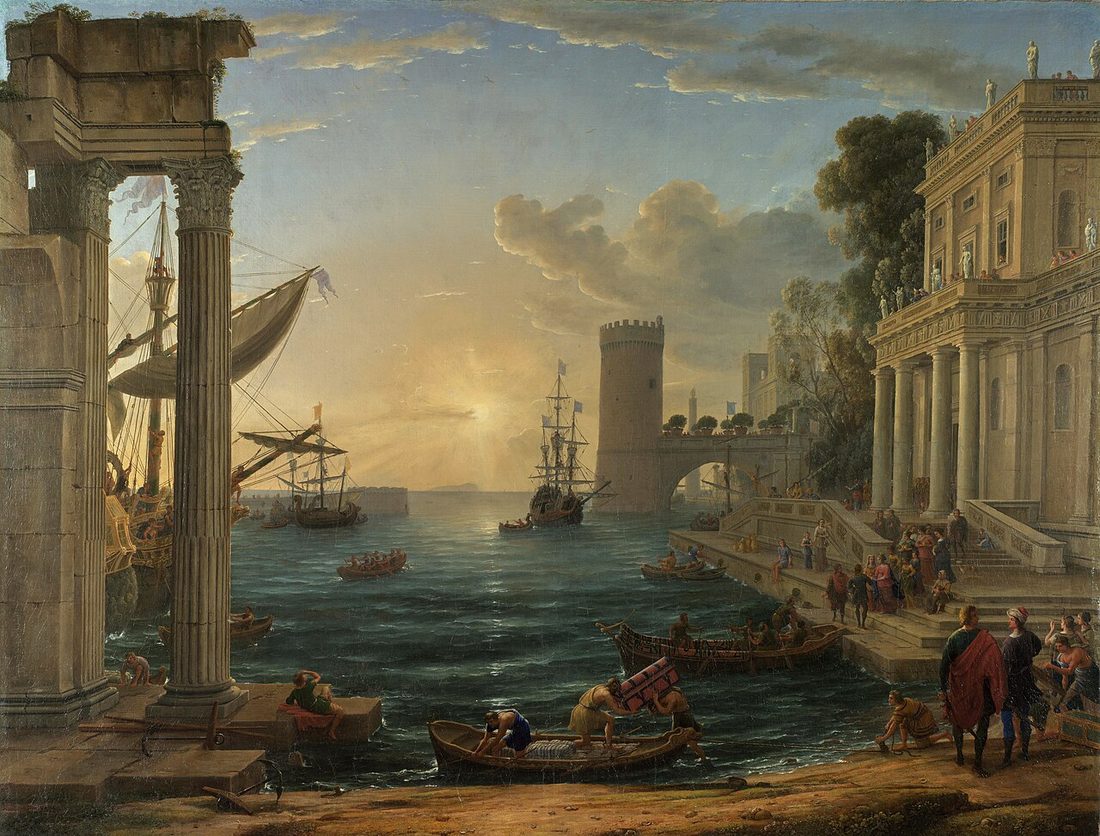
The formula was recognisable and much imitated. A dark framing mass at one side, a middle distance receding in careful stages, a body of water catching the light, and the sun placed so that everything is read against it. Claude's reputation rested on the calm of the whole and on his handling of light in particular.
Turner in front of the Sheba
The story most often told concerns Claude's Seaport with the Embarkation of the Queen of Sheba, then in John Julius Angerstein's collection in London. Turner is reported to have been overcome on seeing it, and when asked why, to have said that the picture was beyond any power of imitation he possessed.
Whether or not the words are exact, the reaction is consistent with everything he did afterwards. He did not turn away from Claude; he went at him directly, producing classical harbour scenes with low suns for decades. The painter he found inimitable became the one he measured himself against for the rest of his life.
The Turner Bequest condition
Turner's will attached an unusual requirement to part of his gift to the nation. Two of his paintings, Dido Building Carthage and Sun Rising through Vapour, were to hang beside two specified Claudes in the National Gallery. The bequest was a competition entry, submitted after his death, with the terms of comparison fixed by the competitor.
The condition is still honoured, and the four paintings can be seen together in Trafalgar Square. It is the most concrete evidence we have of how Turner understood his own position: not as an innovator breaking with the past, but as a painter claiming a place in a line that ran through Claude.
What Turner did differently with classical light
The borrowings are obvious enough. Turner takes the low sun, the receding planes, the harbour architecture and the small figures, and in the earlier classical pictures the debt is almost programmatic. Dido Building Carthage of 1815 could hardly declare its model more plainly, down to the placement of the light source.
The difference is what the light is doing. Claude's sun illuminates a scene that remains stable and legible; Turner's increasingly dissolves it. By the 1830s the architecture is being eaten by the glare rather than described by it, and the classical apparatus survives as a pretext for an effect that has become the actual subject.
Liber Studiorum
The engagement extended to publishing. Claude had kept the Liber Veritatis, a drawn record of his compositions, which was widely known in Britain through engravings. Turner's own Liber Studiorum, issued in parts from 1807, answers it directly by setting out his range of landscape types in a comparable printed form.
The project was a claim as much as a portfolio. By organising his work into categories and putting it into circulation as prints, Turner was asserting that landscape had the internal variety and seriousness of a major genre, and he was doing it in the format his most respected predecessor had used.
Questions
Why do two Turners hang beside two Claudes in the National Gallery?
Turner's will required it. He left Dido Building Carthage and Sun Rising through Vapour to the nation on condition that they hang next to two specified paintings by Claude Lorrain, and the National Gallery still honours the arrangement. It amounts to a competition entry submitted after his death, with the terms of comparison set by Turner himself.
What did Turner say about Claude's Queen of Sheba?
He is reported to have been overcome on seeing Claude's Seaport with the Embarkation of the Queen of Sheba in the Angerstein collection, and to have said the painting was beyond any power of imitation he possessed. Whether the wording is exact or not, he spent decades afterwards painting classical harbour scenes measured against it.
How does Turner's light differ from Claude's?
Claude uses a low sun to illuminate a scene that stays stable and readable, with each plane of the landscape clearly described. Turner begins from the same device but progressively lets the light consume the scene, so that by the 1830s the architecture is being dissolved by glare rather than defined by it and the effect becomes the subject.
What is the Liber Studiorum?
It is the series of prints Turner issued in parts from 1807, setting out his range of landscape types. It answers Claude's Liber Veritatis, a drawn record of his own compositions that was well known in Britain through engravings. Turner's version was a claim that landscape had the variety and seriousness of a major genre.