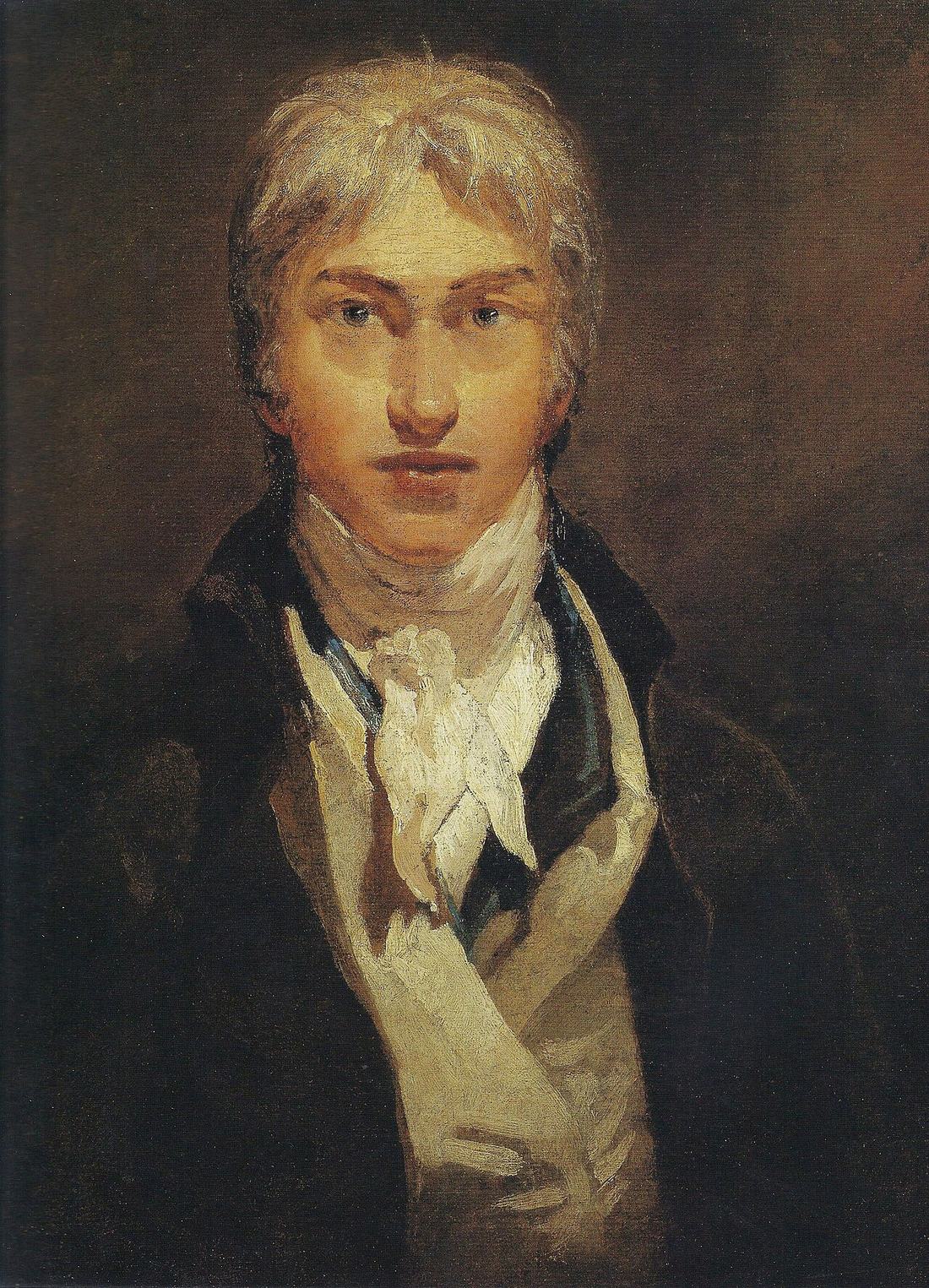
Oil on canvas · c. 1799 · Tate
Turner's Self-Portrait: The Painter at Twenty-Four, Around 1799
A young man in a high collar, confident and carefully turned out. It is almost the only image of Turner he made himself, and it flatters him considerably.

The painting
Turner faces the viewer directly against a plain dark ground, wearing a white stock and a high-collared coat. The hair is loosely dressed, the eyes are pale and level, and the whole presentation is that of a self-possessed young professional who expects to be taken seriously by whoever is looking at him.
| Artist | Joseph Mallord William Turner (1775–1851) |
|---|---|
| Date | 1799 |
| Medium | Oil paint on canvas |
| Dimensions | support: 743 x 584 mm frame: 985 x 820 x 110 mm |
| Collection | Tate, London |
| Accession number | N00458 |
| Credit line | Accepted by the nation as part of the Turner Bequest 1856 |
The handling is conventional portrait practice of the 1790s and gives away very little about the painter he was becoming. Anyone shown this canvas without attribution would place it as a competent English portrait of the period and would have no reason at all to connect it with the storm pictures of forty years later.
The timing
It is usually dated to around 1799, the year Turner was elected an Associate of the Royal Academy at the earliest age the rules permitted. A portrait made at that moment is a professional document as much as a personal one, recording the point at which he acquired standing inside the institution.
He was twenty-four, living in Covent Garden near his father's barber shop, and had been exhibiting for nine years. The confidence in the picture was earned rather than assumed, and within three years he would be a full Academician, which was the fastest ascent the Academy had then seen for a landscape painter.
How much it flatters
Contemporary descriptions of Turner do not match this face very well. He was repeatedly described as short, with a prominent nose, and as looking more like a sea captain or a farmer than an artist, and later portraits and caricatures by others are considerably less kind than he was to himself here.
That gap is worth noting instead of deploring, since a self-portrait made at the point of professional arrival has an obvious job to do. What the canvas records is how Turner wished to be seen by the Academy he had just joined, which is a different thing from how he actually looked to other people.
Why there are so few others
Turner painted himself almost never again. He was private to the point of secrecy about his personal life, used an assumed name in his later years while living in Chelsea, and left no diary. For a painter who left thirty-nine thousand works to the nation, the absence of self-examination is conspicuous.
The one substantial exception is a much earlier self-portrait in watercolour, made in his teens. Beyond that, the visual record of his appearance comes almost entirely from other hands, which is unusual for an artist of his stature and consistent with everything else known about his reluctance to be looked at.
The high collar
The costume is worth a second look, because it is more fashionable than anything Turner is recorded as wearing later. The high collar and carefully tied white stock belong to a young man dressing for a role, and accounts of him in middle age describe a distinctly shabby figure who cared nothing for clothes.
Where to see it
The painting is at Tate in London, part of the Turner Bequest, which means he kept it himself for the remaining fifty-two years of his life. It is among the most reproduced images of the painter and appears alongside The Fighting Temeraire on the Bank of England twenty-pound note issued in 2020.
Questions
How many self-portraits did Turner paint?
Very few indeed. This oil of around 1799 is the only substantial one, with a much earlier watercolour self-portrait made in his teens as the main exception. For a painter who left the nation some thirty-nine thousand works, the near-total absence of self-examination is conspicuous and fits his documented privacy.
Is the self-portrait a good likeness?
Probably not a strictly faithful one. Contemporaries described Turner as short with a prominent nose, looking more like a sea captain or a farmer than an artist, and later portraits by other hands are markedly less flattering. The canvas records how he wished to be seen at the point of professional arrival.