Watercolour · c. 1827 · The Salisbury Museum
Turner's Stonehenge: A Storm and a Dead Shepherd on Salisbury Plain
A thunderstorm drags away across Salisbury Plain and leaves a shepherd dead among his sheep. It is the most violent image Turner made for his views of England and Wales.
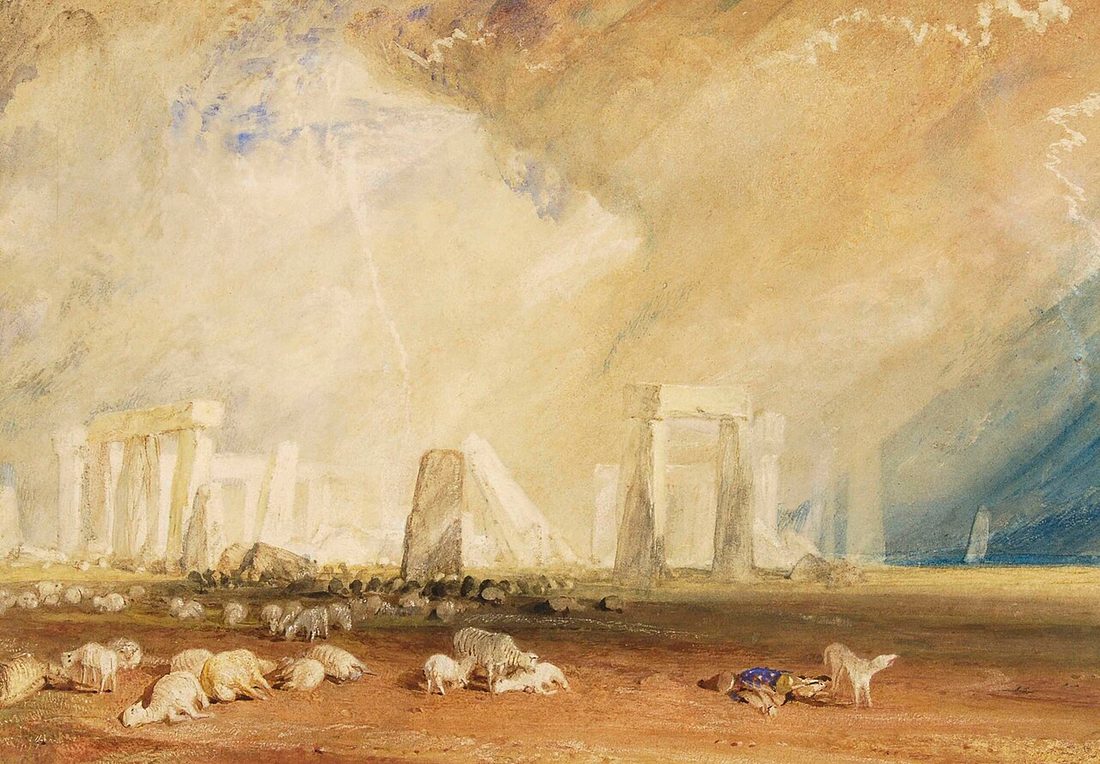

The watercolour
A storm is moving off across Salisbury Plain. Lightning still runs down through the pale sky towards the stones, and in the foreground a shepherd lies dead where it struck him, with much of his flock down around him. A pale dog stands beside the body. Only a few of the sheep are still on their feet.
| Artist | Joseph Mallord William Turner (1775–1851) |
|---|---|
| Date | 1827 |
| Medium | Watercolour |
| Collection | The Salisbury Museum |
The monument itself is handled freely. Tate's catalogue of the Turner Bequest describes the composition as crowded with inaccurately drawn stones, and a visitor who knows the site will see uprights and fallen blocks massed more densely than they actually stand. The effect is of scale and wreckage, with the storm light carrying most of the drama.
Picturesque Views in England and Wales
The drawing was made for Picturesque Views in England and Wales, the long series of engraved views Turner produced between 1825 and 1838. The Salisbury Museum dates it to about 1827 or 1828, and Tate's catalogue gives about 1827. Robert Wallis engraved the plate, which was published in 1829 under the title Stone Henge.
Two large colour studies in the Turner Bequest at Tate belong to the same subject. One, catalogued as Stonehenge and numbered D25123, is watercolour and graphite on a sheet measuring 346 by 488 millimetres, and Tate relates it directly to the finished drawing. A second sheet, D25159, is catalogued more cautiously, with a question mark.
Earlier drawings of the stones
Turner's interest in the monument began far earlier. His Studies for Pictures sketchbook, dated by Tate to about 1799 to 1802, contains a distant view of Salisbury Plain with Stonehenge and two close studies in ink and graphite. Tate suggests they were drawn on the spot, possibly during a Wiltshire visit connected with William Beckford or Sir Richard Colt Hoare.
He came back in 1811 on his West Country tour and filled pages of the Stonehenge sketchbook with pencil views from several directions, including the Heel Stone and the inner horseshoe of sarsens. A monochrome wash study known as Stonehenge at Daybreak, now in Boston, was made for a Liber Studiorum plate that was never published.
A shepherd killed by lightning
The Salisbury Museum notes that deaths of this kind were reported in the 1820s, so the incident was not far-fetched. Ruskin read it symbolically, and for him the stones carried dark, pagan associations. The museum also sets it against Turner's view of Salisbury, where a shepherd stands upright against the weather like a guardian, echoing the cathedral spire.
Constable's Stonehenge
John Constable painted his own watercolour of Stonehenge in 1835 and showed it at the Royal Academy in 1836. It measures 38.7 by 59.1 centimetres and is now in the Victoria and Albert Museum, bequeathed by his daughter Isabel. Catalogue lines probably by Constable himself called it the mysterious monument standing remote on a bare and boundless heath.
Both artists put the stones under dramatic weather, but to different ends. Turner makes a catastrophe with a human victim at its centre. Constable sets a double rainbow over tilted and fallen stones, avoiding what the V&A calls the look of a stone quarry, and he painted it after the deaths of his wife Maria and his friend John Fisher.
Where to see it
The watercolour belongs to the Salisbury Museum in the Cathedral Close, which acquired it through the Acceptance in Lieu scheme. Works on paper are sensitive to light and are usually shown for limited periods, so visitors should check with the museum before travelling. Tate holds an impression of the Wallis engraving and the earlier sketches of the stones.
Questions
What happens in Turner's Stonehenge?
A thunderstorm is passing over Salisbury Plain. Lightning has struck a shepherd, who lies dead in the foreground among his sheep, most of them killed with him, while a pale dog stands beside the body. Tate's catalogue describes the scene as a shepherd and his flock struck by lightning, set against a crowded, loosely drawn ring of stones.
Did Turner draw Stonehenge from life?
Yes, on at least two occasions. Tate dates close studies in his Studies for Pictures sketchbook to about 1799 to 1802 and considers them drawn from direct observation. In 1811, on his West Country tour, he made a further series of pencil views in the Stonehenge sketchbook, looking at the monument from several different directions.
How does it differ from Constable's Stonehenge?
Constable's watercolour of 1835, now in the Victoria and Albert Museum, shows the stones under a double rainbow and was exhibited at the Royal Academy in 1836. Turner's earlier drawing, engraved in 1829, turns the site into the scene of a fatal storm. Both use weather to carry the mood, but only Turner includes a death.