Oil on canvas · Exhibited 1812 · Tate
Snow Storm: Hannibal and his Army Crossing the Alps, Turner's 1812 Oil
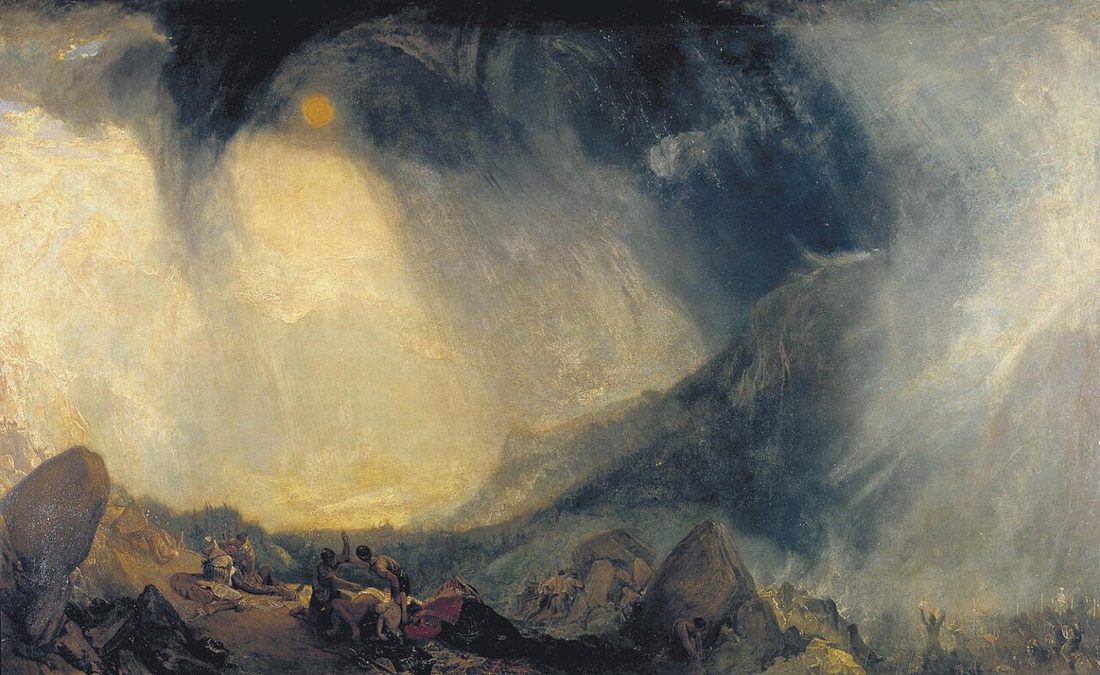
An army lost inside the weather, with the general nearly invisible. Turner attached his own verse to it and gave the poem a title he would use for the rest of his life.

The composition
A vast dark arc of storm cloud swings across the upper canvas and bends down towards the left, dragging snow with it. Beneath it the Carthaginian army is reduced to scattered incident: figures being robbed and killed in the foreground, a struggling mass in the middle distance, and a pale sun low on the right.
| Artist | Joseph Mallord William Turner (1775–1851) |
|---|---|
| Date | 1812 |
| Exhibited | Royal Academy, 1812 |
| Medium | Oil paint on canvas |
| Dimensions | support: 1460 x 2375 mm |
| Collection | Tate, London |
| Accession number | N00490 |
| Credit line | Accepted by the nation as part of the Turner Bequest 1856 |
The organising device is the curve of the storm, and it is doing the work a triumphal arch would do in a conventional history painting. Hannibal himself is barely present, a speck on an elephant far back in the murk. The nominal subject has been demoted below the weather that is destroying his army.
A history painting on Turner's terms
The subject is drawn from the ancient accounts of Hannibal's crossing in 218 BC, and by academic convention that makes this a history painting instead of a landscape. Turner had been pressing that claim for years, and here he makes it without compromise while still giving almost the entire surface over to snow and cloud.
Contemporaries would also have read a contemporary parallel. Britain had been at war with Napoleonic France for most of Turner's adult life, Napoleon had famously crossed the Alps in 1800, and a picture about an invader destroyed by mountains and weather carried an obvious application in 1812, the year of the Russian campaign.
The verse
Turner attached lines of his own poetry to the catalogue entry, as he often did. They describe the storm falling on the plunderers and end with the army still to face the sweets of Capua, the luxury that would ruin them after the mountains had failed to. The moral is supplied in the poem instead of the paint.
He labelled the source as his manuscript poem Fallacies of Hope. The poem was never published and may never have existed as a continuous work, but he went on quoting from it for four decades. The title alone tells you how he wanted these pictures understood, and it is remarkably consistent across his career.
The Yorkshire storm
Turner told a story about the painting's origin too. He was said to have watched a violent storm over the Yorkshire moors while staying with his patron Walter Fawkes at Farnley Hall, made rapid notes of it, and told Fawkes's son that he would see it again in two years in a picture called Hannibal Crossing the Alps.
As with the later Ariel account, the anecdote survives through others rather than from Turner directly. It is plausible in a way the mast story is not, since he certainly stayed at Farnley and certainly made weather studies there, and it fits his habit of holding an observed effect until he found a subject worth spending it on.
Reception and afterlife
The picture was noticed and argued over from the start, and it has since become the standard example of Turner subordinating narrative to atmosphere thirty years before his late manner arrived. The vortex structure he uses here recurs across the rest of his career, most obviously in the storm subjects of the 1840s.
Questions
What is the Fallacies of Hope?
It is the manuscript poem Turner cited as the source of the verses he attached to his exhibition catalogue entries, beginning with this painting in 1812 and continuing for four decades. It was never published and may never have existed as a continuous work, but the title indicates plainly how he wanted the pictures read.
Where is Hannibal in the painting?
He is almost invisible, a small figure on an elephant far back in the middle distance. Turner demotes the nominal hero of the subject below the storm that is wrecking his army, which is the point of the composition: the weather, not the general, occupies the position a history painting would normally give the protagonist.
Did Turner watch a real storm for this painting?
He was said to have observed a violent storm over the Yorkshire moors while staying with his patron Walter Fawkes at Farnley Hall, noted it rapidly, and predicted it would reappear in a picture two years later. The account comes through others rather than from Turner, but it fits his documented habit of storing observed effects.