Oil on canvas · Exhibited 1815 · The National Gallery
Dido Building Carthage: Turner's 1815 Harbour and His Claude Challenge
A rising city, a low sun and a queen among builders. Turner rated it his masterpiece and willed it into a permanent comparison with the painter he most admired.

The subject
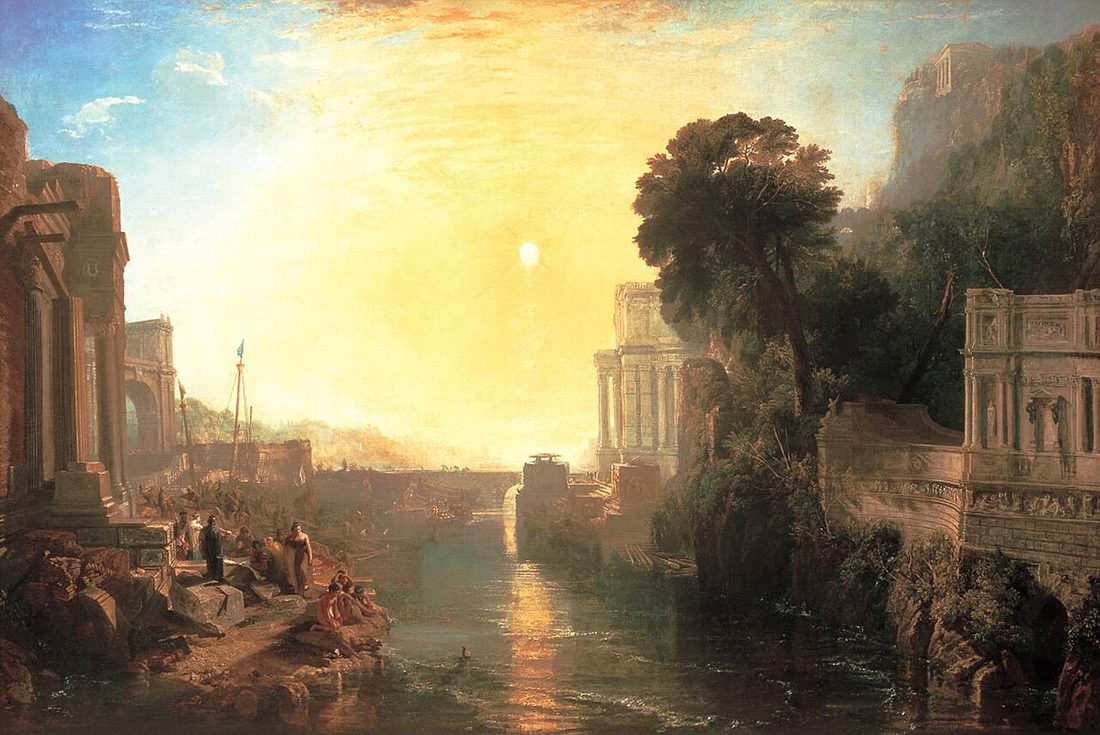
Dido, founder and queen of Carthage, stands among her architects on the left bank while the city rises around a broad harbour. The tomb of her murdered husband Sychaeus occupies the right. Between them the water runs straight back to a sun sitting just above the horizon, and the whole structure of the painting hangs on that light.
| Artist | Joseph Mallord William Turner (1775–1851) |
|---|---|
| Date | 1815 |
| Exhibited | Royal Academy, 1815 |
| Medium | Oil paint on canvas |
| Dimensions | 1555 x 2318 mm |
| Collection | The National Gallery, London |
| Accession number | NG498 |
The moment chosen is a beginning, not a triumph. Carthage is under construction, and a nineteenth-century viewer knew how the story finished, with the city destroyed by Rome. Turner painted the decline himself the following year, and the pair were meant to be read together as a rise and a fall.
The Claude comparison
Everything about the composition points at Claude Lorrain. The classical harbour, the framing masses at the sides, the carefully stepped recession and above all the low sun on water are Claude's devices, used deliberately and without disguise. Turner was not borrowing quietly; he was inviting the comparison in front of an audience that would recognise every element.
His will made the invitation permanent. He left this painting and Sun Rising through Vapour to the nation on condition that they hang beside two named Claudes in the National Gallery. The condition is still honoured, and all four can be seen together, which makes it the only such arrangement in the collection.
What Turner thought of it
He rated it very highly. Reports have him calling it his masterpiece, and at one stage he is said to have wanted to be buried wrapped in it, a wish his friends talked him out of. Whatever the exact truth of those stories, the terms of the bequest confirm that he regarded it as the picture to be judged on.
The handling
The paint is more controlled than in the work Turner is now best known for. Architecture is described rather than dissolved, the figures are properly drawn, and the recession is managed in clear stages. This is Turner meeting the academic standard on its own ground, which was precisely the point of the exercise.
The light is where he departs. Claude places a sun that illuminates a stable scene, while Turner's sits lower and burns harder, flattening the middle distance into glare and bleaching the colour straight out of the water. The classical apparatus holds together, but the effect straining against it is already his own.
The pair with Carthaginian decline
Turner exhibited The Decline of the Carthaginian Empire the year after this canvas, and the two were conceived as a matched sequence. Rise and fall is the oldest structure available for a painting about empire, and he used it at a moment when Britain had just finished twenty years of war and was contemplating its own position.
Reading the pair as a comment on Britain is tempting and was probably intended, though Turner left it unstated. He had a lifelong habit of choosing subjects whose application a contemporary audience could supply for itself, and his catalogue verses about the fallacies of hope pointed the moral without naming a modern target.
Where to see it
The painting is in the National Gallery in London. Because of the terms of the Bequest it hangs in company with the Claudes Turner named, so the comparison he set up can be made directly rather than from reproductions, which is unusual and worth the detour for anyone interested in how he understood his own work.
Questions
Why does Dido Building Carthage hang next to a Claude?
Turner's will required it. He left this painting and Sun Rising through Vapour to the nation on condition they hang beside two specified works by Claude Lorrain in the National Gallery, and the condition is still observed. It lets the comparison Turner wanted be made in front of the actual canvases rather than from reproductions.
Did Turner consider this his best painting?
He rated it extremely highly and is reported to have called it his masterpiece. There is also a story that he wanted to be buried wrapped in it and was dissuaded by friends. The terms of his bequest are the firmer evidence: he chose this canvas to stand in permanent comparison with the painter he most respected.