Theme · Life · 1775–1851
Turner Chronology: The Painter's Life and Work in Dates, 1775–1851
The dates that fix Turner's career, from a barber's shop in Covent Garden to the crypt of St Paul's, with the exhibited pictures placed against them.
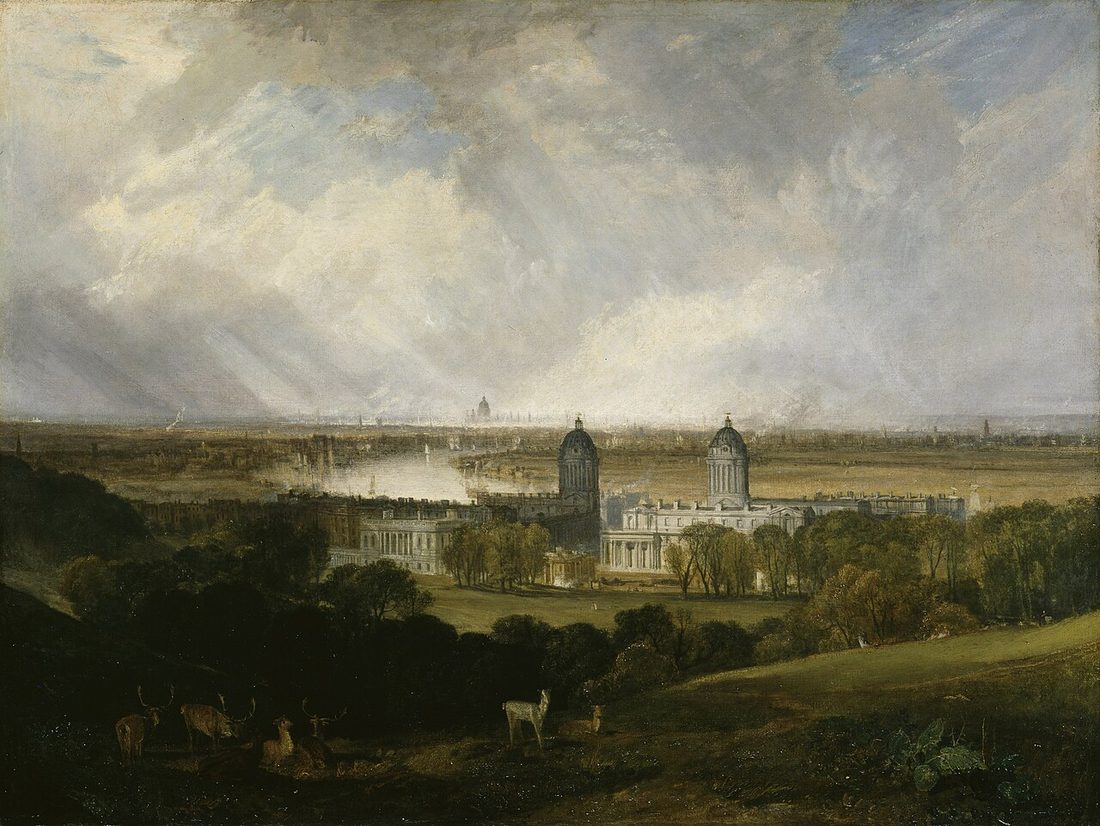

1775 to 1789: Covent Garden and the first drawings
Joseph Mallord William Turner was born in Maiden Lane, Covent Garden, in 1775. He kept 23 April as his birthday, and the parish register records his baptism on 14 May. His father William was a barber and wig-maker, his mother Mary Marshall came from a family of butchers, and the shop stood a few streets from the river.
The earliest surviving drawings date from about 1787, when he was twelve, and his father was already selling them from the shop window for a few shillings each. He was sent for long periods to relatives in Brentford and Margate, coloured prints for an engraver, and worked for the architectural draughtsman Thomas Malton, who taught him perspective.
1789 to 1802: the Royal Academy
In December 1789, aged fourteen, he was admitted to the Royal Academy Schools, and in 1790 a watercolour of the Archbishop's Palace at Lambeth was accepted for the annual exhibition. Through the 1790s he toured Wales, the Midlands and the north every summer, filling sketchbooks with the abbeys, castles and bridges that fed his watercolour commissions.
His first exhibited oil, Fishermen at Sea, hung at the Academy in 1796, when he was twenty-one. In November 1799 he was elected an Associate, at the youngest age the rules allowed, and in February 1802 a full Academician. That summer, during the brief peace with France, he crossed the Channel for the first time and reached the Alps.
1804 to 1819: the gallery, the professorship and the Liber
In 1804 he opened his own gallery beside his house in Harley Street, so that he could show work on his own terms; his mother died that same year in the Bethlem hospital. In 1807 he was elected Professor of Perspective at the Academy, a post he held until 1837, though the lectures themselves did not begin until 1811.
The same year saw the first part of the Liber Studiorum, the series of mezzotints after his own designs that laid out the categories of landscape as he understood them. The exhibited pictures of these years include The Shipwreck in 1805, Snow Storm: Hannibal and his Army Crossing the Alps in 1812, and Dido Building Carthage in 1815.
A tour of the Rhine and the Low Countries in 1817 produced The Field of Waterloo, and in August 1819 he set out for Italy for the first time. He was away for six months, reaching Venice, Rome and Naples, and came home with some fifteen hundred drawings that shaped his colour for the rest of his working life.
1820 to 1839: Petworth, Venice and the Temeraire
Through the 1820s he worked on the engraved series of English views and became a regular guest of Lord Egremont at Petworth, where several of his most informal oils were painted. His father, who had kept house and prepared his canvases for thirty years, died in September 1829, and Turner drew up the first version of his will soon afterwards.
He returned to Italy in 1828 and to Venice in 1833 and again in 1840, and the Venetian oils began to appear at the Academy from 1833. On the night of 16 October 1834 he watched the Houses of Parliament burn from the river and the south bank, and exhibited two canvases of the fire the following year.
The Fighting Temeraire was shown in 1839 and was praised at once, and The Slave Ship followed in 1840, the year he first met the young John Ruskin. Ruskin's Modern Painters, begun in 1843, would defend him for the rest of his life and long beyond it. Both canvases are covered in full on their own pages in this archive.
1840 to 1851: the late work and Chelsea
Snow Storm: Steam-Boat off a Harbour's Mouth was exhibited in 1842 and Rain, Steam and Speed in 1844, the year of his last visit to Switzerland. From 1846 he lived much of the time in a small house on the river at Chelsea with Sophia Booth, his former Margate landlady, and was known to the neighbours only as Mr Booth.
He exhibited for the last time in 1850, with four pictures on the story of Dido and Aeneas, and died at the Chelsea house on 19 December 1851, aged seventy-six. He was buried in the crypt of St Paul's Cathedral, near Reynolds, on 30 December, and his will left the finished pictures in his studio to the nation.
After 1851: the Bequest
The will was contested by relatives and settled in Chancery in 1856, when the studio contents, oils finished and unfinished with some thirty thousand works on paper, passed to the nation. Two paintings hang beside two Claudes in the National Gallery as he required; the rest forms the Turner Bequest at Tate, housed in the Clore Gallery since 1987.
Questions
When exactly was Turner born?
The day is not certain. Turner himself kept 23 April, which is St George's Day and the traditional birthday of Shakespeare, and there is no reason to doubt the year 1775, but the only document is the baptism entry of 14 May at St Paul's, Covent Garden. Biographers give 23 April with that caveat, and this archive follows them.
How many times did Turner travel abroad?
About twenty journeys between 1802 and 1845, once the wars allowed travel at all. Italy drew him in 1819 and 1828, Venice alone in 1833 and 1840, Switzerland from 1802 and repeatedly in the 1840s, and the Rhine, the Low Countries and the north of France in between. Each tour survives as a run of sketchbooks.
Where is Turner buried?
In the crypt of St Paul's Cathedral in London, near Sir Joshua Reynolds, the Academy's first President, at his own request. The crypt is open to visitors and also holds the tombs of Wren, Nelson and Wellington, so the painter of Trafalgar and Waterloo lies among the national figures whose events he had put on canvas.