Oil on pine · 1798 · Tate
Caernarvon Castle: Turner's Small 1798 Oil on Pine at Sunset
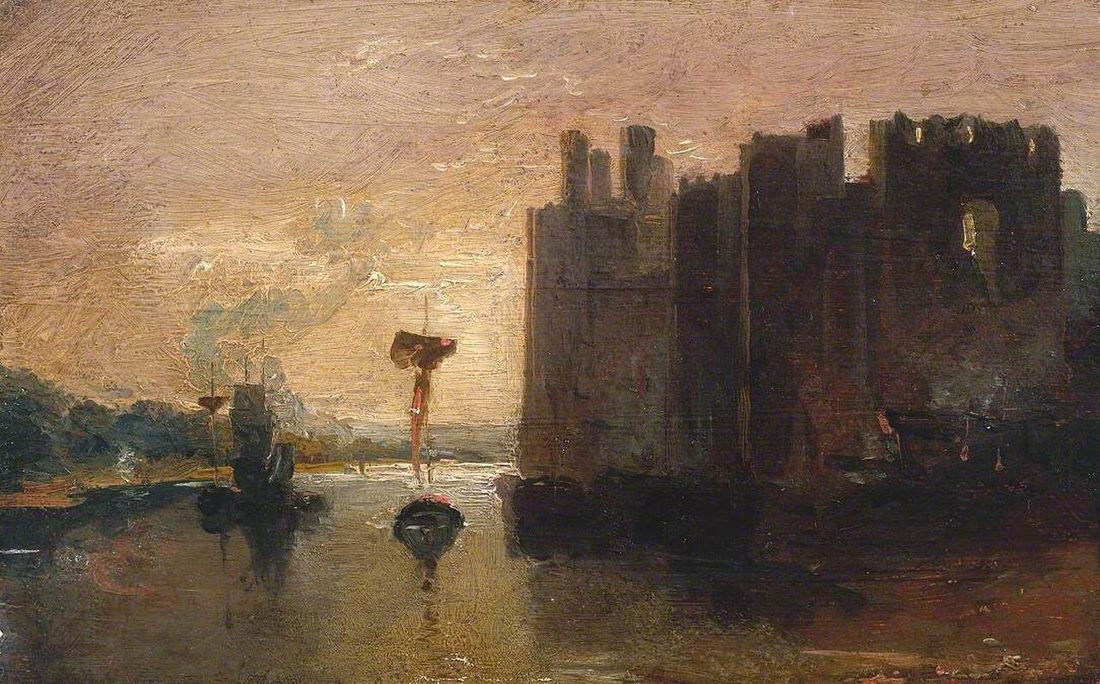
A castle silhouette against a low sun on a panel the size of a sheet of paper. Turner was twenty-three and had already found the device he would use for fifty years.
_-_Caernarvon_Castle_-_N01867_-_National_Gallery.jpg)
A small panel
The support is a pine panel measuring roughly fifteen by twenty-three centimetres, which makes this one of the smallest oils in the Bequest. The scale matters: at this size Turner is working out an effect instead of making an exhibition statement, and the panel functions as a study in oil and not a finished picture.
| Artist | Joseph Mallord William Turner (1775–1851) |
|---|---|
| Date | 1798 |
| Medium | Oil paint on pine |
| Dimensions | support: 152 x 232 mm frame: 208 x 287 x 40 mm |
| Collection | Tate, London |
| Accession number | N01867 |
| Credit line | Accepted by the nation as part of the Turner Bequest 1856 |
The composition places the castle as a dark mass to one side with the sun low behind it, water in the foreground carrying the reflected light directly towards the viewer. It is the Claudean sunset arrangement in miniature, and he had evidently absorbed it thoroughly before he ever exhibited a classical subject.
The Welsh tours
Turner travelled in Wales in 1798 and again in 1799, and both of those tours proved formative. He filled sketchbooks with Caernarvon, with Conway, with Dolbadarn and with the mountains around Snowdon, and that material went on to feed watercolours, oils and engravings for years afterwards. Caernarvon in particular he treated more than once.
Wales offered what he needed at a point when the Continent was closed by war: real mountains, genuine ruins with history attached, and weather that could be made sublime without invention. A generation of British painters worked the same ground for the same reason, and Turner worked it harder than most.
A larger watercolour followed
He exhibited a substantial Caernarvon Castle watercolour at the Academy in 1799, a more ambitious treatment of a related view with figures and a fuller foreground. The relationship between that sheet and this panel shows how he moved between media early on, using each to test what the other could not.
Why the early work is worth attention
Turner's reputation rests so heavily on the late canvases that the early panels get skipped, and that distorts the story. The devices he is famous for pushing to extremes in the 1840s were in his hands before he turned twenty-five, and pictures like this one show them arriving in their conventional form first.
Seeing that sequence matters because it undercuts the romantic account of a painter who simply broke free of tradition. He learned the tradition properly, at small scale and in private, and the late dissolution is what eventually happened to a set of devices he had been practising since his early twenties.
Pine as a support
Painting on wood and not canvas was normal for small work of the period, and pine was cheap and readily available. The rigid surface takes thin paint without the weave interfering, which is why the graded sky in a panel this size holds together in a way it would struggle to on canvas.
Where to see it
The panel is at Tate in London, part of the Turner Bequest, and like most of the small early oils it is shown only occasionally. The Bequest holds a large group of comparable studies, which is the real value: not one panel but a continuous record of a painter teaching himself.
Questions
Did Turner paint Caernarvon more than once?
Yes. He exhibited a substantial Caernarvon Castle watercolour at the Royal Academy in 1799, a more ambitious treatment of a related view with figures and a fuller foreground, and the castle recurs in his Welsh material. The small panel and the exhibited sheet show him using two media to test different things.
How big is the painting?
Roughly fifteen by twenty-three centimetres, painted on a pine panel, which makes it one of the smallest oils in the whole Bequest. At that scale it works as a study in oil instead of an exhibition picture, which is how the small early panels in the collection generally functioned for him.
Why did Turner paint in Wales?
Because the Continent was closed by war and Wales offered exactly what he needed: real mountains, genuine ruins with history attached, and weather that could be made sublime without any invention. He toured there in 1798 and again in 1799, filling sketchbooks that fed watercolours, oils and engravings for years afterwards.