Theme · Ruins · 1790s–1840s
Turner's Castles and Abbeys: Why British Ruins Mattered to Him
Turner drew and painted castles for sixty years. They gave a landscape painter what Italy gave everybody else: history you could stand in front of.
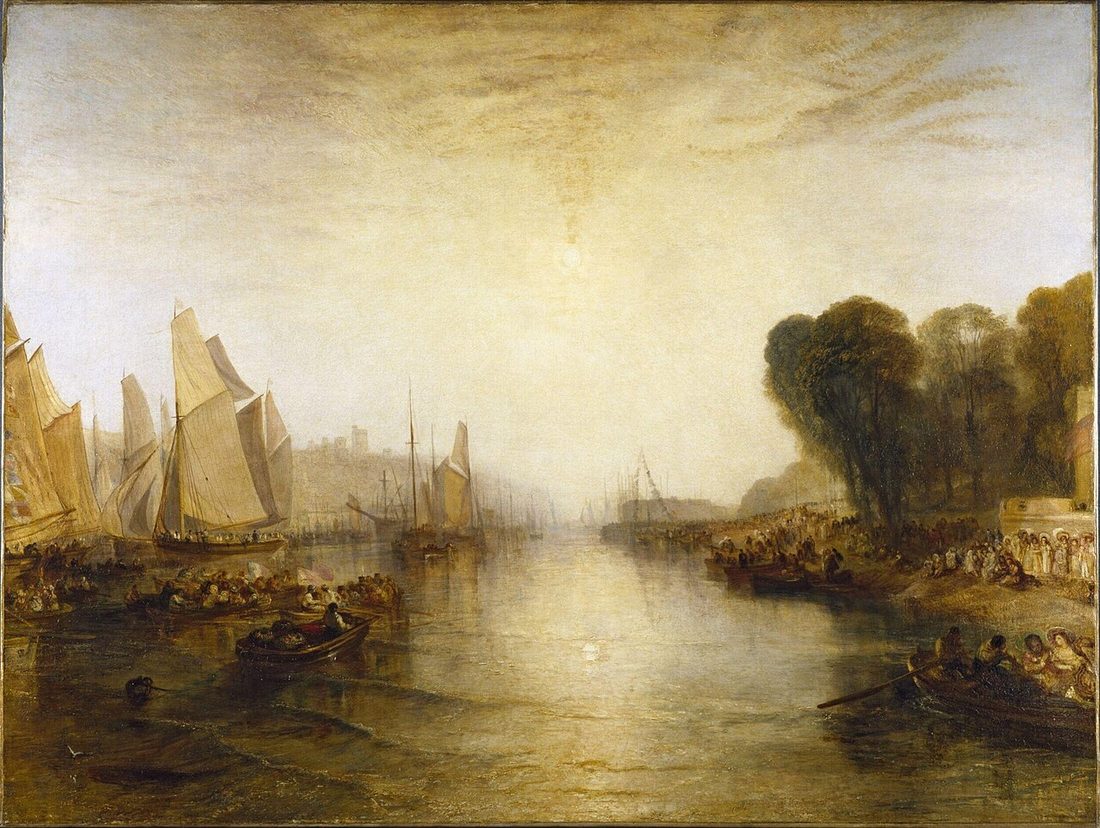

Why ruins
Academic theory ranked landscape below history painting, and the most reliable way for a landscape to acquire historical weight was to contain something with a past. A ruined castle or abbey supplied that instantly: a real structure, a documented history, and a visible argument about time and decay in one subject.
Italy provided the same thing for painters who could travel there, but until 1802 the Continent was closed by war and Turner could not go. British ruins were what was actually available, and the topographical market wanted views of them anyway, so the subject paid its way while it also served his ambitions.
The Welsh castles
His 1798 and 1799 tours produced Caernarvon, Conway, Harlech and Dolbadarn, and the Welsh subjects are the most charged of the early group. They carry a history of conquest and imprisonment that a British audience recognised, and Turner used verse in his catalogue entries to make sure the association was made.
Dolbadarn is the clearest case. He chose it as his Royal Academy diploma work in 1802, which means that when asked to pick one picture to represent him permanently inside the institution, he selected a dark Welsh tower with a captive prince attached and not a marine piece or a topographical view.
The northern abbeys
Kirkstall, Fountains and the other Yorkshire ruins served a rather different purpose. Turner visited them repeatedly, often while staying with his patron Walter Fawkes at Farnley Hall, and the abbeys gave him architecture in an advanced state of collapse, which suited both watercolour and the mezzotints of the Liber Studiorum.
Norham, for fifty years
Norham Castle on the Tweed is the extreme case of his returning to a subject. He first drew it in 1797 and was still working the motif in the 1840s, through watercolours, an engraving and several oils, and the sequence is the single best record of how his handling changed across a whole career.
He is said to have raised his hat to the castle in later life, telling a companion that he owed it a good deal because the engraving after his early view had done so much for his reputation. The story comes second hand, but it fits how carefully he managed his print business.
The topographical trade
Ruins also sold very well. Publishers commissioned series of views of British antiquities throughout Turner's early career, and engravings after castles and abbeys reached an audience far larger than any exhibition room could, which is how a young painter built a reputation before the Academy had taken much notice of him.
What the ruins became
In the late work the historical charge drops away very nearly entirely. Norham Castle, Sunrise contains a castle that has become a pale blue wedge with no describable masonry left in it at all, and the picture is about light on water rather than about conquest, captivity or the passage of time.
Questions
Which abbeys did Turner paint?
Kirkstall and Fountains among the Yorkshire ruins above all, both of which he visited repeatedly while staying with his patron Walter Fawkes at Farnley Hall. Ruined abbeys gave him architecture in an advanced state of collapse, a subject that suited watercolour and the mezzotints of the Liber Studiorum equally well.
Why did Turner paint so many castles?
Because academic theory ranked landscape below history painting, and a ruin was the quickest way for a landscape to acquire historical weight: a real structure with a documented past and a visible argument about decay. Until 1802 the Continent was closed by war, so British ruins were what was available.
Which castle did Turner return to most?
Norham Castle on the Tweed. He first drew it in 1797 and was still working the same motif in the 1840s, through watercolours, an engraving and several oils, so the sequence is the best single record of how his handling changed across an entire working career of roughly fifty years.