Oil on canvas · Exhibited 1800 · Royal Academy of Arts
Dolbadarn Castle: Turner's 1800 Royal Academy Diploma Work
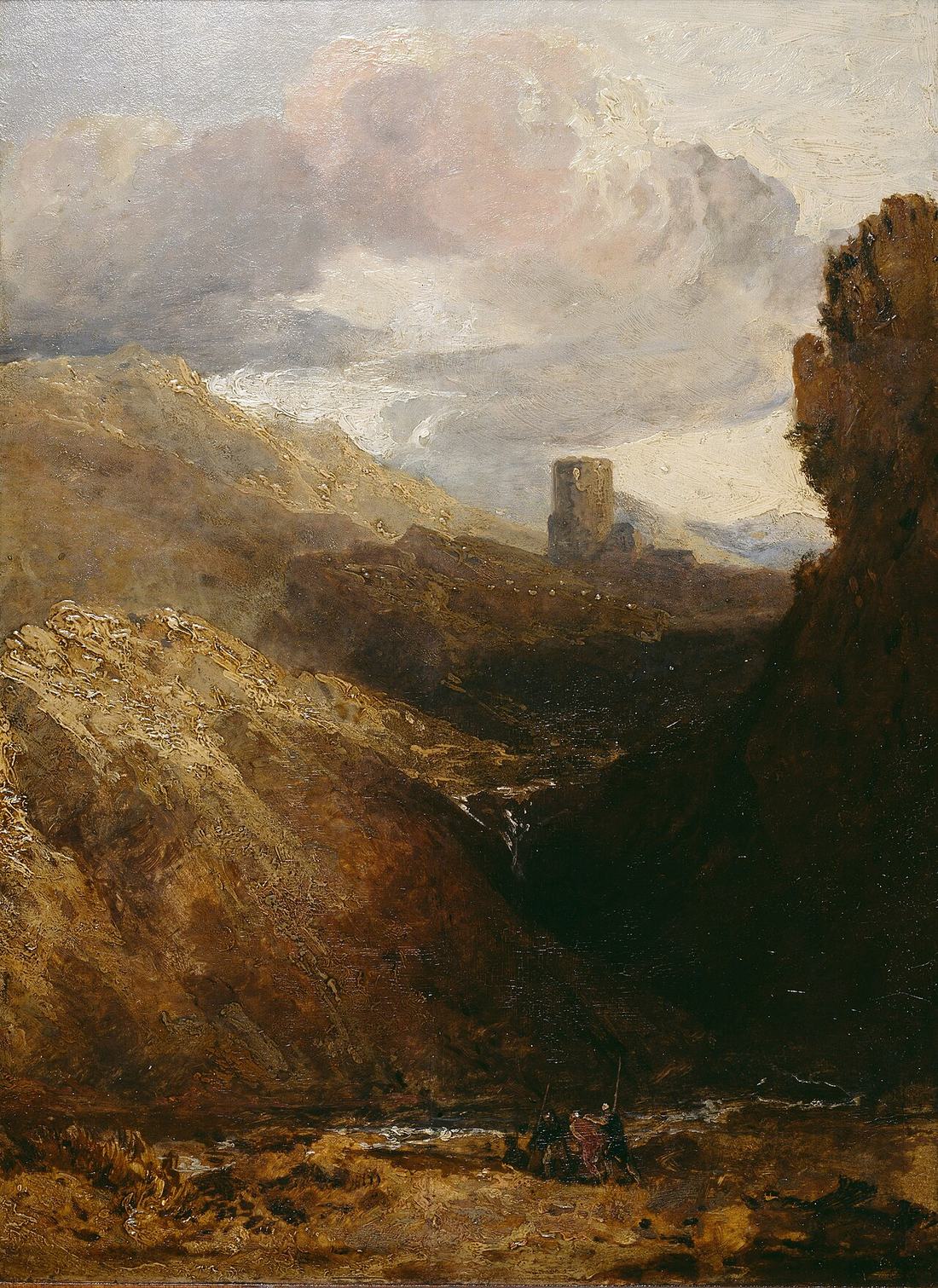
A tower on a crag above a dark pass, and a figure being led away below. Turner chose this picture to represent him permanently at the Academy.

The subject
The round keep of Dolbadarn Castle stands on its rock at the top of the canvas, silhouetted against a pale sky, while the lower two-thirds are given to shadowed rock and the floor of the pass. Small figures near the bottom appear to be escorting a prisoner, and the scale between them and the tower is deliberately brutal.
| Artist | Joseph Mallord William Turner (1775–1851) |
|---|---|
| Date | 1800 |
| Exhibited | Royal Academy, 1800 |
| Medium | Oil paint on canvas |
| Dimensions | 1194 x 902 mm |
| Collection | Royal Academy of Arts, London |
Turner had toured North Wales in 1798 and 1799 and filled sketchbooks with the mountains around Llanberis. The castle is real and the drawings are topographically careful, but the finished painting raises the crag, deepens the gloom and compresses the pass until the site becomes a statement instead of a view.
The captive prince
Dolbadarn was associated with Owain Goch, imprisoned there in the thirteenth century by his brother Llywelyn, and Turner attached verse of his own to the catalogue entry invoking the hopeless captive and the majesty of the place. The figures at the foot of the picture are usually read as that imprisonment.
The choice of subject fits a clear pattern in his early work. Welsh and Scottish castles offered British painters a native equivalent of the ruins that made Italian landscape respectable, with the added advantage of genuine history attached, and Turner used them repeatedly throughout the first decade of his career.
The diploma work
Academicians were required to deposit a work on election, and Turner gave this canvas when he became a full member in February 1802. It has remained in the Royal Academy's collection ever since, which makes it the one major early Turner that never entered the Bequest and never passed through the market.
The choice is informative. Asked to select a single picture to represent him permanently inside the institution, a twenty-six-year-old landscape painter picked a dark Welsh mountain subject with a literary and historical charge instead of a marine piece or a topographical view, which is a statement about where he thought landscape should sit.
Where it fits
Painted two years before he first crossed the Channel, this belongs to the period when Turner's sublime was being assembled out of British material. The mountains, the weather and the ruins he needed were available in Wales and the Lake District, and he worked them hard before the Alps became accessible.
The verse habit starts early
Attaching his own poetry to a catalogue entry became a lifelong practice, and this is one of the earliest instances. It signalled literary seriousness to an audience that ranked history painting above landscape, and it let Turner supply the moral of a picture in words instead of paint it in.
Where to see it
The painting is in the Royal Academy's own collection in London, not at Tate, which is why it appears less often in Turner exhibitions than its importance warrants. Seeing it requires a separate visit from the Bequest, and it is the only one of his major early oils held that way.
Questions
Is Dolbadarn Castle an accurate view?
The castle and its setting above the Llanberis pass are real, and Turner's sketchbook drawings from his 1798 and 1799 Welsh tours are topographically careful. The finished painting is not: he raises the crag, deepens the shadow and compresses the pass until the scale between the figures and the tower becomes deliberately punishing.
What is a diploma work?
A work that a newly elected Academician was required to deposit with the Royal Academy on election. Turner gave Dolbadarn Castle when he became a full member in February 1802, and it has stayed in the Academy's collection since. It is the one major early Turner that never entered the Bequest or passed through the market.
Who was the captive at Dolbadarn?
Owain Goch, imprisoned in the castle in the thirteenth century by his brother Llywelyn. Turner attached verse of his own to the exhibition catalogue invoking the hopeless captive and the majesty of the place, and the small figures at the foot of the painting are generally read as that imprisonment.