Oil on canvas · Exhibited 1829 · The National Gallery
Ulysses Deriding Polyphemus: Turner's 1829 Escape from the Cyclops
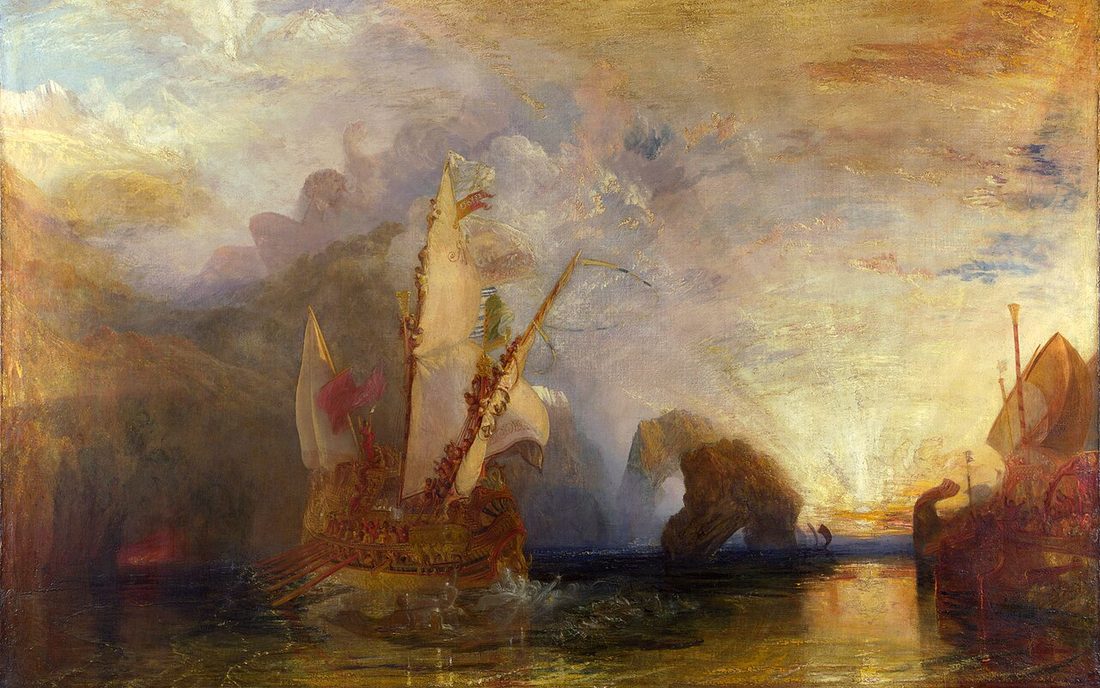
A ship pulls away at dawn while a blinded giant rages on the cliff above. Ruskin called it the central picture in Turner's career, and the colour is the reason.

The subject
The episode is from the ninth book of the Odyssey. Ulysses has blinded the Cyclops Polyphemus and escaped his cave, and as his ship stands out to sea he cannot resist shouting his own name back at the giant. Turner takes the moment of the taunt, with the ship under way and the sun coming up.
| Artist | Joseph Mallord William Turner (1775–1851) |
|---|---|
| Date | 1829 |
| Exhibited | Royal Academy, 1829 |
| Medium | Oil paint on canvas |
| Dimensions | 1327 x 2032 mm |
| Collection | The National Gallery, London |
| Accession number | NG508 |
Polyphemus is the hardest thing in the picture to find, which is deliberate. He is a dark, smoke-coloured mass sprawled along the top of the cliff on the left, so nearly continuous with the rock and cloud that many viewers miss him entirely until the shape resolves into a figure with an arm flung across it.
The horses of the sun
At the left edge of the rising sun, drawn in thin bright paint, are the horses of Apollo's chariot. They are barely there, and Turner clearly meant them to be barely there, since a fully painted team would have turned a sunrise into an illustration of a myth and broken the illusion he was after.
The detail shows how he liked to work classical machinery into a picture without letting it dominate. The sun is doing real optical work as the light source, and the mythological reading is available to anyone who looks hard enough, but nothing forces it on a viewer who simply wants a dawn at sea.
The ship
The vessel is not a plausible Homeric galley. It carries banners, elaborate decoration and a rigging arrangement that belongs to no particular period, and Turner was perfectly capable of drawing an accurate ancient ship had he wanted one. The point was festivity and escape instead of archaeological correctness about the Bronze Age.
Ruskin's claim
Ruskin described this as the central picture in Turner's career, the point at which his handling of colour changed decisively. It is a strong claim for a single canvas, and it rests on the way the whole surface is organised by hue and temperature rather than by the tonal modelling that governs his earlier work.
Whether or not one accepts the verdict, the painting does sit at a hinge. Everything before it can be described in terms of light and shade on solid form; a good deal after it cannot, because colour has taken over the structural role. The pictures of the 1830s and 1840s follow from what happens here.
Reception
Critics in 1829 were divided in the way that had become usual. The colour was the flashpoint, with some reviewers finding it gaudy and unnatural, and one of the better-known complaints of the period concerned the quantity of yellow in his recent exhibits generally and not this canvas in particular.
Where to see it
The painting is in the National Gallery in London, where it arrived with the Turner Bequest. It hangs in the same collection as Dido Building Carthage, and seeing the two of them together is the quickest way to grasp the change Ruskin was pointing at, since only fourteen years separate the two canvases.
Questions
Where is Polyphemus in the painting?
He is the dark, smoke-coloured mass sprawled along the top of the cliff on the left, so nearly continuous with the rock and cloud behind him that many viewers miss him altogether at first. The concealment is deliberate, and the shape only resolves into a figure with an arm thrown across it once you look for it.
What are the horses in the sun?
They are the horses of Apollo's chariot, drawn in very thin bright paint at the left edge of the rising sun. Turner meant them to be almost invisible: a fully painted team would have turned a sunrise into a straightforward illustration of a myth and destroyed the optical effect he was actually pursuing.
Why did Ruskin think this painting was so important?
He described it as the central picture of Turner's career, the point where his handling of colour changed decisively. The claim rests on the way the whole surface is organised by hue and temperature rather than by the tonal modelling of solid form that governs his earlier work, and the later paintings follow from it.