Oil on canvas · Exhibited 1832 · Tate
Childe Harold's Pilgrimage – Italy: Turner's 1832 Byron Landscape
Byron had been dead eight years. Turner exhibited an Italian valley under his title, quoted the poem in the catalogue, and gave the picture to the nation.
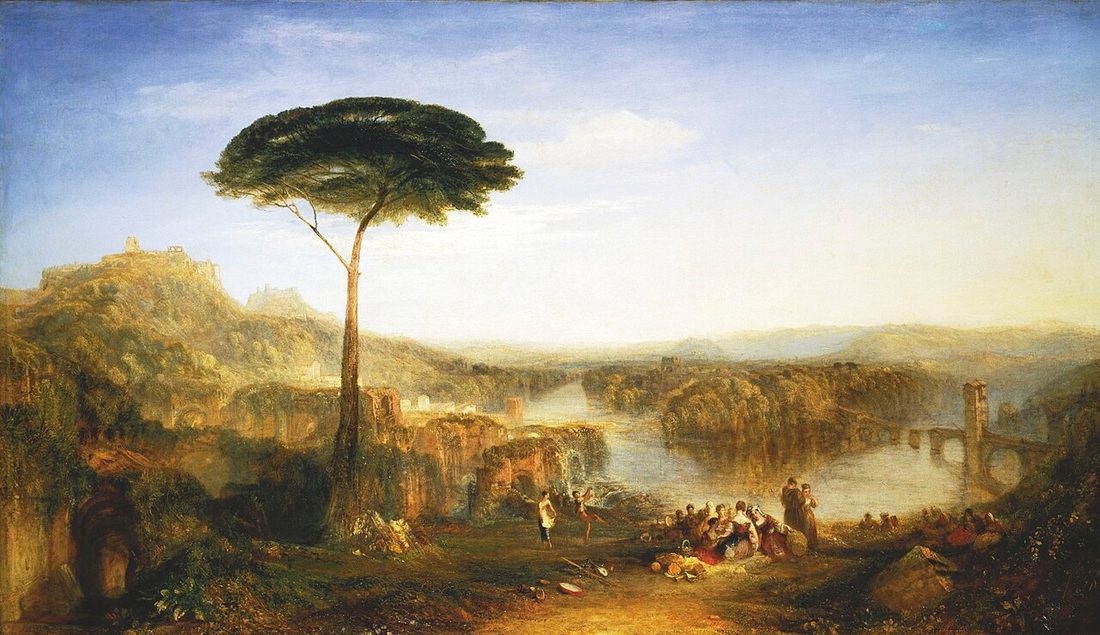

What the picture shows
A broad Italian valley opens between framing trees, with a river winding through the middle distance and blue hills closing the view. Figures rest in the foreground among fragments of masonry, a viaduct or aqueduct crosses the middle ground, and the whole composition is bathed in a warm even light.
| Artist | Joseph Mallord William Turner (1775–1851) |
|---|---|
| Date | 1832 |
| Exhibited | Royal Academy, 1832 |
| Medium | Oil paint on canvas |
| Dimensions | support: 1422 x 2483 mm frame: 1920 x 3000 x 190 mm |
| Collection | Tate, London |
| Accession number | N00516 |
| Credit line | Accepted by the nation as part of the Turner Bequest 1856 |
There is no narrative and no identifiable episode from the poem. Turner is painting the mood of Byron's fourth canto and not an event in it, and the picture works as a general statement about Italy as a landscape of ruins and light rather than as an illustration of anything a reader could point to.
The Byron connection
Byron died in 1824 and the two men never met. Turner nevertheless had a long working relationship with the poetry: he produced designs for illustrated editions of Byron for publishers through the 1820s and 1830s, and he knew the fourth canto of Childe Harold, which deals with Italy, extremely well.
He quoted lines from that canto in the exhibition catalogue, choosing a passage on Italy as a land of fallen greatness. The practice was habitual with him, and using a fashionable modern poet and not his own verse gave the picture a literary standing that the Academy's hierarchy still rewarded.
Italy observed, then reorganised
By 1832 Turner had been to Italy twice, in 1819 and again in 1828, and had filled sketchbooks with the Campagna, with Rome and with Naples. So unlike Crossing the Brook of seventeen years earlier, the Italian light here is something he had actually stood in rather than inferred from Claude's paintings.
The composition is still Claude's, though, and openly so. Framing masses, a stepped recession and a warm even distance are all borrowed, and the topography is invented from remembered fragments instead of recording any particular valley. Direct experience of Italy changed the colour and left the underlying structure entirely alone.
A late classical picture
Exhibiting this kind of subject in 1832 was already slightly out of step. Turner was in his late fifties, his handling was drawing complaints, and the market for large classical landscapes was thinning, yet he went on producing them for another fifteen years because the genre was where his ambition sat.
Ruins as subject
The masonry fragments in the foreground do a specific job. Italy was legible to a British audience as a landscape of fallen greatness, and broken stone in a warm light carried that reading without a single figure needing to act it out, which is why so many of these pictures contain rubble.
Where to see it
The painting is at Tate in London, part of the Turner Bequest, so it was another that stayed with him. It hangs in the same collection as the late unfinished oils, which makes the contrast plain: a fully resolved classical landscape and the dissolved canvases of the 1840s by the same hand.
Questions
Which lines did Turner quote?
He took a passage from the fourth canto of Childe Harold's Pilgrimage, the canto that deals with Italy, on the country as a land of fallen greatness. Quoting verse in a catalogue entry was habitual for him, and using a fashionable modern poet instead of his own lines carried real literary standing at the Academy.
Did Turner know Byron?
No, the two never met, and Byron died in 1824, eight years before this picture was exhibited. Turner did have a long working relationship with the poetry, producing designs for illustrated editions of Byron for publishers through the 1820s and 1830s, and he knew the Italian fourth canto of Childe Harold very well.
Does the painting illustrate a scene from the poem?
No. There is no identifiable episode and no narrative incident anywhere in it. Turner is painting the mood of Byron's fourth canto instead of an event in it, so the canvas works as a general statement about Italy as a landscape of ruins and light rather than as an illustration of anything specific.