Oil on canvas · Exhibited 1818 · Tate
The Field of Waterloo: Turner's 1818 Battlefield After the Fighting
Britain wanted a victory picture. Turner went to the battlefield, then painted a heap of the dead from both sides, lit by a flare, with the winners nowhere in it.

What Turner painted
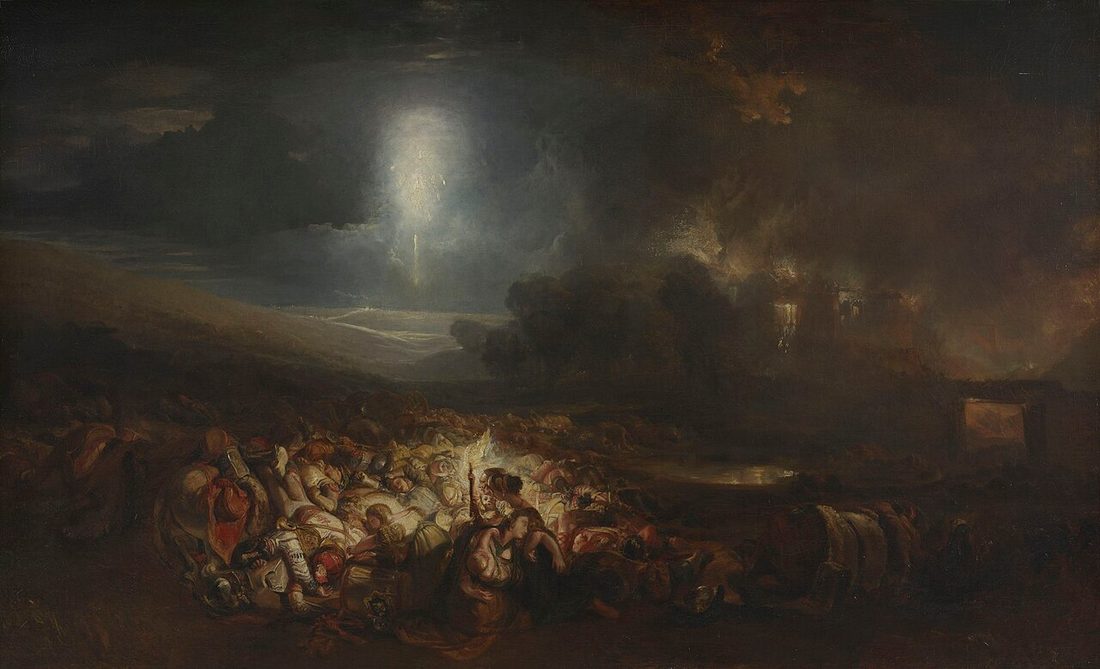
The canvas shows the field at night after the fighting has stopped. Bodies lie tangled in the foreground, British and French together and not distinguishable from one another. Women search among them by torchlight, a flare burns in the sky, and the ruined buildings of Hougoumont smoulder in the darkness behind.
| Artist | Joseph Mallord William Turner (1775–1851) |
|---|---|
| Date | 1818 |
| Exhibited | Royal Academy, 1818 |
| Medium | Oil paint on canvas |
| Dimensions | support: 1473 x 2388 mm frame: 1860 x 2773 x 180 mm |
| Collection | Tate, London |
| Accession number | N00500 |
| Credit line | Accepted by the nation as part of the Turner Bequest 1856 |
There is no triumph anywhere in it. No general, no standard, no moment of decision, and nothing that identifies which army won. For a British audience three years after the battle this was close to a provocation, since the expected treatment was a celebration of Wellington and the army that had produced the result.
The 1817 visit
Turner travelled to the Continent in 1817, his first extended trip after the wars ended, and went to the battlefield itself. Sketchbook pages from the visit record the ground and the buildings at Hougoumont, with notes on where the heaviest casualties had fallen and rough figures for the numbers of dead.
That note-taking matters for how the painting reads. He was not composing a generic scene of carnage but working from the specific place, and the numbers he wrote down suggest he was interested in the scale of the loss as a fact before he was interested in it as a subject for paint.
The verse and the reception
He attached lines from Byron's Childe Harold's Pilgrimage to the catalogue entry, quoting the passage on the field where friend and foe lie mingled in one bloody burial. The choice put a fashionable and sceptical poet behind a picture that was already refusing to do what a battle painting was supposed to do.
Critics were not pleased. Several found the composition confused and the subject distasteful, and the painting did not sell. It stayed with Turner and came to the nation in the Bequest, which is how a great deal of his most uncompromising work ended up in public hands and not private collections.
The flare and the light
The single source of illumination is a flare or rocket burning above the field, and every effect in the painting depends on it. It throws the foreground bodies into hard relief while leaving the middle distance almost black, so the viewer sees a great deal of one small area and nothing at all of the rest.
Turner had been experimenting with artificial light against darkness for years, in limekilns, forges and moonlit harbours. Here the device carries a moral weight it does not have in those subjects, because what the light picks out is a heap of the dead and what it conceals is the scale of the field beyond them.
How it is read now
The painting is now treated as one of the earliest serious anti-heroic treatments of modern warfare in British art, anticipating attitudes that became common only much later. It sits oddly in Turner's output, since he was perfectly willing to paint naval triumph elsewhere, and that inconsistency is part of what makes it interesting.
It also shows how little Turner cared about pleasing a market when a subject took hold of him. The canvas was unsaleable in 1818 and he must have known it would be, having chosen a treatment that denied his audience the one thing they wanted from a Waterloo picture, which was the sense of having won.
Questions
Did Turner visit the Waterloo battlefield?
Yes. He travelled to the Continent in 1817, in his first extended trip after the end of the wars, and went to the field itself. Sketchbook pages from the visit record the ground and the ruined buildings at Hougoumont, along with written notes on where casualties had been heaviest and rough figures for the numbers of dead.
Why is there no victory in the painting?
Turner chose the aftermath and not the battle, and painted the dead of both armies mingled and indistinguishable, searched over by women with torches. No general, standard or decisive moment appears, and nothing identifies the winning side. Critics in 1818 found it confused and distasteful, and the canvas did not sell.