Oil on canvas · Exhibited 1796 · Tate
Fishermen at Sea: Turner's First Oil Shown at the Royal Academy, 1796
Turner was twenty-one and had shown only watercolours. This was the canvas that announced he intended to compete as a painter in oil, and it was noticed immediately.
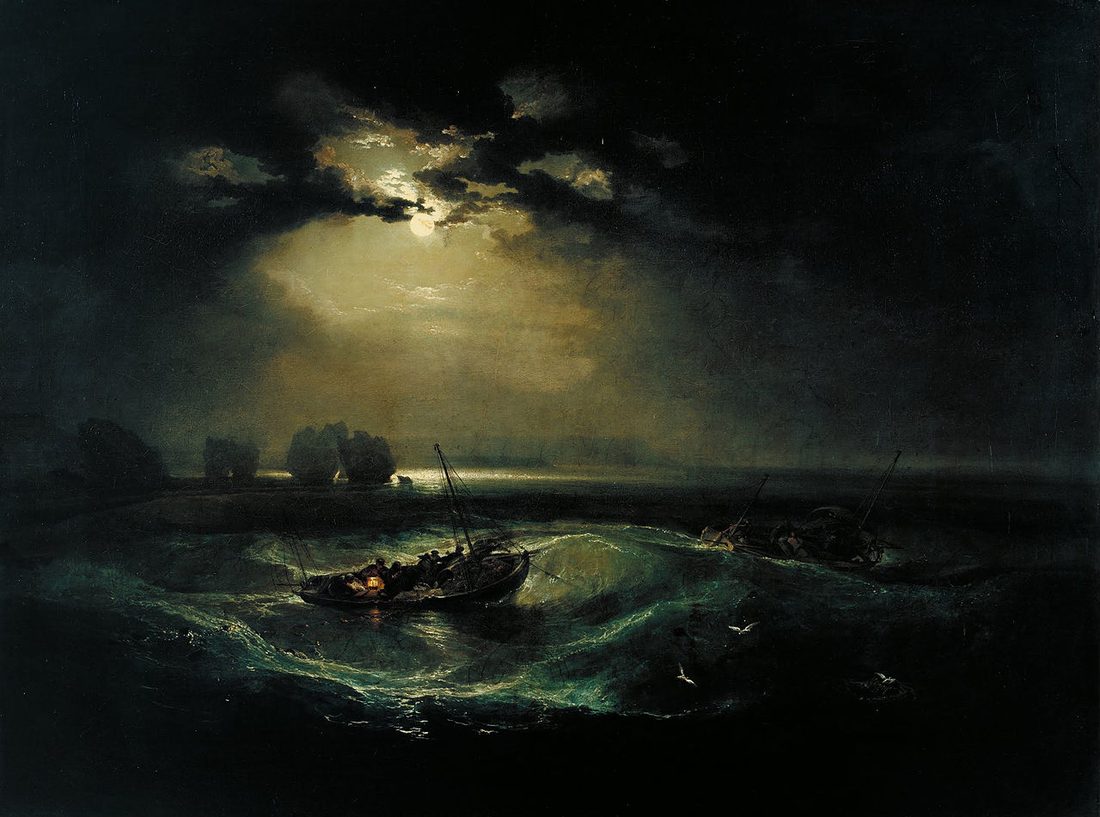

The painting
Two fishing boats work in open water at night, lit by a moon that sits high in a break in the cloud. A lantern burns in the nearer boat, giving a second and warmer light source close to the viewer. The jagged silhouette on the left is the Needles, off the western tip of the Isle of Wight.
| Artist | Joseph Mallord William Turner (1775–1851) |
|---|---|
| Date | 1796 |
| Exhibited | Royal Academy, 1796 |
| Medium | Oil paint on canvas |
| Dimensions | support: 914 x 1222 mm frame: 1120 x 1425 x 105 mm |
| Collection | Tate, London |
| Accession number | T01585 |
| Credit line | Purchased 1972 |
The sea is a long low swell instead of a storm, and the danger is implied instead of staged. The boats are small, the water is deep, and the men are a long way from shore in the dark. Turner would return to that understatement rarely; most of his later marine work raises the stakes considerably.
Why it mattered
Turner had been exhibiting at the Academy since 1790, but only watercolours, which occupied a lower rung in the institution's hierarchy. Showing an oil was a declaration of intent, and doing it at twenty-one with a competent night piece put him among the painters who had to be taken seriously.
The reception was good. Reviewers singled it out, and one described it in terms suggesting real surprise at the handling of the two light sources. It was bought soon afterwards, and Turner was elected an Associate of the Royal Academy three years later, in 1799, at the earliest age the rules allowed.
The debts it declares
The moonlight piece was an established genre and Turner was working inside it openly. The Dutch marine painters of the seventeenth century are behind the boats and the swell, and the specific device of a lantern against moonlight had been used by Joseph Wright of Derby and by Philippe Jacques de Loutherbourg.
What distinguishes the picture is the confidence of the tonal control and not any novelty of subject. Holding two light temperatures in one dark canvas without muddying either is difficult, and a painter who could do it at twenty-one had clearly spent a great deal of time looking at how light behaves on water.
The Needles
The chalk stacks off the western end of the Isle of Wight were already a recognised landmark and a known hazard to shipping. Turner had toured the island in 1795, the year before he exhibited, filling a sketchbook with coastal views, so the setting comes from direct observation and not another painter's composition.
What it set up
Almost every element here recurs across the next fifty years of his output. Small working boats set against a large sea, a light source placed to do structural instead of decorative work, and a coastline reduced to silhouette are the basic furniture of Turner's marine painting, and he was still rearranging them in the 1840s.
The difference is one of nerve instead of vocabulary. This canvas keeps every form legible and every edge under control, because a young painter competing for attention could not afford to look incompetent. The licence he took later was earned by first demonstrating, here, that he did not need it.
Where to see it
The painting is at Tate in London. It came into the collection in 1972 rather than through the Bequest, having been in private hands since shortly after it was first shown, so it is one of the relatively few major early Turners that was not part of his own retained holdings.
Questions
Was this Turner's first painting?
It was his first oil painting exhibited at the Royal Academy, shown in 1796 when he was twenty-one. He had been exhibiting there since 1790, but only watercolours, which the Academy ranked below oil. Moving to oil was a declaration that he intended to compete as a serious painter rather than as a topographical draughtsman.
What is the landmark in the painting?
The jagged silhouette on the left is the Needles, the chalk stacks off the western tip of the Isle of Wight, already well known as a landmark and a hazard to shipping. Turner had toured the island in 1795 and filled a sketchbook with coastal views, so the setting comes from his own observation.