Theme · Colour · Pigments and theory
Turner's Use of Colour: From Earth Tones to Chrome Yellow and Beyond
Turner began in browns and ended in yellows so intense that critics accused him of a disease. The change is the clearest single narrative in his working life.

Where he started
The early oils are built on the tonal system Turner inherited from the eighteenth century: a dark foreground, a lit middle distance, browns and umbers holding the structure, and colour used locally rather than as the organising principle. Buttermere Lake of 1798 is a competent, entirely conventional example of that method.
The system was not a limitation he failed to notice. It was how landscape had been painted for a century, it read well in the varnished gallery conditions of the day, and it reproduced clearly in the engravings that carried a painter's reputation. Abandoning it was a commercial risk as much as an aesthetic one.
The new pigments
Turner's shift coincided with a genuine expansion of the available palette. Chrome yellow became commercially available in the early nineteenth century, along with emerald green, cobalt blue and a range of new lakes, and he adopted all of them quickly. A painter who wanted intensity suddenly had materials capable of delivering it.
He was not cautious about stability. Some of what he used was known even then to be fugitive, and he used it anyway, which tells you where his priorities sat. The effect in the exhibition room mattered more to him than the condition of the canvas fifty years later, and several pictures have paid for that.
Goethe and the theory
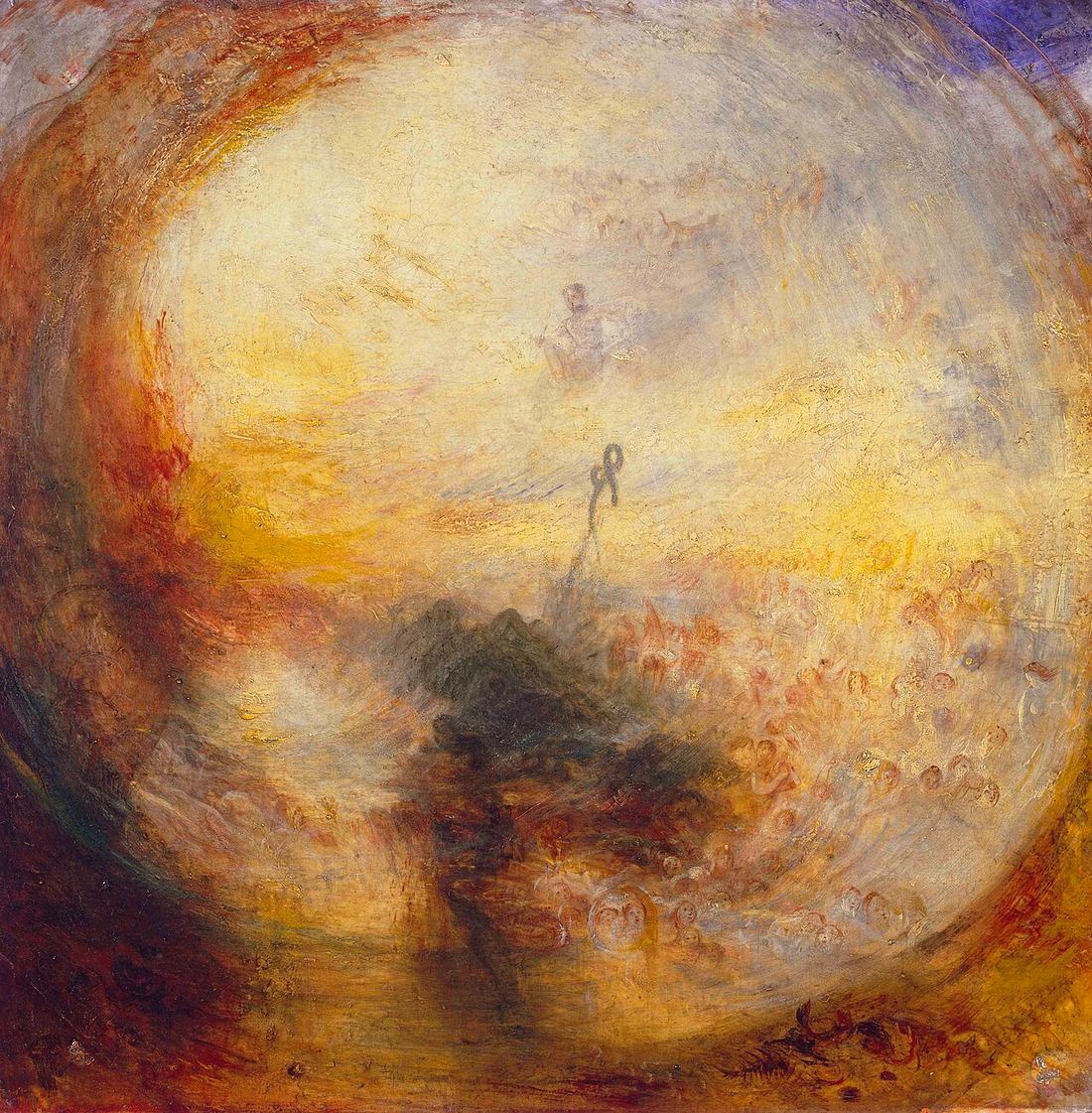
Turner owned an annotated copy of Goethe's Theory of Colours in Charles Eastlake's 1840 translation, and he responded to it directly in a pair of canvases exhibited in 1843. Goethe had divided colours into a plus side of warm, active hues and a minus side of cool, passive ones, associating each with a moral temper.
The pair Turner made from that reading sets a dark deluge against a light one, and he attached verse to both. Whether he accepted Goethe's scheme or was arguing with it has been debated for a century, and the pictures support either reading, which is characteristic of how he used theory when he bothered with it.
The yellow accusations
From the 1820s critics complained persistently about yellow. The word appears again and again in hostile notices, one reviewer suggesting Turner had contracted a yellow fever, and the charge became a standing joke in the press. It was the single most common criticism of his mature exhibits over two decades.
The complaint was not baseless as description. Turner did push yellow hard, and in a room of tonal landscapes the effect would have been startling. What the critics read as a failure of taste was a deliberate decision to let colour instead of tone carry the structure of a picture, which is why it looks modern now.
What has changed since
Several canvases no longer read as they did. Fugitive lakes have faded and some yellows have shifted, so a painting that now looks unbalanced may have lost a rose or crimson passage that once held it together. Conservation reports on Turner regularly record exactly this, and any argument about his colour has to allow for it.
Questions
Why were critics so hostile about Turner's yellow?
From the 1820s onward the word appears constantly in unfavourable notices, with one reviewer suggesting he had caught a yellow fever, and it became a standing press joke. The complaint worked as description — he did push yellow hard — but what critics read as bad taste was a decision to let colour carry structure instead of tone.
Did Turner read Goethe's colour theory?
He owned an annotated copy of Charles Eastlake's 1840 translation of Goethe's Theory of Colours and responded to it in a pair of canvases exhibited in 1843, one a dark deluge and one a light one. Whether he accepted Goethe's scheme or was disputing it has been argued both ways for a century.
Have Turner's colours faded?
Some have. He adopted new pigments quickly, including chrome yellow and a range of lakes, and used materials known even then to be fugitive. Faded crimsons and shifted yellows mean several canvases no longer read as exhibited, which conservation reports record and which any discussion of his colour has to take into account.