Theme · Late work · 1835–1851
Light in Turner's Late Work: What Changed After 1835, and Why
In his last fifteen years Turner stopped describing things and started describing what light does to them. His own audience thought he had lost the ability to finish a picture.
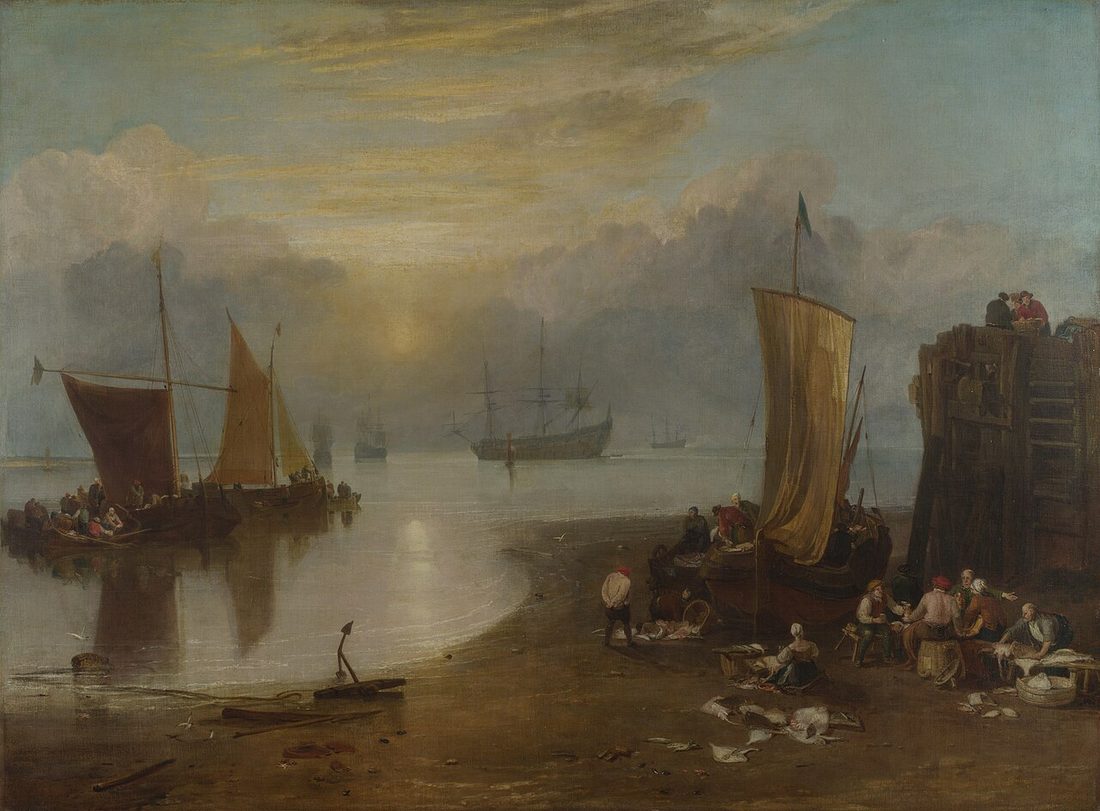

What actually changed
The shift is not simply that the paint got looser. In the early work, light falls on solid forms that have been drawn first and are modelled by tone; in the late work, colour and luminosity establish the forms directly, and there is often no underlying drawing for them to be modelled against at all.
That is a structural change and not a stylistic one, which is why it cannot be reversed by looking harder. A viewer who tries to find the edges in Norham Castle, Sunrise is looking for something the painting does not contain, because the distribution of warm and cool is doing the work edges would normally do.
The unfinished oils
A large group of canvases in the Bequest were never exhibited and never sold, and they are the clearest evidence of the method. Some are barely more than a ground with two or three passages of colour laid in, and several are now among the most reproduced paintings Turner made.
Whether he considered any of them complete is unanswerable, and the question may be the wrong one. He habitually brought canvases to the Academy in a comparable state and finished them on the varnishing days, so the boundary between a study and a finished picture was genuinely movable in his practice.
Why his audience objected
Finish was not a matter of taste in the 1840s; it was the standard by which competence was judged. A picture was expected to arrive at a resolved surface, and a canvas that did not was read as unfinished work offered for sale, which is closer to a professional accusation than an aesthetic complaint.
So the hostility makes sense on its own terms. Reviewers who called the late exhibits soapsuds or whitewash were not failing to see what Turner was doing; they were declining to accept it as a legitimate way to end a painting, and several of them said as much quite explicitly in print.
The eyesight question
It was suggested at the time, and occasionally still is, that Turner's eyesight was failing him. The suggestion does not survive the evidence: his sketchbooks from the 1840s contain precise small-scale observation, and the unfinished canvases show deliberate, controlled decisions about where to stop and not any inability to continue.
How the twentieth century reread it
From the early twentieth century onward the late work was recast as an anticipation of modern painting, and the unfinished oils in particular were promoted from studio leftovers to major statements. That reading made Turner newly important, and it also quietly detached the pictures from what he was actually trying to do.
The caution worth keeping is that these remain landscapes of specific places. Norham was a castle he had drawn since 1797, and the late Venetian sheets record a city he had walked. The compression is extreme, but it is compression of something observed, not a move away from observation towards abstraction.
Questions
Did Turner's late paintings anticipate abstract art?
Twentieth-century critics argued so, and the reading made him newly important. The caution is that these remain landscapes of specific places: Norham was a castle he had drawn since 1797, and the late Venetian sheets record a city he had walked. The compression is extreme but it is compression of something observed.
Why did critics call the late work unfinished?
Because finish was the standard by which competence was judged in the 1840s, not a matter of taste. A picture was expected to reach a resolved surface, and one that did not was read as unfinished work offered for sale. Reviewers saw what Turner was doing and declined to accept it as a legitimate ending.
Was Turner going blind?
It was suggested at the time and occasionally still is, and the evidence does not support it. His sketchbooks from the 1840s contain precise small-scale observation, and the unfinished canvases show controlled decisions about where to stop instead of any inability to continue working at the level he had always worked at.