Oil on canvas · Exhibited 1815 · Tate
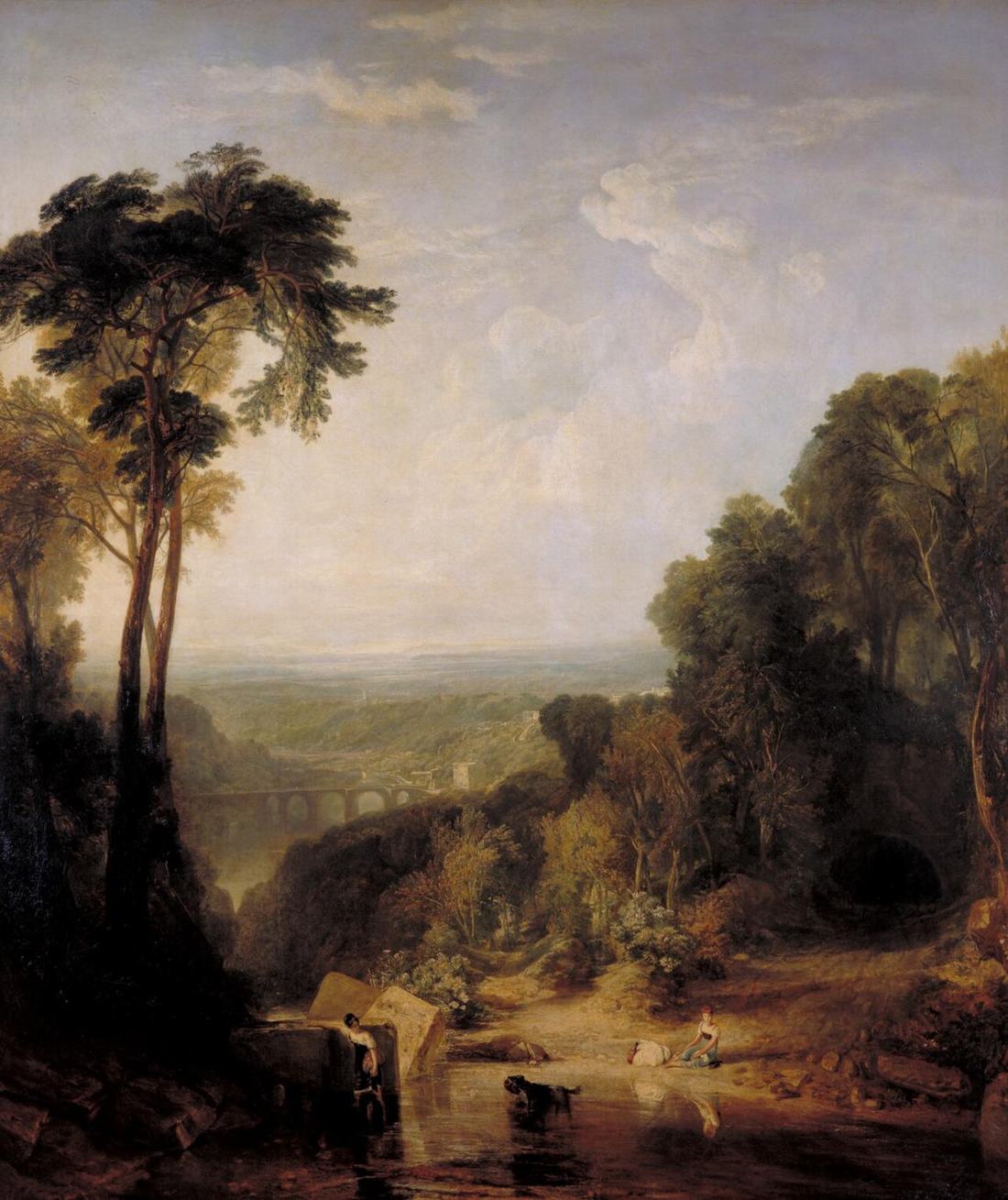
Crossing the Brook: Turner's 1815 Devon Landscape After Claude
An English river valley arranged as a classical landscape, with two girls at a ford in the foreground. Turner painted Devon and made it look like Italy.

What the picture shows
A wooded valley opens out below the viewer and recedes in careful stages towards a blue distance. Two girls and a dog occupy the foreground at a shallow crossing, framing trees close the composition on both sides, and a bridge carries the eye across the middle distance towards hills that dissolve into haze.
| Artist | Joseph Mallord William Turner (1775–1851) |
|---|---|
| Date | 1815 |
| Exhibited | Royal Academy, 1815 |
| Medium | Oil paint on canvas |
| Dimensions | support: 1930 x 1651 mm frame: 2060 x 2350 x 180 mm |
| Collection | Tate, London |
| Accession number | N00497 |
| Credit line | Accepted by the nation as part of the Turner Bequest 1856 |
The structure is Claude's, used without disguise. Dark framing masses at the edges, a lit middle ground, water catching the light and a recession managed in distinct planes are all devices Turner had studied for two decades. What is unusual is that he applied them to a specific English river and not an imagined Mediterranean one.
The setting is real
The view is the Tamar valley on the Devon and Cornwall border, looking from near Gunnislake, and the bridge in the middle distance is the New Bridge across the Tamar. Turner had toured the West Country in 1813, filling sketchbooks with the valley, and the painting was worked up from that material in London.
Identifying the place matters because of what he then does to it. The topography is recognisable to anyone who knows the valley, and it has simultaneously been rearranged, heightened and warmed until the light plainly belongs to a different latitude. That double character is the whole interest of the picture.
Painted before he saw Italy
Turner did not reach Italy until 1819, four years after exhibiting this canvas. The Italianate light here is therefore borrowed rather than observed, arrived at through Claude and through the engravings that carried Claude's compositions to British collectors, which makes it a painting about a place he had only seen in other men's pictures.
The reception
It did not go down well in some quarters at all. Sir George Beaumont, an influential connoisseur and collector who disliked the direction of Turner's work generally, was hostile about the colour, and his opinion carried real weight with buyers. The canvas remained unsold and stayed in Turner's possession for the rest of his life.
That pattern recurs often enough to be worth noting properly. Several of the pictures Turner is now best known for were commercial failures in their own decade, and they reached the public collection precisely because nobody bought them, which means the Bequest over-represents the work his own contemporaries liked least.
The two girls
The figures at the ford are slight, and Turner's figure drawing was attacked throughout his whole career. Here their thinness actually works in his favour: they are small enough to set the scale of the valley without asking to be looked at, which is what a Claudean foreground group is structurally for.
Where to see it
Crossing the Brook is a Bequest picture, held at Tate in London. It sits usefully beside Dido Building Carthage in the National Gallery, since the two were exhibited within a year of each other and show him applying the same Claudean apparatus to a Devon valley and to an imagined ancient city.
Questions
Where is the view in Crossing the Brook?
It is the Tamar valley on the Devon and Cornwall border, seen from near Gunnislake, with the New Bridge across the Tamar in the middle distance. Turner toured the West Country in 1813 and filled sketchbooks with the valley, then worked the painting up from that material in his London studio.
Had Turner been to Italy when he painted it?
No. He first reached Italy in 1819, four years after exhibiting this canvas in 1815. The Italianate light is therefore borrowed rather than observed, arrived at through Claude Lorrain and the engravings that carried Claude's compositions to British collectors, so it is a painting about a place he had only seen in other men's pictures.
Why did the painting not sell?
Sir George Beaumont, an influential connoisseur who disliked the direction of Turner's work in general, was hostile about the colour, and his opinion carried weight with buyers. The canvas stayed with Turner for the rest of his life and reached the nation through the Bequest, which is a common pattern among his best-known works.