Pencil and watercolour · 1822 · Tate
Dartmouth Castle, on the River Dart: Turner's 1822 Devon Watercolour
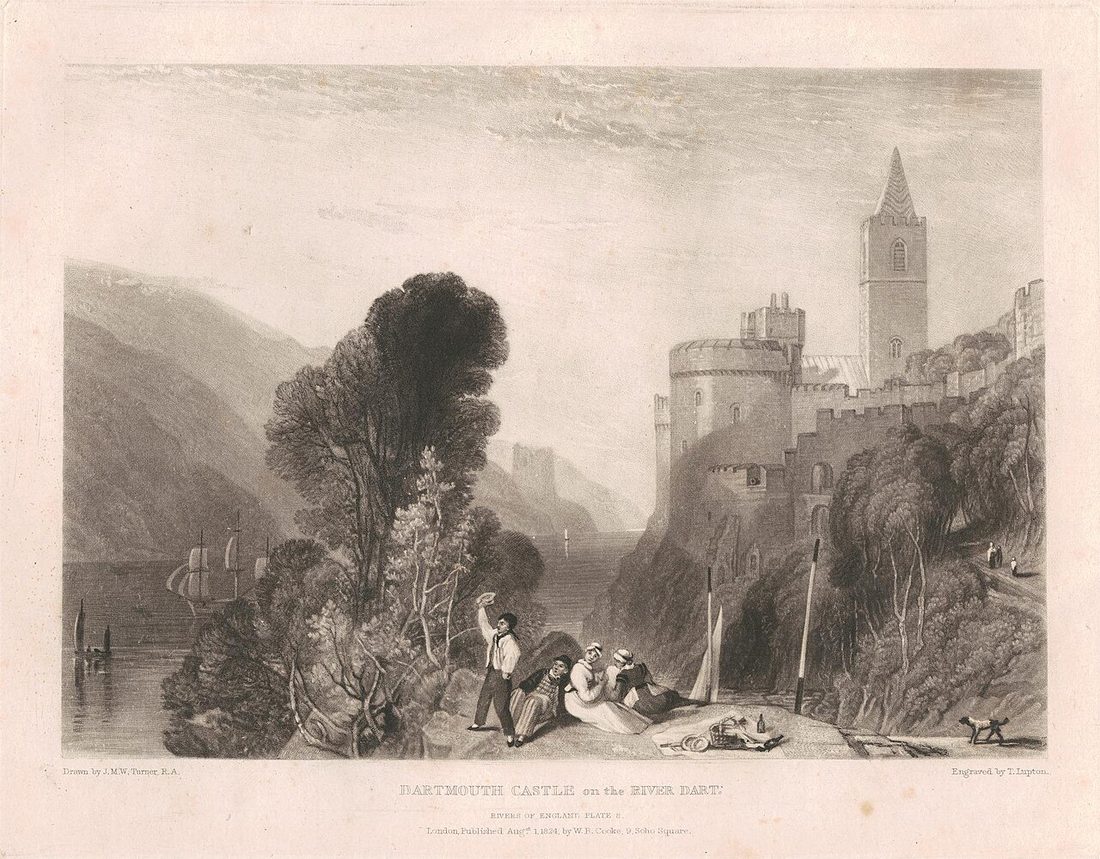
A tiny, densely worked watercolour of the castle at the mouth of the Dart, with a party of sailors in the foreground. Turner made it in 1822 for W.B. Cooke's Rivers of England, and it was engraved in mezzotint by Thomas Lupton in 1824.

The watercolour
Tate catalogues the work as Dartmouth Castle, on the River Dart, dated 1822, accession number D18137 in the Turner Bequest. It is drawn in pencil and watercolour on white wove paper and measures only 158 by 223 millimetres, a small sheet packed with detail. The Library Edition of Ruskin's works lists it as The Dart. Dartmouth Castle.
| Artist | Joseph Mallord William Turner (1775–1851) |
|---|---|
| Date | 1822 |
| Medium | Graphite and watercolour on paper |
| Dimensions | support: 158 x 223 mm |
| Collection | Tate |
| Accession number | D18137 |
The view looks across to Dartmouth Castle, which has guarded the mouth of the Dart estuary in Devon since the late fifteenth century. The limestone tower of the church of St Petrox rises immediately behind it. In the distance, on a rocky promontory reaching out into the estuary, the neighbouring Kingswear Castle is also clearly visible.
The figures
The foreground belongs to a party of sailors and their companions, set in front of brambles and trees. One sailor waves towards the river, apparently to fellow seamen. Another sits slumped on a boulder with a stupefied look, and an empty bottle lies beside a pair of swords. The women with them appear unimpressed.
On the calm water beyond, a solitary figure sails a small boat and a ship passes with bright white sails. The foliage, trees and hillside on the left bank are built up by stippling and careful layering of colour, which gives them a notable richness and complexity of tone and texture.
The Rivers of England
The Rivers of England was a watercolour and mezzotint series begun by the engraver and publisher W.B. Cooke. Between 1822 and 1826 he commissioned eighteen river subjects from Turner, averaging about 155 by 220 millimetres, on gelatine-sized paper that allowed heavy working. Turner lent the drawings for engraving instead of selling them, at eight guineas each.
Part of the appeal for Cooke was a new technique. Thomas Lupton had developed steel-faced mezzotint plates in 1820, and these wore down far more slowly than copper, so more impressions could be printed and sold cheaply. Of the twenty-one plates published in the series, sixteen were after Turner, and four were after his late friend Thomas Girtin.
Two views of Dartmouth
Turner treated Dartmouth twice for the series, once for the town and once for the castle. The companion sheet, Dartmouth, on the River Dart, is also at Tate and looks towards Kingswear in bright morning light. The castle view was engraved in mezzotint by Thomas Lupton and published in 1824, and Tate holds impressions of the print.
The composition goes back to Turner's tour of the West Country in 1811. A pencil sketch in his Devonshire Coast, No.1 sketchbook, showing Dartmouth and Kingswear from near the castle, bears a resemblance to the finished design, and the same book contains several other studies of the castle, St Petrox and Kingswear drawn on the spot.
Where to see it
The watercolour is part of the Turner Bequest at Tate, accepted by the nation in 1856. Works on paper from the bequest are shown only for short periods because of their sensitivity to light, and Tate lists the companion Dartmouth sheet and the Lupton mezzotints as available to view by appointment in its study room.
Questions
Where is Turner's Dartmouth Castle watercolour?
It is at Tate, where it forms part of the Turner Bequest accepted by the nation in 1856, accession number D18137. Turner lent his Rivers of England drawings to the publisher for engraving and did not sell them, and this sheet and its Dartmouth companion stayed in his possession until they passed to the nation.
How large is the Dartmouth Castle watercolour?
Tate gives the sheet as 158 by 223 millimetres, roughly six by nine inches. That is typical of the Rivers of England drawings, which average about 155 by 220 millimetres. The small size is deceptive: the surface is heavily worked, with stippled foliage and fine figure detail meant to survive translation into mezzotint.
Who engraved Dartmouth Castle, on the River Dart?
Thomas Goff Lupton engraved it in mezzotint, and the plate was published in 1824 as part of W.B. Cooke's Rivers of England. Lupton had developed steel-faced mezzotint plates in 1820, and their durability was one of Cooke's reasons for the series. Tate holds several impressions of the print alongside the original watercolour.