Oil on canvas · Exhibited 1813 · Tate
Frosty Morning: Turner's 1813 Winter Road and the Painting He Kept
A cold road at sunrise, a coach in the distance, and no drama of any kind. It is the least Turner-like famous Turner, and he never let it go.
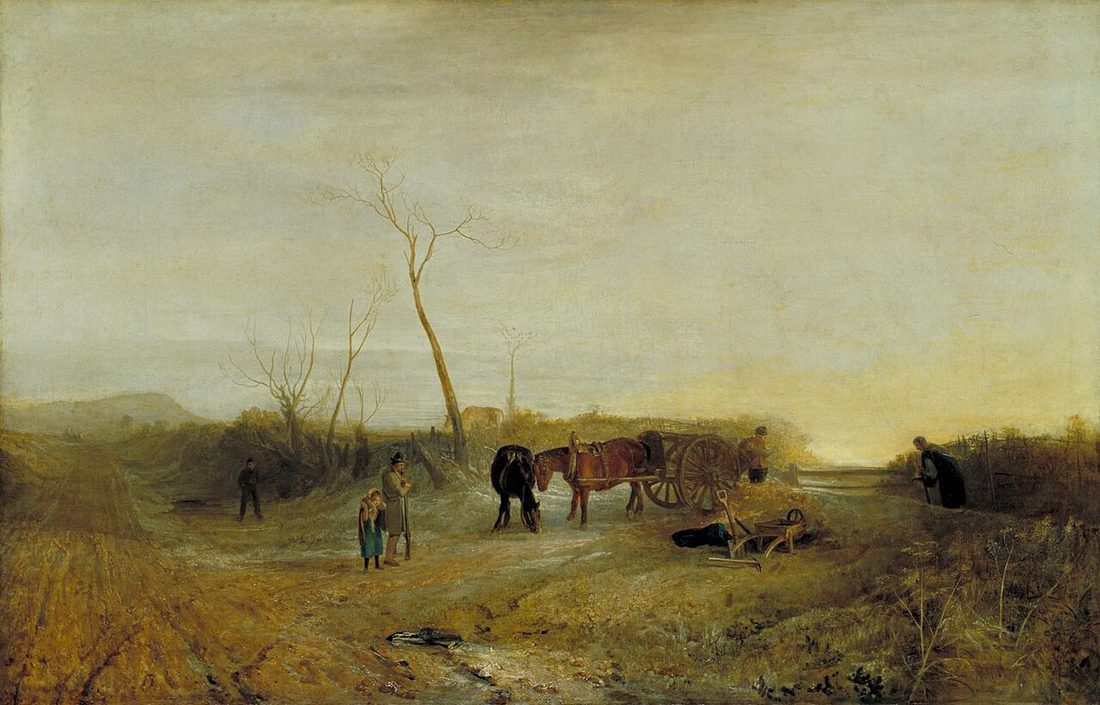

What is in the picture
A rutted road runs back into a flat English landscape under a low winter sun. A man with a gun stands beside a girl in a shawl, two labourers dig at a ditch, and a horse waits in front of a cart. A stagecoach is just visible far off on the right, and frost lies white in the furrows.
| Artist | Joseph Mallord William Turner (1775–1851) |
|---|---|
| Date | 1813 |
| Exhibited | Royal Academy, 1813 |
| Medium | Oil paint on canvas |
| Dimensions | support: 1137 x 1746 mm |
| Collection | Tate, London |
| Accession number | N00492 |
| Credit line | Accepted by the nation as part of the Turner Bequest 1856 |
Nothing happens in the picture and nothing is about to. There is no storm, no wreck, no burning building and no classical pretext of any kind, and the light is thin and colourless instead of spectacular. For a painter whose reputation rests on catastrophe and glare, this is a deliberate exercise in the ordinary.
Why it matters
It is the painting most often produced to argue that Turner could do what Constable did, and do it first. The observation of cold, damp English weather is exact, the figures are unidealised, and the whole thing is built from a kind of attention to the unremarkable that Turner is not usually credited with.
The comparison is not quite fair to either man, since Constable made the cultivated working landscape his life's subject while Turner treated this as one experiment among a great many. The picture does demonstrate, though, that his later dissolution of form was a deliberate choice instead of the only thing he was capable of.
The horse and the girl
Two details are traditionally attached to the painting. The horse is said to have been Turner's own, a creature he used for travelling and drew repeatedly, and the girl in the shawl has been identified as his daughter Evelina, though the identification is traditional rather than documented and has been questioned.
Turner had two daughters by Sarah Danby, and he acknowledged them in his will while keeping them almost entirely out of his public life. Given how private he was, a portrait of one of them standing in an English field would be a rare thing, which is part of why the identification has stuck.
The frost itself
The technical achievement is the frost. Turner renders it as a dry, scumbled white dragged thinly over a warmer ground, so the furrows read as rimed instead of snow-covered, and the difference between the two is exactly the sort of distinction he spent sketchbook pages working out on the spot.
He kept it
The canvas stayed with Turner and came to the nation in the Bequest. It belongs to the small group he would not sell, alongside The Fighting Temeraire, and that grouping is itself informative: the pictures he held back are not all spectacular, and this one is the quietest thing in the set.
Exhibited beside a Wilkie
At the Academy in 1813 the picture hung near work by David Wilkie, then the most fashionable painter of rural incident in Britain. Turner's canvas offers no incident at all, which reads less like a failure of invention than a quiet argument about what a landscape actually needs to contain.
Where to see it
Frosty Morning belongs to the Turner Bequest and hangs at Tate Britain. It rewards being seen next to one of the late Venetian or storm canvases in the same collection, because the distance between the two manners is the clearest single demonstration of what Turner did to his own painting across thirty years.
Questions
Is the girl in Frosty Morning Turner's daughter?
She has traditionally been identified as Evelina, one of his two daughters by Sarah Danby, but the identification is not documented and has been questioned. Turner acknowledged both daughters in his will while keeping them almost entirely out of his public life, which is part of why the story has held on.
Why is Frosty Morning compared to Constable?
Because the observation of cold, damp English weather is exact, the figures are unidealised, and the subject is deliberately unremarkable — all things Constable is usually credited with and not Turner. The comparison is imperfect, since Constable made the working countryside his life's subject and Turner treated this as one experiment.