Oil on canvas · c. 1845 · Tate
Norham Castle, Sunrise: Turner's Unfinished Late Oil of an Old Subject
Turner first drew Norham in 1797 and was still returning to it in the 1840s. This version was never exhibited, never finished, and is now among his most admired paintings.
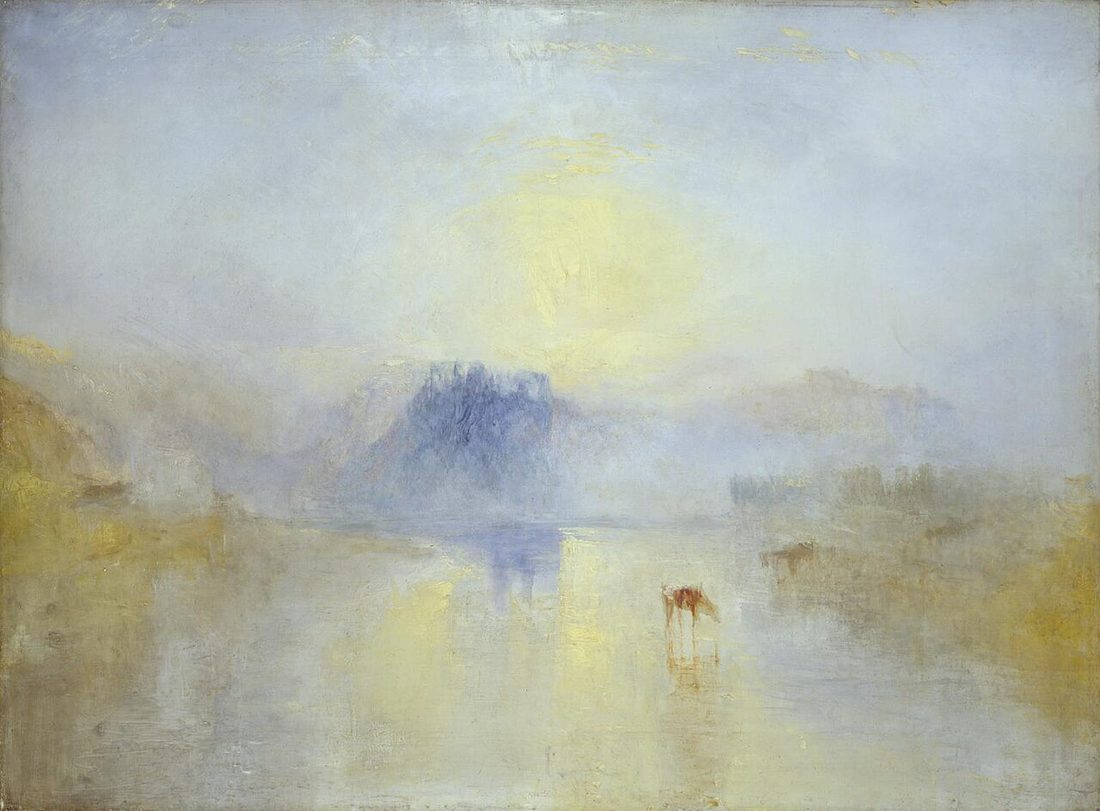

What survives on the canvas
A castle keep stands as a pale blue mass on the left, barely more than a wedge of tone. A cow drinks in the river in the foreground, and the sun sits in the middle distance as a concentrated yellow with no drawn edge at all. Everything else is thin washes of blue, cream and rose.
| Artist | Joseph Mallord William Turner (1775–1851) |
|---|---|
| Date | 1845 |
| Medium | Oil paint on canvas |
| Dimensions | support: 908 x 1219 mm frame: 1060 x 1370 x 70 mm |
| Collection | Tate, London |
| Accession number | N01981 |
| Credit line | Accepted by the nation as part of the Turner Bequest 1856 |
There is almost no drawing anywhere in it. Forms are established by where one colour stops and another begins, the canvas weave shows through in places, and the paint is thinned to the consistency of watercolour. Nothing in the picture is described; the whole thing is arrived at through temperature and tone.
Fifty years of one subject
Turner first saw Norham on his 1797 tour of the north and made drawings of it then. A watercolour followed, then an engraving, then further versions across the decades, and he was still working the motif in the 1840s. Few subjects held him as long, and none shows the change in his handling so clearly.
The story is that he raised his hat to the castle when passing it in later life, telling a companion he owed it a good deal, since the engraving after his early view had done much for his reputation. The anecdote comes second hand but is consistent with how carefully he managed his print business.
Unfinished, and not exhibited
The painting was never shown in Turner's lifetime and was found in his studio after his death. Whether he considered it complete is unanswerable. He often took canvases to the Academy in a comparable state and finished them on the varnishing days, so the distinction between unfinished and resolved was elastic in his practice.
What can be said is that he did not exhibit it, and that its present reputation rests on qualities his own audience would not have recognised as finish at all. The painting entered the public collection through the Bequest, along with a large number of similarly unresolved oils from the same studio.
Why it is read as radical
Twentieth-century critics found in pictures like this an anticipation of abstraction, and the canvas is reproduced constantly in support of that argument. Colour is doing the structural work that drawing normally performs, and the subject has become a pretext for an arrangement of light that very nearly stands on its own.
The claim needs a caveat. Turner was not working towards abstraction as a goal, and the picture is a landscape of a specific place he had studied for half a century. What it demonstrates is how far observation can be compressed, not a wish to leave the observed world behind.
Where to see it
The painting is at Tate in London. Several other late unfinished oils from the Bequest are held in the same collection, which makes it possible to see that this canvas is not an isolated experiment but one of a substantial group Turner kept in his studio and never brought to exhibition.
Questions
Is Norham Castle, Sunrise finished?
It was never exhibited and was found in Turner's studio after his death, so the question cannot be settled. He frequently took canvases to the Royal Academy in a comparable state and completed them during the varnishing days, which means the line between unfinished and resolved was genuinely elastic in his working practice.
How often did Turner paint Norham Castle?
He first drew it on his 1797 tour of the north and returned to the motif for the rest of his life, through watercolours, an engraving and several oils, still working on it in the 1840s. Few subjects held his attention as long, and none shows the change in his handling across five decades so plainly.
Does the painting anticipate abstract art?
Twentieth-century critics often argued so, since colour does the structural work that drawing normally performs. The caveat is that Turner was not aiming at abstraction: this is a landscape of a specific place he had studied for fifty years, and it shows how far observation can be compressed rather than abandoned.