Oil on canvas · c. 1800, reworked 1847 · Tate
The Hero of a Hundred Fights: A Foundry Canvas Turner Reworked
A picture begun around 1800 as an industrial interior, left for decades, then exhibited in 1847 with a burst of light dropped into the middle of it.
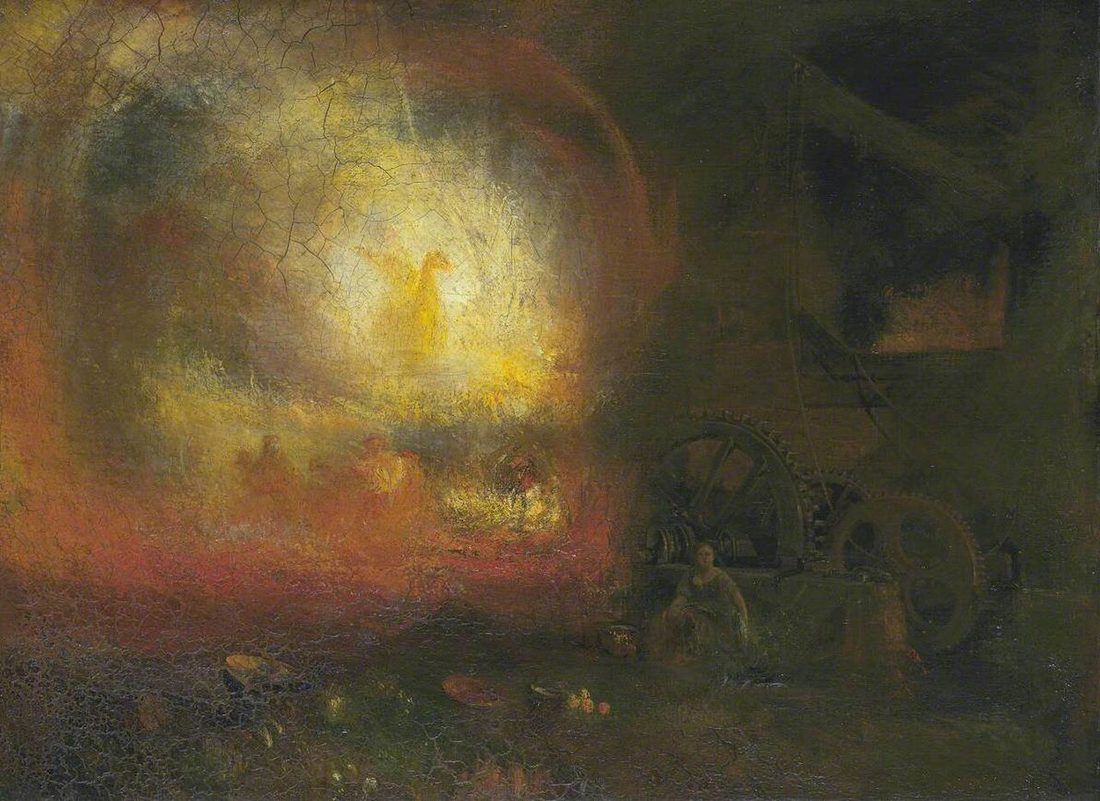
_-_The_Hero_of_a_Hundred_Fights_-_N00551_-_National_Gallery.jpg)
Two paintings in one
The canvas began around 1800 as an interior view of an iron foundry, a dark subject of the kind several British painters were taking up as industry became a legitimate theme. It was never exhibited, and it stayed in Turner's studio for something close to half a century before he picked it up again.
| Artist | Joseph Mallord William Turner (1775–1851) |
|---|---|
| Date | 1800 |
| Exhibited | Royal Academy, 1847 |
| Medium | Oil paint on canvas |
| Dimensions | support: 908 x 1213 mm frame: 1275 x 1585 x 180 mm |
| Collection | Tate, London |
| Accession number | N00551 |
| Credit line | Accepted by the nation as part of the Turner Bequest 1856 |
What he then did to it is unusual even by his standards. He introduced a flood of light at the centre, over and through the existing foundry architecture, and re-titled the picture so that it referred to the casting of an equestrian statue of the Duke of Wellington rather than to industry in general.
The Wellington reference
The title names the hero of a hundred fights, a phrase applied to Wellington, and the picture was exhibited in 1847 when a colossal equestrian statue of him by Matthew Cotes Wyatt was a matter of public argument. The subject therefore became the moment of casting, with the mould opening in the light.
Whether the reference is admiring or sardonic has never been settled. The statue was widely thought ridiculous at the time, the light Turner adds is overwhelming enough to read as bathos quite as easily as glory, and he supplied no verse on this occasion to indicate which way he meant it taken.
Why it looks incoherent
Because it partly is. The foundry architecture belongs to a tonal, descriptive manner of 1800, and the light belongs to the manner of the 1840s, and the two systems do not resolve into one picture. Viewers regularly find it baffling, and the bafflement is a reasonable response instead of a failure of attention.
What makes it valuable is exactly that visible seam. Two phases of Turner's practice, separated by nearly fifty years, sit on one surface where they can be compared directly, which no other canvas in the Bequest offers quite so plainly. It is a diagram of his own development by accident.
Reworking was normal for him
Turner kept old canvases and returned to them, sometimes decades later, and the practice is recorded across the Bequest in pictures with altered titles and reworked passages. He treated a stored canvas as material rather than as a finished object, which is consistent with how he used the varnishing days.
Industry as a subject
The original foundry interior belonged to a genuine trend of the period. British painters were beginning to treat furnaces, forges and mills as legitimate material around 1800, partly because the artificial light inside them offered exactly the tonal drama that a landscape otherwise had to wait for weather to supply.
Where to see it
The painting is at Tate in London as part of the Turner Bequest. It is worth seeking out precisely because it is not a satisfying picture: it shows the mechanics of how he actually worked, and a resolved canvas by definition hides them, so in this case the awkwardness is the information.
Questions
Did Turner often rework old canvases?
Yes, and the practice is recorded across the Bequest in pictures with altered titles and reworked passages. He kept old canvases and returned to them, sometimes decades later, treating a stored painting as material rather than as a finished object, which is consistent with how he used the Academy's varnishing days.
Why does the painting look like two different pictures?
Because in a sense it is. The foundry architecture was painted around 1800 in a tonal, descriptive manner, and the flood of light at the centre was added for the 1847 Academy in the manner of his late work. The two systems do not resolve, and finding it baffling is a reasonable response.
Who is the hero of a hundred fights?
The phrase was applied to the Duke of Wellington. Turner exhibited the reworked canvas in 1847, when Matthew Cotes Wyatt's colossal equestrian statue of Wellington was a matter of public argument, and re-titled the picture so that it referred to the casting of that statue rather than to industry generally.