Oil on canvas · Exhibited 1846 · Tate
The Angel Standing in the Sun: Turner's 1846 Apocalyptic Late Oil
An angel in unbearable light, calling the birds to a feast of kings. Turner was seventy-one, and critics treated the picture as evidence that he had lost control.

The subject
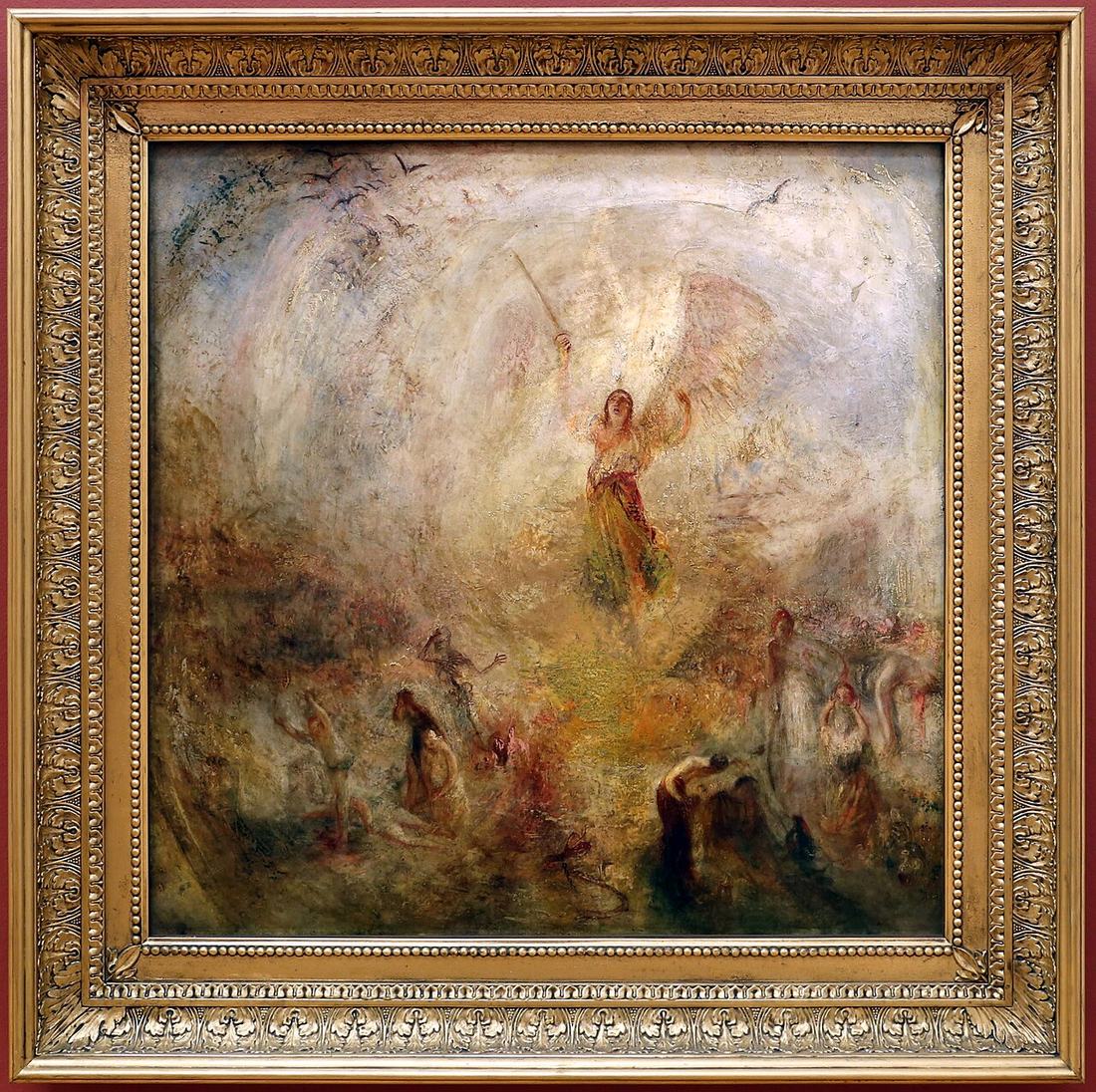
A winged figure stands at the centre of a blaze of yellow and white, arms raised, holding a sword. Around the lower edges of the canvas, half legible in shadow, are biblical figures: Adam and Eve over the body of Abel, Judith with the head of Holofernes, and Delilah. Birds gather at the upper left.
| Artist | Joseph Mallord William Turner (1775–1851) |
|---|---|
| Date | 1846 |
| Exhibited | Royal Academy, 1846 |
| Medium | Oil paint on canvas |
| Dimensions | support: 787 x 787 mm frame: 1035 x 1035 x 120 mm |
| Collection | Tate, London |
| Accession number | N00550 |
| Credit line | Accepted by the nation as part of the Turner Bequest 1856 |
The source is the Book of Revelation, where an angel standing in the sun calls the fowls of the air to gather for the supper of the great God, to eat the flesh of kings and captains. Turner quoted the passage in the catalogue, along with lines from Samuel Rogers on the fall of empires.
Light as the whole picture
The canvas is organised as a single concentric burst, and the figure at its centre is almost consumed by it. There is no horizon, no architecture and no ground plane, so nothing gives the eye a stable reference, and the effect depends on the viewer accepting a picture built out of glare rather than described space.
This is the furthest Turner took a device he had been developing for twenty years. Where the vortex storms of the 1840s wheel around a dark centre, here the centre is the light itself and the darkness has been pushed to the margins, which inverts the structure he normally used for catastrophe.
How it was received
Badly, and by then predictably. The late exhibits of the 1840s drew increasingly hostile notices, and reviewers who had disliked the handling for a decade found an apocalyptic subject painted in pure yellow an easy target. Some of the commentary shaded into suggestions about the painter's eyesight and his mental state.
Those suggestions have not held up at all. The unfinished oils in the Bequest show him working with complete deliberation in exactly the same period, and his sketchbooks from the 1840s record precise and patient observation. What changed was what he was willing to leave out, not his capacity to put it in.
The figures at the edges
The biblical figures round the lower margin are easy to miss and hard to identify without the catalogue. Adam and Eve stand over the body of Abel, Judith holds the head of Holofernes, and Delilah appears with shears. Each is a killing, and Turner arranges them where the light does not reach.
A statement about his own work
The painting is often read as a self-referential one, with the angel in the sun standing for the painter of light and the biblical judgements around the edge as a comment on human history. Turner left nothing to confirm that reading, and it depends on the verse he attached more than on the paint.
The sword
The angel holds a sword, which is not in the Revelation passage Turner quoted. The addition pulls the figure towards the avenging angel of other biblical texts, and it is the one element in the picture that turns a summons into a judgement, which is presumably why he put it there.
Where to see it
The picture came to the nation with the Bequest and is at Tate. It hangs in the same collection as the late unfinished oils, which is the useful comparison: the finished apocalyptic subject and the unexhibited studies were made in the same years by a painter working in full command of both.
Questions
What biblical passage is behind The Angel Standing in the Sun?
The Book of Revelation, where an angel standing in the sun calls the fowls of the air to gather for the supper of the great God and eat the flesh of kings and captains. Turner quoted the passage in the exhibition catalogue, together with lines from Samuel Rogers about the fall of empires.
Did Turner's eyesight fail in his late years?
It was suggested at the time by hostile reviewers, and the claim has not held up. The unfinished oils in the Bequest show him working with complete deliberation through the 1840s, and his sketchbooks from those years record precise observation. What changed was what he chose to leave out of a finished picture.