Reception · 1851 to the present · After Turner
Turner's Legacy: Monet, Pissarro, Signac, Whistler and Rothko
Turner left no school and almost no pupils. What he left instead was a body of work that later painters kept returning to, often for reasons he would not have recognised.
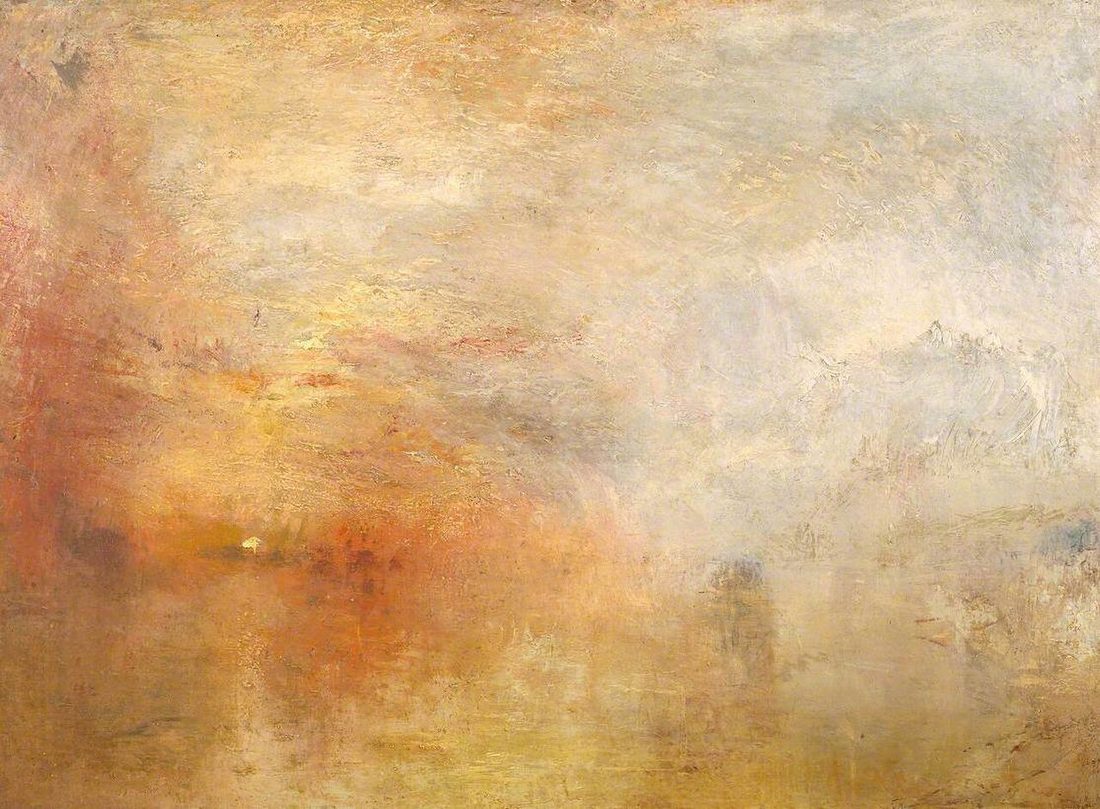
_-_Sun_Setting_over_a_Lake_-_N04665_-_National_Gallery.jpg)
No school, no followers
Turner took no apprentices in any lasting sense and founded no movement. He worked alone, guarded his methods, and in his last years lived under an assumed name in Chelsea. When he died in 1851 there was nobody to carry on a Turner manner, and the painters of the following decades mostly went in other directions.
His influence therefore arrived late and indirectly, through the pictures themselves. The Turner Bequest put hundreds of oils and thousands of works on paper into public hands, and from the 1850s onward anyone in London could study them. The painters who took most from him were visitors who met the work long after the man.
Monet and Pissarro in London
Claude Monet and Camille Pissarro both left France during the Franco-Prussian War and spent the winter of 1870 to 1871 in London. Pissarro later recalled that Monet worked in the parks while he himself studied the effects of fog, snow and springtime. Both men saw the Turners then on view at the National Gallery.
How much the visit changed them is disputed. Writing in 1902 to the English painter Wynford Dewhurst, Pissarro allowed that Turner and Constable had been useful, as all great painters are, but insisted that the basis of their art was French. His list of masters ran from Poussin and Claude to Chardin and Corot.
Monet came back to London repeatedly between 1899 and 1901 and painted long series of Waterloo Bridge, Charing Cross Bridge and the Houses of Parliament in fog. The subject, the river and the dissolving light invite a comparison with Turner that critics made at the time, though Monet himself was sparing in what he said about it.
Signac's colour theory
Paul Signac gave Turner a place in theory. His book D'Eugène Delacroix au néo-impressionnisme, serialised in La Revue blanche and published in 1899, traced a progressive conquest of light and colour from Delacroix to Seurat. In that account the English landscape painters, Constable and Turner, contributed a great deal to the liberation of colour.
Whistler and Ruskin
The most public quarrel of Turner's legacy was fought over another painter. John Ruskin, whose Modern Painters had made the case for Turner, attacked a Whistler nocturne in 1877. Whistler sued for libel, and in 1878 a jury found in his favour but awarded him a single farthing in damages, leaving both men badly bruised.
The irony was noticed at once. Ruskin had defended Turner against critics who found the late pictures unfinished and incomprehensible, and he then used much the same objection against Whistler. The case showed how far the argument had moved, with the charge once levelled at Turner now made by his own champion against a younger painter.
Rothko and the Tate
The American painter Mark Rothko admired Turner, and in 1966 the Museum of Modern Art in New York showed the late work in the exhibition Turner: Imagination and Reality. Rothko later chose to give a group of his Seagram murals to the Tate Gallery, drawn partly by the prospect of hanging in the same building as Turner.
Nine of the paintings arrived in London on 25 February 1970. On the same day Rothko was found dead in his studio in New York. Tate has since shown the murals at Tate Britain beside the Turner collection, the pairing the painter himself had hoped for when he made the gift to the gallery.
Questions
Did Turner influence the Impressionists?
Monet and Pissarro saw his paintings in London during the winter of 1870 to 1871, and later critics often linked Monet's fogbound Thames series to Turner. Pissarro himself, writing in 1902, called Turner useful but insisted the basis of Impressionism was French, so the influence is real in places and easily overstated.
Why did Mark Rothko give paintings to the Tate?
Rothko admired Turner and gave nine of his Seagram murals to the Tate Gallery, partly because they would hang in the same building as the Turner collection. The paintings arrived in London on 25 February 1970, the day Rothko was found dead in New York, and Tate has since displayed them beside the Turners.
Who carried on Turner's style after his death?
Nobody did in any direct sense. Turner took no lasting pupils and founded no school, and the painters of the following decades mostly worked in other directions. His influence came later and through the pictures themselves, once the Turner Bequest had put his paintings and drawings on public view in London.