Theme · Marine subjects · 1796–1850
Turner's Marine Painting: Sixty Years of Ships, Storms and Water
Turner's first exhibited oil was a night scene of fishing boats. He was still painting the sea fifty years later, and it is the one subject he never stopped returning to.

Why the sea, and for so long
Marine painting was a commercially reliable genre in a maritime nation at war, and Turner entered it early and deliberately with Fishermen at Sea in 1796. But the commercial logic does not explain the persistence: he was still building canvases around water in the late 1840s, long after he could afford to paint whatever he liked.
The subject also happened to suit the problem that interested him most. Water has no fixed form, changes with the light on it, and reflects the sky that is producing the weather, so a painter who wanted to make atmosphere the real subject of a picture had a natural excuse for doing so in a seascape.
The Dutch inheritance
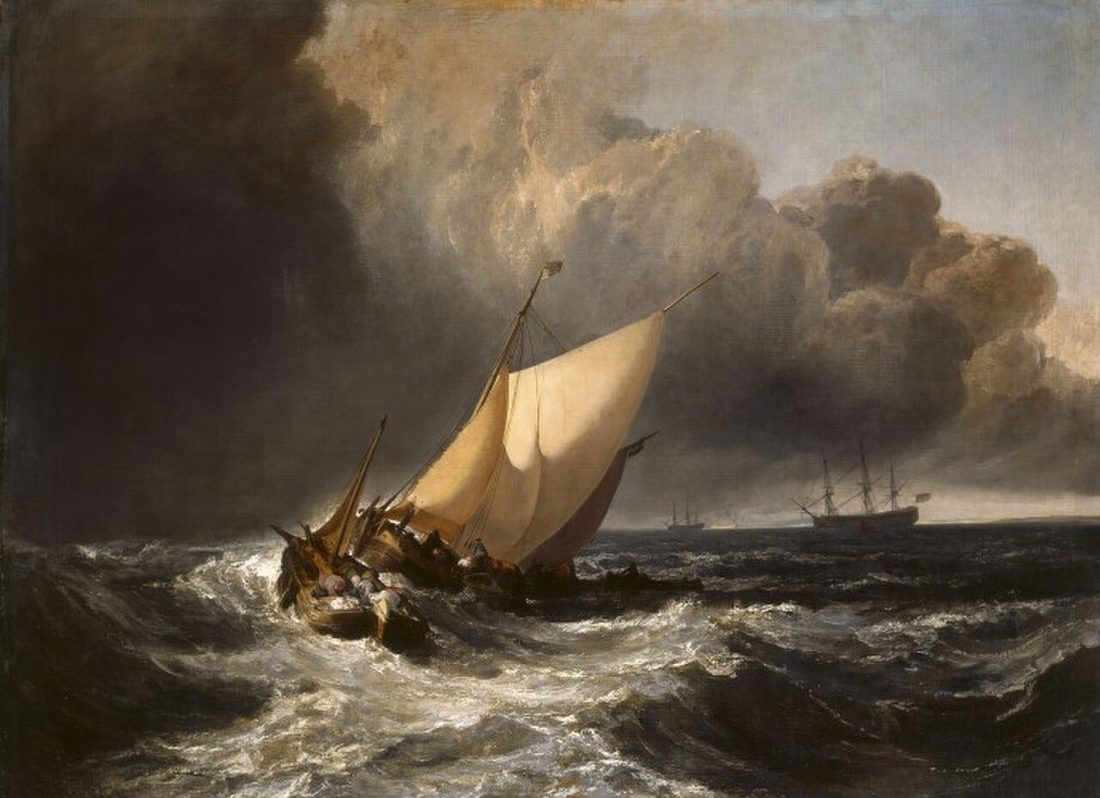
His models were the seventeenth-century Dutch marine painters, above all Willem van de Velde the Younger, whose work was in British collections and widely engraved. From them Turner took the low viewpoint, the careful specification of vessel types, and the convention of measuring a storm by what it does to small working craft.
Calais Pier of 1803 shows the debt most plainly, and he acknowledged it in his titles more than once. What he added was scale of incident: where a Dutch marine keeps the sea legible and the ships intact, Turner increasingly let the water take over the composition and the vessels become things it is happening to.
He knew how ships worked
This matters more than it sounds. Turner drew rigging accurately, distinguished a brig from a barque, and understood what a hull does in a following sea, because he had spent time on the water and filled sketchbooks with vessels at anchor and under way. Contemporary sailors are recorded as finding his ships convincing.
The technical knowledge is what makes the late storms legible. A canvas like the 1842 Snow Storm dissolves nearly everything, and it still reads as a paddle steamer in serious trouble rather than as weather alone, because the few marks Turner leaves are the ones a seaman would need in order to know what he is looking at.
How the handling changed
The trajectory is easy enough to follow across the collection. The Shipwreck of 1805 models every wave and draws every figure in the boats; Snow Storm of 1842 keeps almost nothing at all but the direction of the paint. The subject stayed constant while his willingness to describe it dropped away decade by decade.
Both extremes are built on the same understanding of how water moves, which is the point worth holding on to. The late canvases are not an abandonment of observation but a compression of it, and the compression only works because the observation had been banked over forty years of sketchbooks.
The commercial side
Marine subjects also sold, and engravings after them sold better. The mezzotint after The Shipwreck, published in 1807, was Turner's first real success in reproduction and taught him that prints could carry his compositions far beyond the exhibition rooms, which shaped how he managed his output for the rest of his career.
Questions
Which was Turner's first marine painting?
Fishermen at Sea, exhibited at the Royal Academy in 1796 when he was twenty-one. It was also his first oil painting shown there, since he had previously exhibited only watercolours, so his entry into oil painting and his entry into marine subjects happened in the same canvas and the same year.
Did Turner actually understand ships?
Yes, and it shows. He drew rigging accurately, distinguished vessel types, and understood how a hull behaves in a following sea, having spent real time on the water and filled sketchbooks with ships at anchor and under way. Contemporary sailors are recorded as finding his vessels convincing and not decorative.
Which Dutch painters influenced him?
Principally Willem van de Velde the Younger, whose seventeenth-century marines were in British collections and widely engraved, along with the wider Dutch tradition. Turner took from them the low viewpoint, the accurate specification of vessel types, and the habit of measuring a storm by its effect on small working craft.