Oil on canvas · Exhibited 1805 · Tate
The Shipwreck: Turner's 1805 Painting of a Vessel in Heavy Seas
No named ship, no identifiable coast, no rescue in sight. Turner painted the general case of drowning, and it became one of the most widely reproduced pictures of his career.
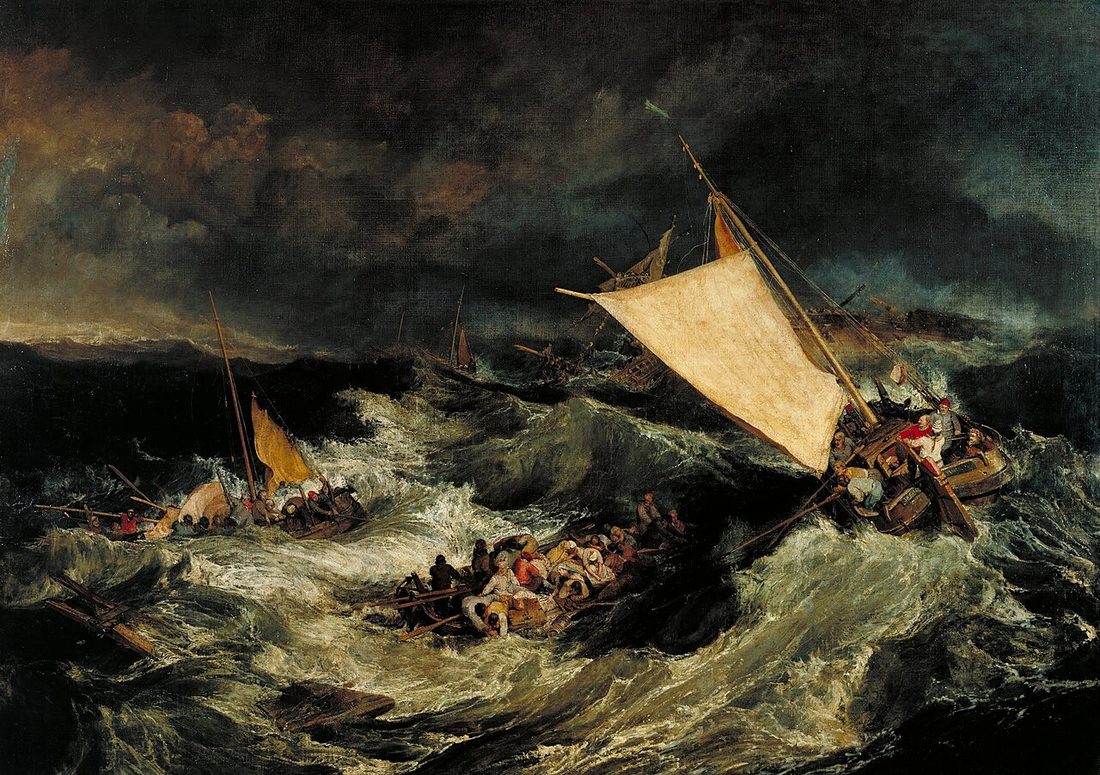

The composition
A ship has broached and is going over on the right, her masts already down at an angle no vessel recovers from. In the centre a fishing boat crammed with figures rides the back of a wave, and a second boat is being swamped in the trough. The horizon is lost entirely in spray.
| Artist | Joseph Mallord William Turner (1775–1851) |
|---|---|
| Date | 1805 |
| Exhibited | Royal Academy, 1805 |
| Medium | Oil paint on canvas |
| Dimensions | support: 1705 x 2416 mm frame: 2085 x 2795 x 235 mm |
| Collection | Tate, London |
| Accession number | N00476 |
| Credit line | Accepted by the nation as part of the Turner Bequest 1856 |
Turner builds the whole thing on interlocking triangles. The wave crests, the leaning masts and the packed bodies in the boats form a sequence of unstable pyramids that keep the eye moving and never settle. The device gives the canvas its sense of continuous motion without any single passage being especially loose.
No named disaster
Unlike most shipwreck paintings of the period, this one records nothing in particular. There is no ship's name, no date, no coast that can be identified and no reference to a reported loss. Turner exhibited it simply as The Shipwreck, which puts it closer to a general statement than to reportage.
That was a deliberate choice, and an unusual one for the moment. Audiences in 1805 were accustomed to marine disaster pictures tied to specific wrecks, often with a printed pamphlet attached for the details. Removing the particulars left viewers with nothing to do but look at the sea, which is exactly where Turner wanted their attention.
The mezzotint
Charles Turner, who was no relation to the painter, engraved the composition as a large mezzotint published in 1807. It sold strongly and went through multiple states, and for most of the nineteenth century that print was how the public knew the image. It was his first real commercial success in reproduction.
That matters for his later practice. The experience taught him that engraving could carry his compositions to an audience far beyond the exhibition rooms, and he spent decades afterwards working closely with engravers, supervising proofs and correcting the plates himself. His reputation on the Continent was built almost entirely on prints instead of paintings.
Sea as subject
Turner had grown up in Covent Garden but knew the Thames and the south coast well, and he had been painting water seriously since Fishermen at Sea in 1796. By 1805 he could construct a convincing sea from memory, which is what this picture required, since nobody sketches a wreck from the middle of it.
The handling is still tight by the standards of his later storms. Individual waves are modelled, spray is described rather than implied, and the figures in the boats are properly drawn. What changed over the following thirty years was not his understanding of water but his willingness to let the paint behave like it.
The figures
Turner is often said to have drawn figures badly, and the criticism was made in his own lifetime. In the boats here they are deliberately generic: packed, straining silhouettes with no individual faces or gestures to fasten on. The picture is about a collective predicament instead of any particular person's death.
Where to see it
The canvas hangs at Tate in London as part of the Bequest. It is worth comparing directly with the 1842 Snow Storm in the same collection, which takes the identical subject of a vessel in trouble and shows how far Turner had travelled with it across nearly four decades of continuous work.
Questions
Which shipwreck does the painting show?
None in particular, which was unusual for the period. There is no ship's name, no date, no identifiable coast and no reference to any reported loss, and Turner exhibited it simply as The Shipwreck. Audiences in 1805 expected marine disaster pictures tied to specific wrecks, so removing the particulars was a deliberate choice.
Why was the painting so well known in the nineteenth century?
Charles Turner, who was no relation, engraved it as a large mezzotint published in 1807. The print sold strongly and went through several states, and for most of the century it was how the public knew the image. It was the painter's first real commercial success in reproduction and shaped his later work with engravers.