Oil on canvas · Exhibited 1835 · The Cleveland Museum of Art
The Burning of the Houses of Lords and Commons: The Cleveland Version
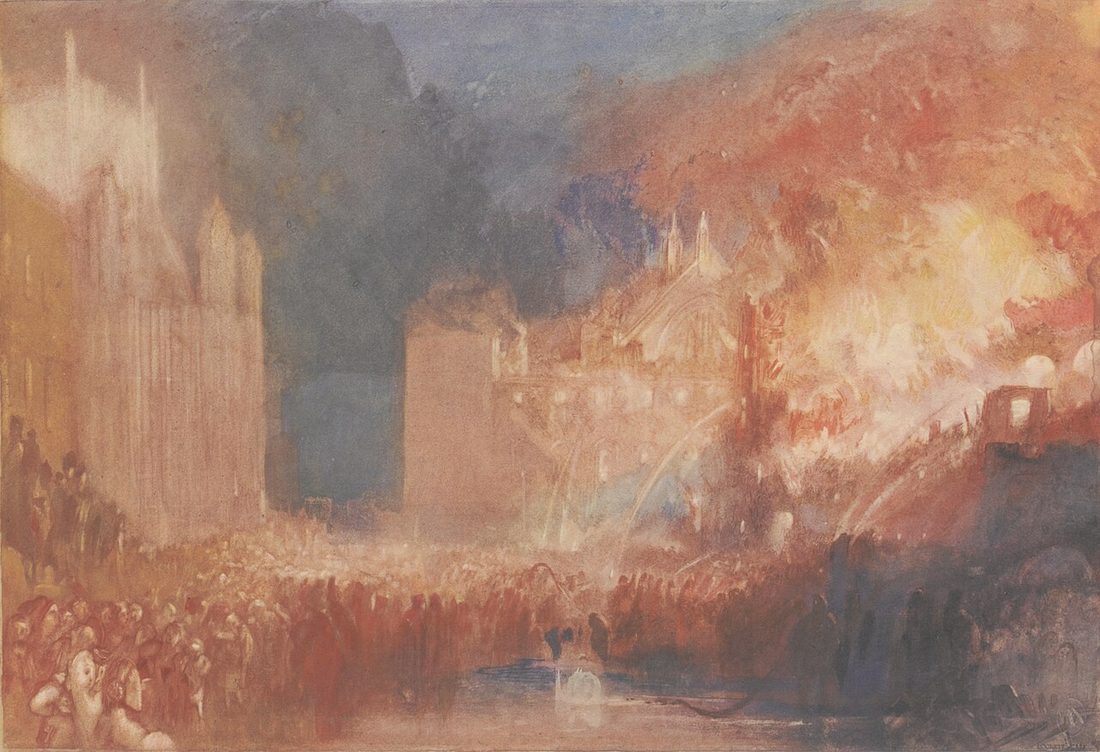
Turner painted the Westminster fire twice for the same season. This is the closer, more frontal version, and it is the one someone watched him finish in public.

How it differs from the Philadelphia canvas
Both pictures take the fire of 16 October 1834 as their subject and both were shown in 1835, but the compositions are not variants of one design. This version moves closer and more square to the blaze, gives the flame a larger share of the canvas, and reduces the crowd to a band along the lower edge.
| Artist | Joseph Mallord William Turner (1775–1851) |
|---|---|
| Date | 1835 |
| Exhibited | Royal Academy, 1835 |
| Medium | Oil paint on canvas |
| Dimensions | 921 x 1232 mm |
| Collection | The Cleveland Museum of Art |
The Philadelphia painting, by contrast, stands further downstream, uses Westminster Bridge as a long architectural diagonal, and puts the packed spectators between the viewer and the event. Between them the two canvases test opposite decisions about how much structure a picture of a fire needs in order to stay legible.
Shown at the British Institution
This version was exhibited at the British Institution in February 1835 rather than at the Royal Academy. The Institution was a separate exhibiting body with its own premises in Pall Mall, and showing there let Turner put a major new picture in front of the public months before the Academy opened in May.
The varnishing day
The painter Edward Villiers Rippingille left an account of watching Turner work on this canvas at the Institution before the exhibition opened, and it is the fullest first-hand description we have of his method in public. He records Turner arriving with the picture barely resolved and finishing it on the wall.
The detail that sticks is the manner of it. Rippingille describes him working with his face close to the surface, using small tools and rolling and dabbing with apparent disregard for the whole, saying almost nothing to the artists gathered round, and then leaving abruptly without looking back at what he had done.
He also records Turner working quickly enough that the transformation was visible over the course of just a few hours. For a painter whose late canvases were routinely dismissed as unfinished, an eyewitness account of the finishing itself is valuable evidence, and it describes deliberate assembly instead of anything like improvisation.
Why the fire suited him
A building burning at night gave Turner everything he had been developing for twenty years in one real event: a single overwhelming light source, dense smoke that obscures form, reflections on water, and a crowd reduced to silhouette. He had painted limekilns and forges for the same reason on a much smaller scale.
What the crowd saw
Contemporary reports describe enormous numbers watching from both banks and from the bridges, with boats hired on the river to get a better view. A national building destroyed in front of a paying audience was a modern subject that needed no classical pretext, which is rare in Turner's exhibited work.
Turner had painted fire before
Limekilns, forges and furnaces appear repeatedly across his earlier work, and they are the technical rehearsal for this canvas. Each gave him a contained, artificial light source burning inside darkness, and the problem of how such a light behaves on smoke and on wet stone is identical whatever its scale.
Where to see it
The painting is in the Cleveland Museum of Art, and its companion is in the Philadelphia Museum of Art. The on-the-spot watercolour sketchbooks Turner filled on the night of the fire remain in the Bequest at Tate, so the raw notes and the two finished canvases are now on different sides of the Atlantic.
Questions
Why did Turner paint the fire twice?
He exhibited two differently composed oils of the subject in 1835, one at the British Institution in February and one at the Royal Academy. They are not variants of a single design: this version is closer and more frontal with less crowd, while the Philadelphia canvas uses Westminster Bridge as a long architectural diagonal.
What happened on the varnishing day?
The painter Edward Villiers Rippingille wrote down what he saw at the British Institution, and it is the fullest first-hand account of Turner's public working method. He describes Turner arriving with the canvas barely resolved, working with his face close to the surface using small tools, saying almost nothing, then leaving abruptly.