Oil on canvas · Exhibited 1835 · Philadelphia Museum of Art
The Burning of the Houses of Lords and Commons: Turner and the Fire
Turner was in the crowd on the night of 16 October 1834, sketching from the south bank and from a boat. He exhibited two different paintings of it the following year.

The night
On 16 October 1834 the old Palace of Westminster caught fire after tally sticks were burned in a furnace beneath the House of Lords. The blaze destroyed most of the medieval complex and drew enormous crowds to both banks of the Thames and onto the bridges. Turner was among them, and he sketched through the night.
| Artist | Joseph Mallord William Turner (1775–1851) |
|---|---|
| Date | 1835 |
| Exhibited | Royal Academy, 1835 |
| Medium | Oil paint on canvas |
| Dimensions | 921 x 1232 mm |
| Collection | Philadelphia Museum of Art |
Two sketchbooks from that evening survive in the Turner Bequest, filled with rapid watercolour notes made on the spot or immediately after. They record the fire from several positions, including from the water, and they are among the most direct evidence we have of how he gathered material for a major painting.
The Philadelphia painting
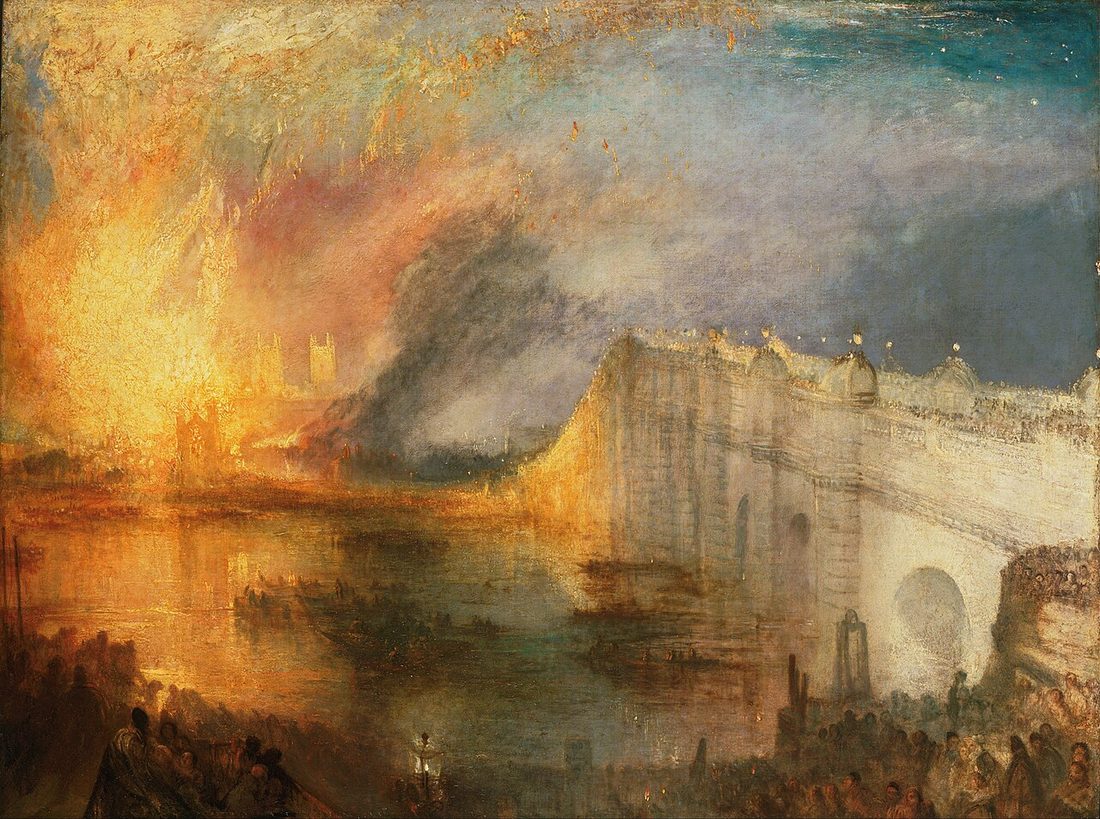
This version takes a position downstream, with Westminster Bridge running back on the right and the fire filling the centre of the canvas. The crowd is packed along the near bank in dark masses, and the reflection carries the flame colour down the full depth of the water towards the viewer.
The construction is essentially theatrical. Turner puts the spectators between us and the event so that we watch the fire over their heads, which is how nearly everyone present actually saw it. The bridge gives him a hard architectural diagonal to set against the formlessness of the flame and smoke above it.
Two paintings, not one
Turner exhibited a second, differently composed version of the same subject in 1835, now in Cleveland. That canvas takes a closer and more frontal view, with the fire higher in the frame and less of the crowd. Painting one subject twice for the same season was unusual even for him.
The pair suggests he thought the event worth more than a single attempt, which is not surprising. A national building destroyed by fire in front of a vast audience was exactly the kind of modern subject that could carry the weight of a history painting without needing a classical pretext to justify it.
A contemporary subject
The fire carried a political charge as well. The Palace had housed Parliament right through the Reform crisis, and the building that burned was the one associated with the unreformed system that the 1832 Act swept away. Turner does not editorialise anywhere on the canvas, because his audience brought the meaning with them.
From sketchbook to canvas
The relationship between the notes and the finished oils is not one of transcription. The watercolours are concerned with the shape and colour of the fire itself, worked at speed with very little drawing, while the paintings add the architecture, the bridge and the crowd that give the event a setting and a scale.
That gap is characteristic of how Turner worked throughout his career. He gathered raw optical information on the spot and then constructed the picture later in the studio, which is why the accusation that his late canvases were careless misreads the method. The looseness was arrived at deliberately, after the observation was banked.
Where to see them
The version described here is in the Philadelphia Museum of Art, and the second is in the Cleveland Museum of Art. The on-the-spot watercolour sketchbooks remain in the Turner Bequest at Tate in London, so the finished paintings and the raw notes are now on opposite sides of the Atlantic.
Questions
Did Turner see the fire himself?
Yes. He was among the crowds watching the Palace of Westminster burn on the night of 16 October 1834 and sketched from the south bank and from a boat on the river. Two sketchbooks of rapid watercolour notes made that night survive in the Turner Bequest and are held at Tate in London.
Why are there two versions of the painting?
Turner exhibited two differently composed oils of the subject in 1835, one now in Philadelphia and one in Cleveland. The second takes a closer, more frontal view with less of the crowd. Painting a single subject twice for the same season was unusual even for him and suggests he thought the event merited more than one attempt.