Oil on canvas · c. 1827 · Tate
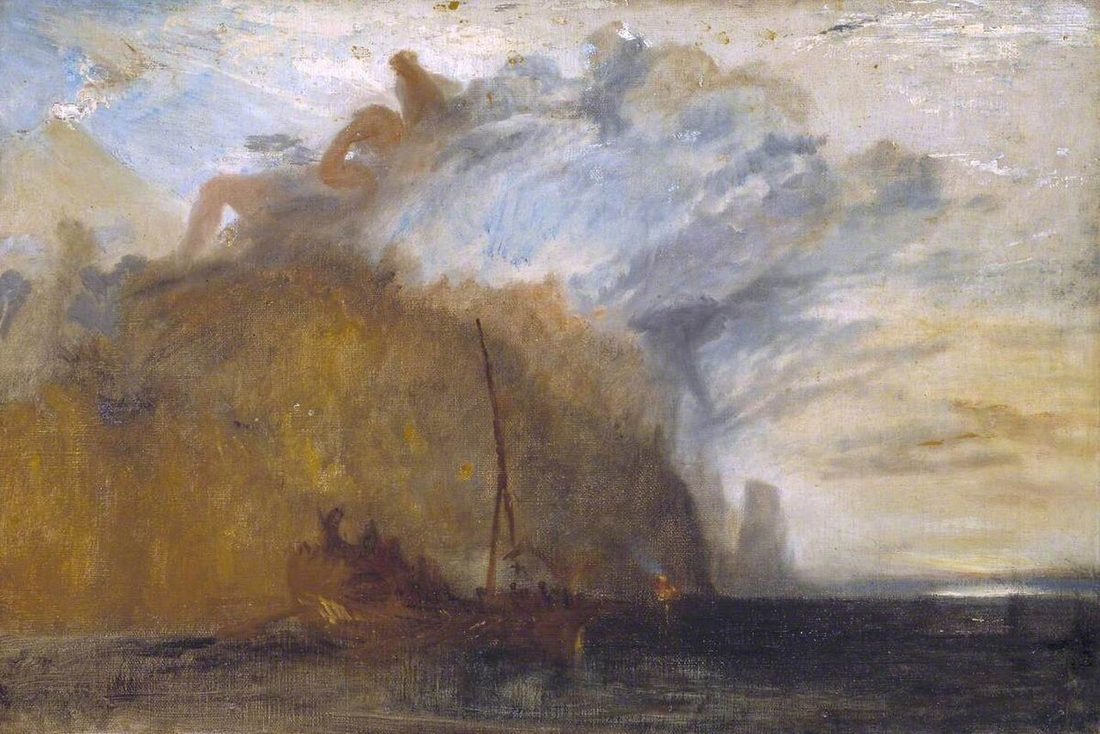
Sketch for Ulysses Deriding Polyphemus: An Oil Study for the 1829 Work
A rapid oil laying in the light and the mass of the Polyphemus composition, without the ship, the giant or the horses of the sun.
_-_Sketch_for_%27Ulysses_Deriding_Polyphemus%27_-_N02958_-_National_Gallery.jpg)
The record
An oil sketch in the Turner Bequest, dated to around 1827 and connected by later cataloguers to the large canvas Turner exhibited at the Royal Academy in 1829. It was never exhibited and never sold, and it carries no title of Turner's own at all; the name it goes by is a subsequent identification.
| Artist | Joseph Mallord William Turner (1775–1851) |
|---|---|
| Date | 1827 |
| Medium | Oil paint on canvas |
| Dimensions | support: 600 x 892 mm frame: 883 x 1170 x 118 mm |
| Collection | Tate, London |
| Accession number | N02958 |
| Credit line | Accepted by the nation as part of the Turner Bequest 1856 |
What it contains
The distribution of light and the principal masses, and very little else. There is no rigging, no figure group and none of the detail that makes the finished picture legible as a scene from the Odyssey, so the sheet functions as a decision about the structure rather than about the subject.
Questions
Why are there so many unfinished oils in the Bequest?
Because Turner kept whatever he did not sell and never once cleared out his studio. The Bequest therefore preserves canvases at every stage of completion, including a good many he had probably abandoned, and that body of unresolved work is now among the most closely studied parts of his entire output.
Is this definitely a study for the 1829 painting?
The connection is a cataloguer's identification based on the composition and an approximate date of 1827, not something Turner recorded. He left thousands of untitled works, and attributions of this kind are inferences, so the sketch is best described as related to the finished picture instead of proven to precede it.