Oil on canvas · c. 1838 · Tate
Steamer and Lightship: The Oil Long Read as a Temeraire Study
A dark steamer, a light on the water, and almost nothing else. It has been read for a century as Turner working out the most famous picture he ever painted.
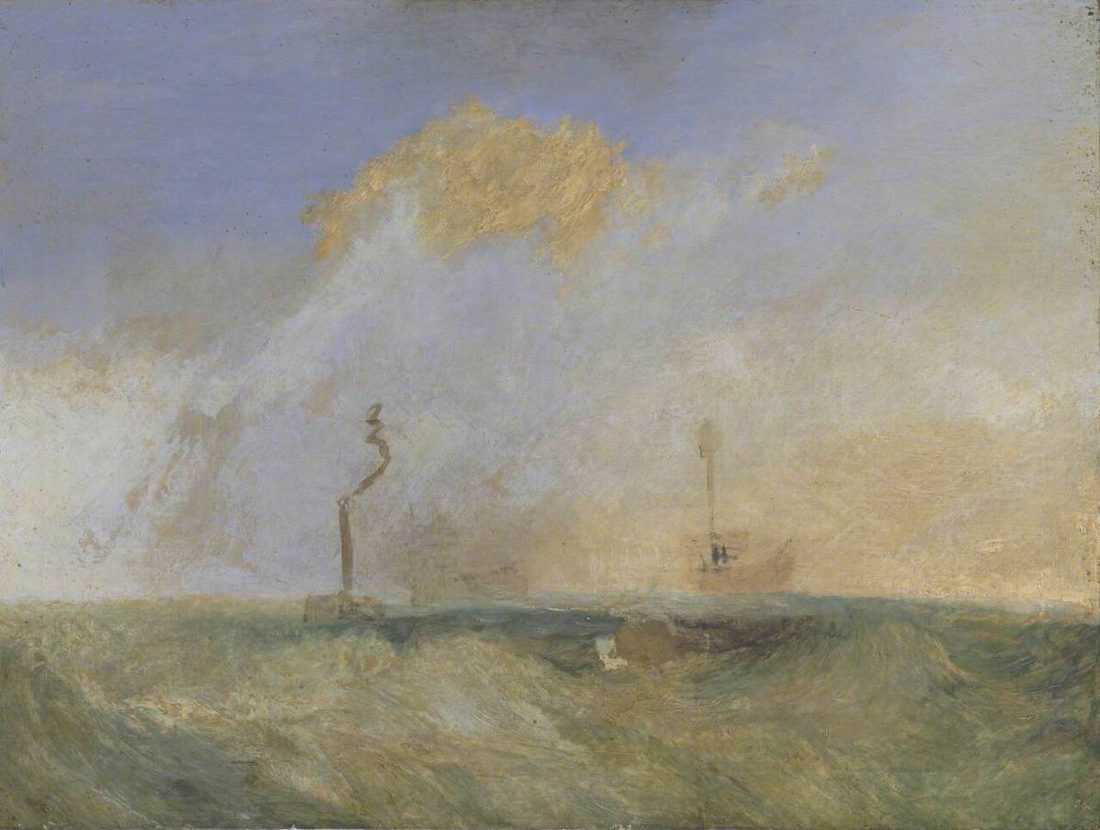
_-_Steamer_and_Lightship,_a_study_for_%27The_Fighting_Temeraire%27_-_N05478_-_National_Gallery.jpg)
What is on the canvas
A steam vessel sits low and dark in the left half of the picture, with a lightship or a bright marker further off and a broad expanse of water and sky taking up everything else. The paint is thin, the horizon is barely established, and no passage in the picture has been brought to a finish.
| Artist | Joseph Mallord William Turner (1775–1851) |
|---|---|
| Date | 1838 |
| Medium | Oil paint on canvas |
| Dimensions | support: 914 x 1197 mm |
| Collection | Tate, London |
| Accession number | N05478 |
| Credit line | Accepted by the nation as part of the Turner Bequest 1856 |
What it has in common with The Fighting Temeraire is a specific pairing: a small dark powered vessel set against open water under a strong light. That is the structural idea of the finished painting, present here without the warship, the sunset or the composition that made the 1839 canvas famous.
Why it is called a study
The attribution rests on that shared idea and on the date, which is placed at around 1838, the year of the Temeraire's actual tow and the year before the finished picture was exhibited. On those grounds it has been catalogued and reproduced as a preparatory work for a great many decades.
The argument against it is that Turner did not generally make oil studies for his exhibition pictures in this particular way at all. His preparation ran through sketchbooks and through watercolour, and the unfinished oils in the Bequest are more often independent canvases he abandoned than rehearsals for specific finished works.
Why the question is hard
Turner left no working notes about individual paintings, so the relationship between any two canvases has to be inferred from the pictures themselves. With an unfinished work there is even less to go on, because the evidence that would settle it is precisely what a study at this stage does not yet contain.
What it shows regardless
Whatever its status may be, the canvas demonstrates how little Turner actually needed in order to establish a marine subject. Two tonal masses and a single light source are sufficient, and the finished Temeraire adds description, narrative and sentiment to a structure that was already complete without any of them.
That is worth seeing next to the finished painting, because the famous canvas is so freighted with meaning by now that its underlying simplicity is very easy to miss. Stripped of the warship and the sunset, what remains is a dark shape, a bright shape, and a great deal of water.
How the Bequest complicates titles
Many canvases in the Bequest were named by later cataloguers rather than by Turner, since he left thousands of works with no titles at all. A descriptive name like this one is a curator's identification, and calling something a study for a famous picture can make an inference look like a fact.
Where to see it
The canvas is at Tate in London as part of the Bequest, while The Fighting Temeraire is over at the National Gallery. The two are a short walk apart, which makes the comparison possible, though it requires two visits instead of one and the study itself is not always on display.
Questions
Who gave the painting its title?
A later cataloguer, almost certainly. Turner left thousands of works with no titles at all, so many names in the Bequest are curators' identifications and not his own. That matters here, because describing a canvas as a study for a famous picture can make an inference look like an established fact.
Is it definitely a study for The Fighting Temeraire?
Not definitely, no. The attribution rests on a shared structural idea and on a date of around 1838, the year before the finished picture was exhibited. Against it is that Turner did not generally make oil studies for exhibition pictures, preparing instead through sketchbooks and watercolour, so the connection remains an inference.
Why can't the question be settled?
Because Turner left no working notes about individual paintings, so the relationship between any two canvases has to be inferred from the pictures themselves. With an unfinished work there is even less to go on, and the decisive evidence — a passage carried over into the finished painting — is what a study this early does not contain.