Watercolour · 1842 · Three collections
The Three Rigis: Turner's Mount Rigi at Dawn, Morning and Dusk, 1842
Three finished watercolours of 1842 show the same mountain across Lake Lucerne at different times of day. Each is named for its dominant tone: dark, blue or red.
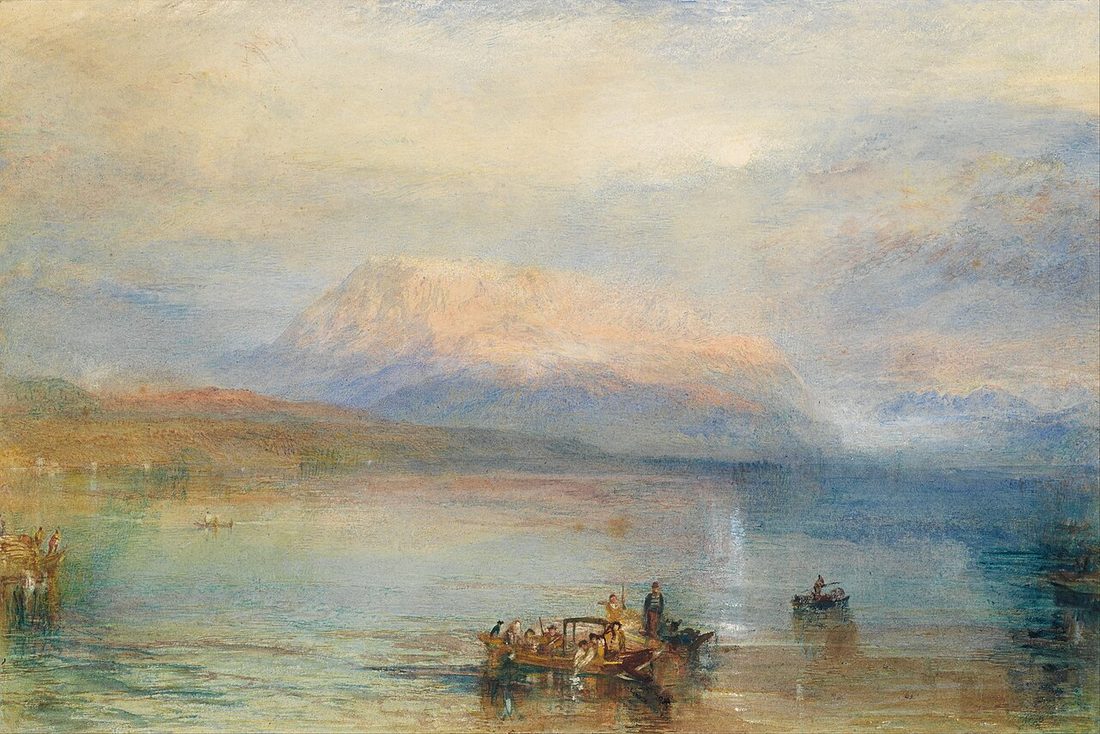

Three views of one mountain
The Rigi rises above Lake Lucerne, and Turner painted it seen across the water from the lake. In the three finished sheets the silhouette barely changes. What changes is the hour. The Dark Rigi is an early morning view, the Blue Rigi catches the moment before sunrise, and the Red Rigi shows the mountain in evening sunlight.
| Artist | Joseph Mallord William Turner (1775–1851) |
|---|---|
| Date | 1842 |
| Medium | Watercolour, wash and gouache with some scratching out |
| Dimensions | 30.5 × 45.8 cm (sheet) |
| Collection | National Gallery of Victoria, Melbourne (Felton Bequest, 1947) |
| Accession number | 1704-4 |
All three are watercolours of 1842 and of almost identical size, roughly thirty by forty-five centimetres. The Red Rigi is catalogued in Melbourne as watercolour, wash and gouache with some scratching out, and the Dark Rigi as watercolour with scraping out, so Turner was lifting colour away from the paper as well as laying it down.
The ten Swiss watercolours of 1842
The Rigis belong to a commercial scheme. In 1842 Turner asked his dealer, Thomas Griffith, to find buyers for ten finished views, most of them Swiss lake and mountain subjects. He showed collectors a few finished specimens and a set of preliminary samples, and worked up further subjects once someone had agreed to buy them.
The buyers were few. Hugh Munro of Novar took three, including the Red and the Dark Rigi. Elhanan Bicknell, who made his fortune in whaling, took two, among them the Blue Rigi. John Ruskin, with his father's money, bought two. The tenth sheet, a view of Lake Constance, found no buyer and went to Griffith.
The sample studies
To show collectors what they would be getting, Turner gave Griffith a sheaf of samples: loose colour studies developed from pencil drawings made on the spot in Switzerland. Sample studies for all three Rigis survive in the Turner Bequest at Tate, dated about 1841 to 1842, each a little smaller than the finished sheet it anticipates.
Comparing a sample with its finished version is the clearest way to see what the commission added. The studies fix the arrangement of mountain, lake and sky in broad washes. The finished sheets keep that arrangement but carry it much further, with boats, reflections and a range of tone that the quick samples never attempt.
The Blue Rigi and the 2007 appeal
The Blue Rigi was sold at auction on 5 June 2006 for 5.8 million pounds. An export stop gave British institutions time to match the price, and after tax remissions Tate needed 4.95 million pounds. The National Heritage Memorial Fund offered up to 1.95 million, the Art Fund 500,000, and Tate's own trustees two million.
The remainder came from a public appeal. Donors could buy a single brushstroke for five pounds, and over five weeks more than 550,000 pounds arrived from around 11,000 people, some of them abroad. Tate announced on 1 March 2007 that the watercolour had been saved, and it entered the collection as T12336.
Where to see them
Tate Britain showed the three together for the first time in The Three Rigis, an exhibition that opened on 22 January 2007. Afterwards they separated again. The Blue Rigi is at Tate, the Red Rigi at the National Gallery of Victoria, Melbourne, and the Dark Rigi in private hands. In 2019 it was placed under a temporary export bar.
Questions
Why are they called the Blue, Dark and Red Rigi?
The names describe the dominant tone of each sheet, which in turn follows the time of day. The Blue Rigi shows the cool light just before sunrise, the Dark Rigi an early morning view, and the Red Rigi the mountain warmed by evening sun. The mountain and the viewpoint across Lake Lucerne stay essentially the same.
Who owns the three Rigi watercolours?
The Blue Rigi belongs to Tate, which bought it in 2007 after a public appeal. The Red Rigi is in the National Gallery of Victoria, Melbourne, acquired through the Felton Bequest in 1947. The Dark Rigi is privately owned, and in 2019 it was described as the only work from the Rigi group outside a public collection.
Can the sample studies be seen?
Yes. The sample studies for the Blue, Red and Dark Rigi are part of the Turner Bequest at Tate and can be viewed by appointment in the Prints and Drawings Room at Tate Britain. They are loose colour studies of about 1841 to 1842, made so that the dealer Thomas Griffith could show collectors the intended subjects.