Theme · Switzerland · 1802 and 1841–1844
Turner in Switzerland: The Alps of 1802 and of the 1840s
Turner saw the Alps twice in his life, forty years apart. The first time he painted threat; the last time he painted distance, haze and calm water.

The 1802 crossing
The Peace of Amiens briefly reopened the Continent in 1802 and Turner went almost at once, at twenty-seven, travelling through France into Switzerland and crossing several of the Alpine passes. He filled sketchbooks rapidly and in difficult conditions, and that material went on to feed exhibited pictures for the next two decades.
What he took from the journey was scale and danger. The Alps gave a British painter something that the Lake District and Snowdonia simply could not: genuinely vertical country, weather that kills, and a documented history of whole armies destroyed by both. The Hannibal picture of 1812 is the most direct result.
What the early Swiss work looks like
Threat organises very nearly all of it. Avalanches bury chalets, passes close in on travellers, and the figures are placed so as to be overwhelmed by what surrounds them. The Devil's Bridge and the Saint Gotthard subjects use a near-vertical format to press the mountains in on both sides of a narrow gorge.
These pictures are the clearest demonstration anywhere in his output of Burke's sublime applied directly. Vastness, obscurity and terror experienced from safety are all present and all quite deliberate, and the fact that he had just stood in the places concerned gave the formula an authority that invention could not.
The return, forty years later
Turner went back to Switzerland repeatedly between 1841 and 1844, by then in his late sixties, staying mainly around Lake Lucerne and Lake Zug. The travel was much easier by that point, the tourist infrastructure existed, and he worked from inns rather than from the road, which changed what he was looking at.
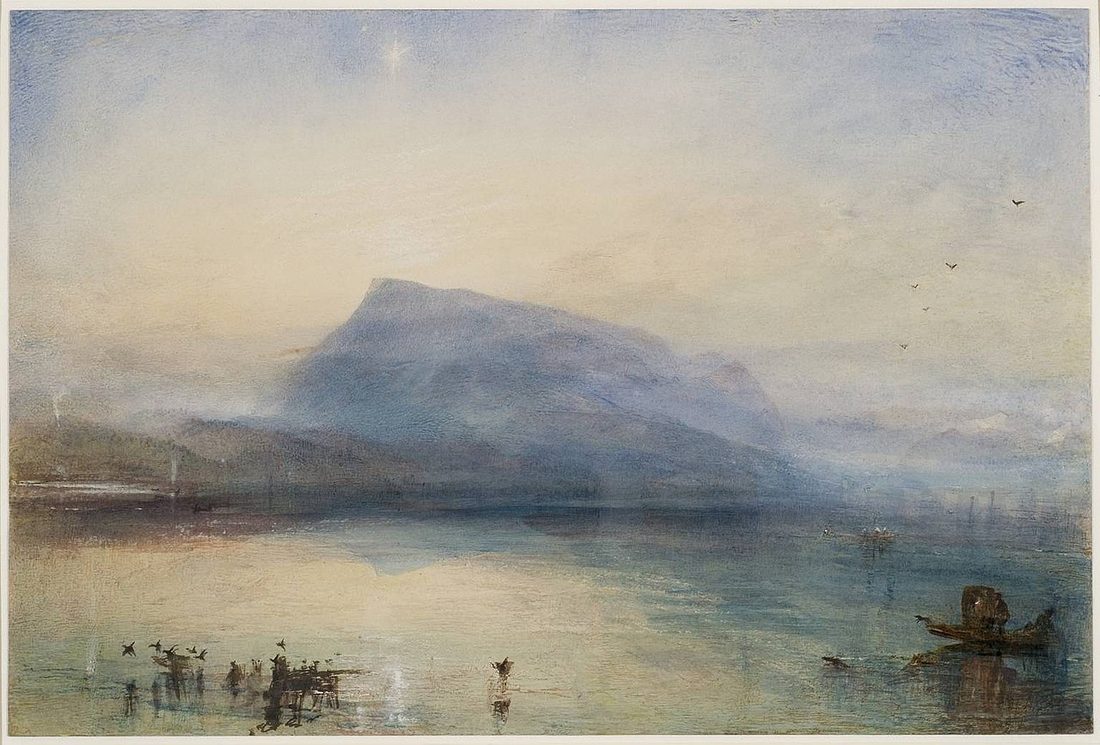
The late Swiss work is almost entirely calm. The Rigi sheets, the Lucerne subjects and the Zug watercolours are concerned with atmosphere over open water, with a mountain reduced to a silhouette at a great distance, and with the particular colour of early morning. Nothing in any of them is threatening anybody.
The sample studies
The late sheets came out of a specific commercial arrangement he had by then settled on. Turner would show a dealer loose studies, and the finished watercolours followed only where a buyer had committed in advance, which is why so many roughs survive alongside comparatively few finished sheets from these particular years.
Why the contrast matters
The two Swiss bodies of work make one point better than any other pairing in his output: what changed across his career was not his subjects but his attitude to them. The same mountains that had been a machine for generating terror in 1802 became, at the end, a way of painting distance and light.
Questions
What did Turner paint on the 1802 journey?
He filled sketchbooks across France and Switzerland and crossed several of the Alpine passes, and that material fed exhibited pictures for two decades afterwards. The results include the Saint Gotthard and Devil's Bridge subjects and, most directly of all, the Hannibal canvas of 1812 with its army destroyed by a storm.
How many times did Turner visit Switzerland?
He first crossed the Alps in 1802, aged twenty-seven, when the Peace of Amiens briefly reopened the Continent, and he then returned repeatedly between 1841 and 1844 in his late sixties. The two bodies of Swiss work are separated by about forty years and are more or less opposite in temper.
Why is the late Swiss work so different?
The early Alpine subjects are organised around threat: avalanches, closing passes and figures placed to be overwhelmed. The late work is calm, concerned with atmosphere over water and mountains reduced to silhouettes at a distance. Travel was easier by the 1840s and he worked from inns rather than from the road.
What are the sample studies?
A commercial arrangement Turner used late in life. He would show a dealer loose studies, and a finished watercolour followed only where a buyer committed in advance. That is why many roughs from the Swiss years survive alongside comparatively few finished sheets, and the roughs are now in the Bequest.