Oil on canvas · c. 1844 · Tate
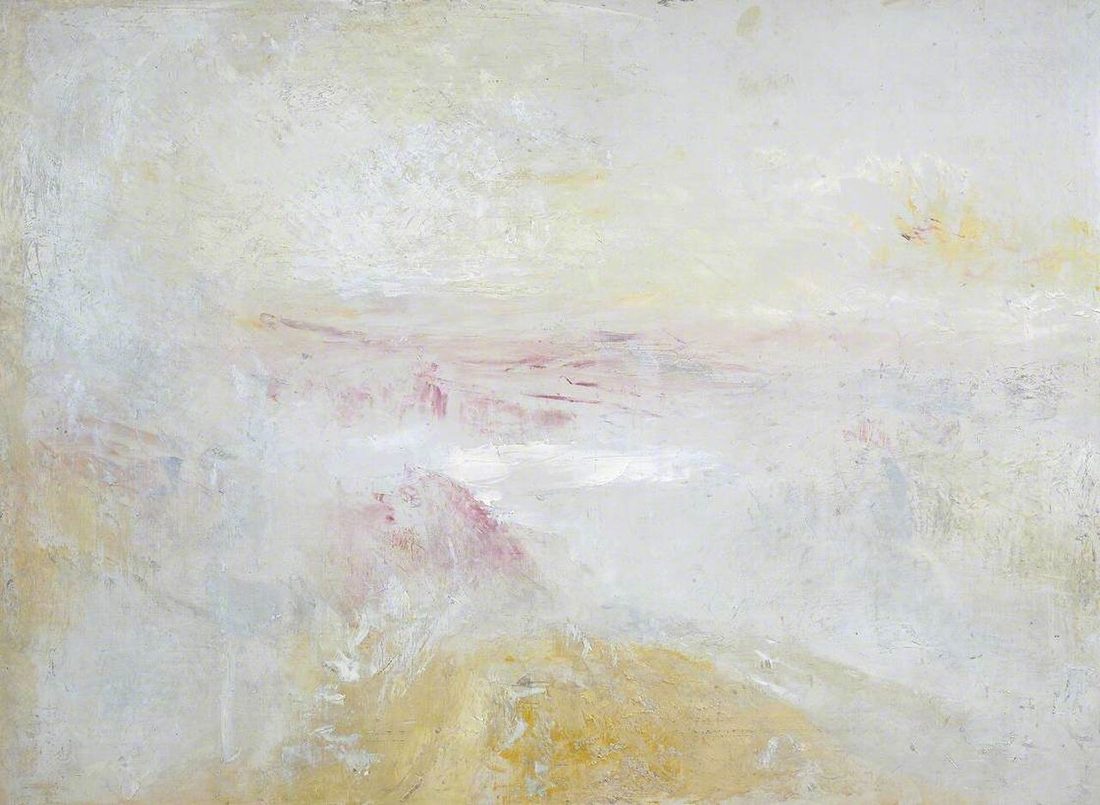
Sunset from the Top of the Rigi: Turner's Unfinished Swiss Oil
The Rigi appears again and again in Turner's last decade, mostly in watercolour. This is the mountain in oil, left unresolved, and never shown in his lifetime.
_-_Sunset_From_the_Top_of_the_Rigi_-_N05486_-_National_Gallery.jpg)
The Rigi
The Rigi is a mountain above Lake Lucerne in central Switzerland, not high by Alpine standards but isolated enough to be seen from a long distance across the water. By the 1840s it was a fixture of the tourist route, with a path to the summit and inns at the top for people who went up to watch the sunrise.
| Artist | Joseph Mallord William Turner (1775–1851) |
|---|---|
| Date | 1844 |
| Medium | Oil paint on canvas |
| Dimensions | support: 711 x 965 mm frame: 836 x 1096 x 57 mm |
| Collection | Tate, London |
| Accession number | N05486 |
| Credit line | Accepted by the nation as part of the Turner Bequest 1856 |
Turner visited Switzerland repeatedly between 1841 and 1844, when he was in his late sixties, and the Rigi became one of his central late subjects. He drew and painted it in different lights and from different distances across those years, treating it much as he had treated Norham Castle for half a century.
The watercolours
The best-known results are the watercolours, and three in particular: the Blue Rigi, the Red Rigi and the Dark Rigi, each taking the same silhouette under different conditions. They were produced through the sample-study system he used late in life, showing a prospective buyer a rough and working the finished sheet to order.
Those sheets are among the most admired works he made, and the Blue Rigi in particular is a fixture of the public collection now. This oil belongs to the same preoccupation but sits apart from it, since he was not making oils of the Rigi for buyers in the way he made the watercolours.
Unfinished, and unexhibited
The canvas was never shown and was found in the studio, which places it with the large group of late unresolved oils in the Bequest. The forms are established almost entirely in colour, the mountain reads as a soft mass instead of a drawn shape, and there is no detail anywhere that asks to be identified.
Why Switzerland late
The Alps had impressed him on his first crossing in 1802, but the late Swiss work is different in temper. The early Alpine subjects are about threat, with avalanches and armies destroyed by weather; the late ones are calm, concerned with distance, haze and the behaviour of light over a large body of water.
That shift tracks the change in his painting more generally. The vortex and the catastrophe belong to the decades from the 1810s through to the 1840s, and running alongside them in the final years is a quieter body of work about atmosphere, of which the Rigi subjects are the clearest and most sustained example.
The sample studies
The system behind the late Swiss watercolours is worth knowing about. Turner would show a dealer or a collector a loose sketch, and a finished sheet followed only if somebody committed to buying it, which meant the roughs survived in quantity and now form a substantial part of the Bequest.
Where to see it
The oil is at Tate in London as part of the Bequest. The Blue Rigi watercolour is also in the public collection, having been bought for the nation in 2007 after a public appeal, so the oil and the most famous of the watercolours can be compared without leaving London.
Questions
Where is the Blue Rigi now?
In the public collection at Tate. It was bought for the nation in 2007 after a public appeal, having been at risk of leaving the country following a sale, so the most famous of the Rigi watercolours and this unfinished oil of the same mountain can both be seen in London.
What is the Rigi?
A mountain above Lake Lucerne in central Switzerland, not high by Alpine standards but isolated enough to be visible from a long way across the water. By the 1840s it was a fixture of the tourist route, with a summit path and inns at the top for visitors who went up to watch the sunrise.
What are the three Rigi watercolours?
The Blue Rigi, the Red Rigi and the Dark Rigi, each taking the same mountain silhouette under different light. They came out of the sample-study system Turner used late in life, showing a prospective buyer a rough sketch and then working the finished sheet to order, and they are among his most admired works.