Watercolour · 1822 · Museum of Fine Arts, Boston
Dover Castle from the Sea: Turner's 1822 Watercolour for Marine Views
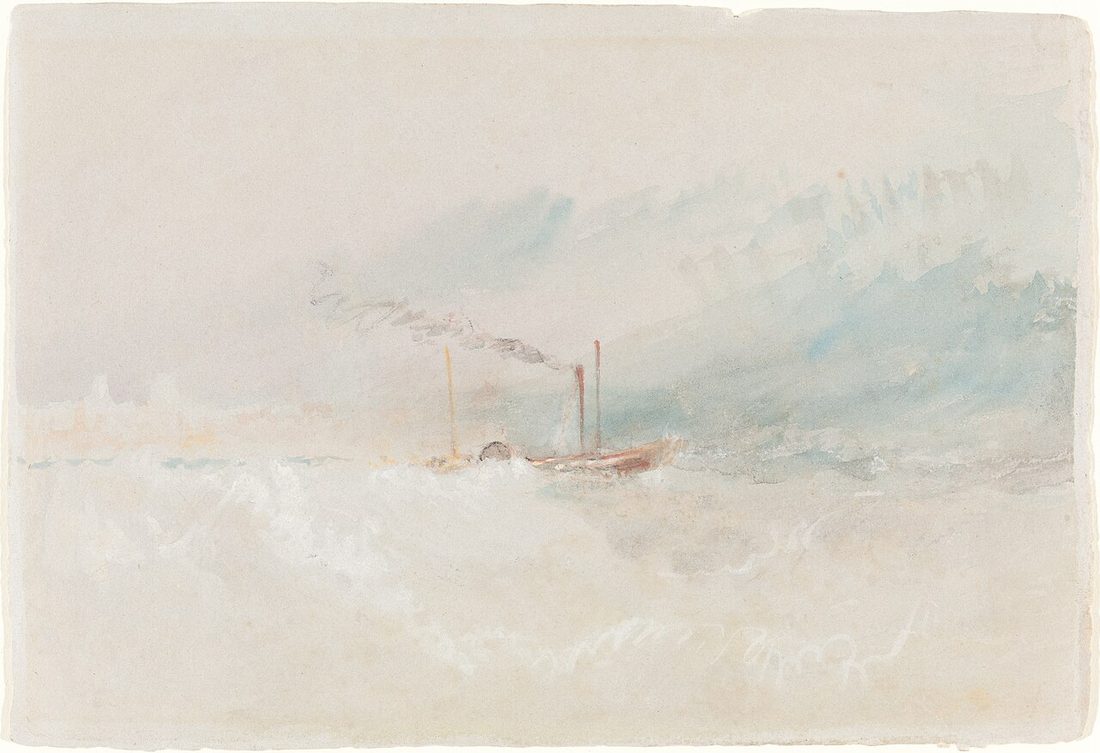
Fishing boats and a smoking steamboat work through a choppy sea below the white cliffs, with the castle lit above them. Turner signed and dated the sheet in 1822, and it has been in Boston since 1923.

The picture
The Museum of Fine Arts, Boston catalogues the work as Dover Castle from the Sea, for Marine Views, and dates it 1822. It is a large sheet for a watercolour, 40.5 by 60 centimetres, worked in transparent and opaque colour on paper, and it is signed and dated J.M.W. Turner 1822 at the lower right.
| Artist | Joseph Mallord William Turner (1775–1851) |
|---|---|
| Date | 1822 |
| Medium | Transparent and opaque watercolour on paper |
| Dimensions | Sheet: 40.5 x 60 cm (15 15/16 x 23 5/8 in.) |
| Collection | Museum of Fine Arts, Boston |
| Accession number | 23.513 |
The view looks in from the Channel towards the harbour piers, with Dover Castle standing above the centre on the crest of the white cliffs. Fishing boats labour in a stiff wind and a broken sea, while a steamboat trailing a long ribbon of smoke makes its way in towards the harbour.
Marine Views
The engraver and publisher W.B. Cooke had worked with Turner for years, most notably on the Picturesque Views on the Southern Coast of England. In the early 1820s a plan for a new series of Marine Views led Turner to make large sea subjects between 1822 and 1824, on a scale to match his earlier Eddystone Lighthouse design.
The project never got far. Only a small number of its subjects were engraved, and relations between Turner and Cooke soured before ending in 1827. Eric Shanes proposed Dover Castle as one of the watercolours associated with the scheme, and Cooke showed it in his London gallery in January 1823, catalogued as drawn in December 1822.
The colour study at Tate
A large preparatory colour study for the design survives in the Turner Bequest at Tate, on Whatman paper watermarked 1822. It is loosely laid in over light pencil, and Thomas Ardill has described its rich blue sky, pale yellow cliffs and boats, and a greenish sea made by toning the blue down with yellow.
Comparing the two shows how the design was tightened. In the study the lugger in the foreground sits roughly in the middle. In the finished watercolour it moves to about a third of the way in from the left, which opens space for a lively group of Channel craft at the right and lets the eye rise to the castle.
Provenance
The museum records the watercolour as lent anonymously to the Cooke exhibition in 1823. By 1857 it belonged to John Stuart Hippisley, who lent it to the Art Treasures exhibition in Manchester that year. It then passed through several London collections and sales, including the Leech sale at Christie's in 1887, where Agnew bought it.
It crossed the Atlantic in the later nineteenth century. Samuel Putnam Avery of New York had it by 1900 and offered it to the Boston museum. It later belonged to Clara Bertram Kimball of Boston, passed to her husband David P. Kimball, and came to the museum in 1923 under his bequest in her memory.
Where to see it
The watercolour is in the Museum of Fine Arts, Boston, accession number 23.513, and the museum currently lists it as not on view. Like most large watercolours it is shown only for limited periods. It travelled to New York in 2017 for the exhibition Turner's Modern and Ancient Ports: Passages Through Time at the Frick Collection.
Questions
Where is Turner's Dover Castle watercolour?
It belongs to the Museum of Fine Arts, Boston, which received it in 1923 as the bequest of David P. Kimball in memory of his wife, Clara Bertram Kimball. The museum's accession number is 23.513, and its online collection record currently describes the sheet as not on view, which is usual for light-sensitive watercolours.
How big is Dover Castle from the Sea?
The museum gives the sheet as 40.5 by 60 centimetres, or 15 15/16 by 23 5/8 inches, and the framed work as 73.3 by 93 centimetres. That is large for a Turner watercolour, and in keeping with the other sea subjects he made on an impressive scale for the Marine Views project between 1822 and 1824.
Was Dover Castle engraved for Marine Views?
Apparently not. Tate's catalogue of the short-lived Marine Views scheme lists only two published subjects, and Dover Castle is not among them. It notes that Eric Shanes proposed Dover Castle as one of the associated watercolours, and that Cooke exhibited it at his gallery in 1823, catalogued as drawn in December 1822.