Influence · Contemporary · 1740–1812
Turner and Philippe Jacques de Loutherbourg: Spectacle and Industry
A painter of theatrical spectacle who staged light as entertainment, and who reached Alpine disaster and industry by night before Turner did.
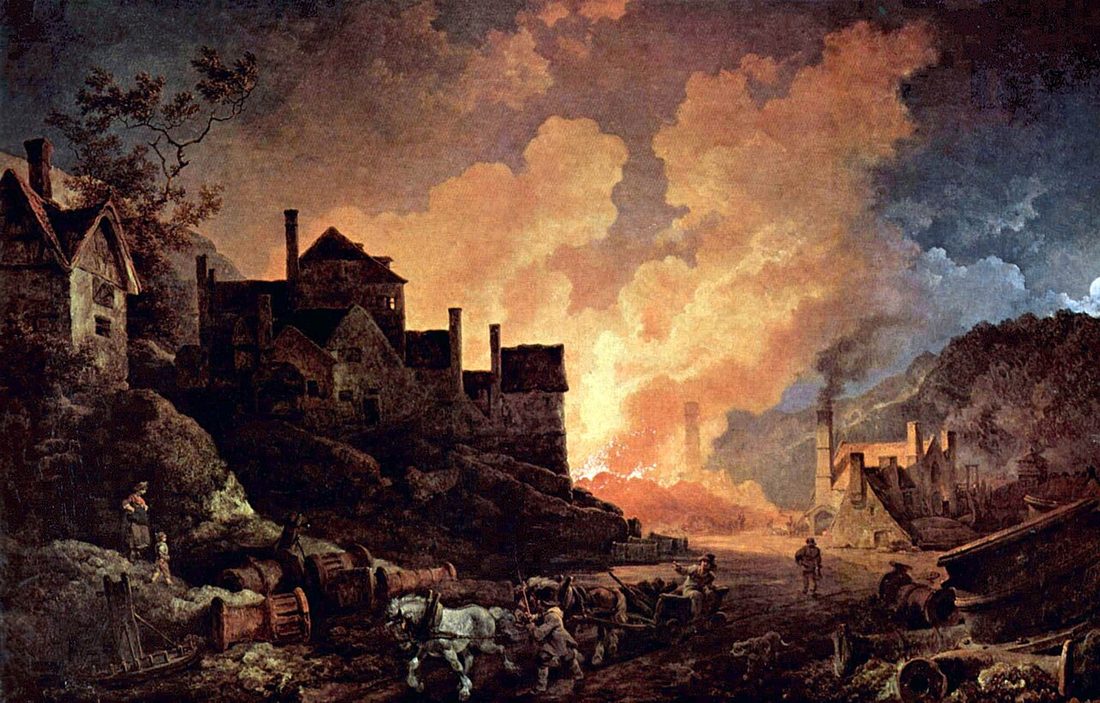

Who he was
Philippe Jacques de Loutherbourg, 1740 to 1812, was born in Strasbourg and later settled in London, where he worked as a scene painter for David Garrick at Drury Lane before being elected to the Royal Academy. Stage design shaped very nearly everything he then went on to do in paint.
The Eidophusikon
From 1781 he ran the Eidophusikon, a small theatre of moving pictures in which lighting effects, coloured glass and sound produced storms, fires and sunrises for a paying audience. Turner is generally thought to have seen it, and it is the clearest precedent for treating light itself as a spectacle.
Coalbrookdale
His Coalbrookdale by Night of 1801 painted industrial furnaces as an infernal light source, and that subject is the direct ancestor of Turner's limekilns, his forges and ultimately the burning of Parliament. The device of a contained artificial fire inside darkness passes straight from the one painter to the other.
Questions
What did Turner take from de Loutherbourg?
The treatment of light itself as pure spectacle. De Loutherbourg staged storms, fires and sunrises as paid entertainment in his Eidophusikon and he painted industrial furnaces as an infernal light source, and both of those ideas run directly on into Turner's limekilns, his forges and eventually the burning of Parliament.
What was the Eidophusikon?
A small theatre of moving pictures that de Loutherbourg ran in London from 1781, using lighting effects, coloured glass and sound to stage storms, fires and sunrises for a paying audience. Turner is generally thought to have seen it, and it is the clearest precedent for treating light as spectacle in its own right.