Oil on canvas · c. 1844–5 · Tate
Heidelberg: Turner's Crowded Late Oil of a Castle Above a River Valley
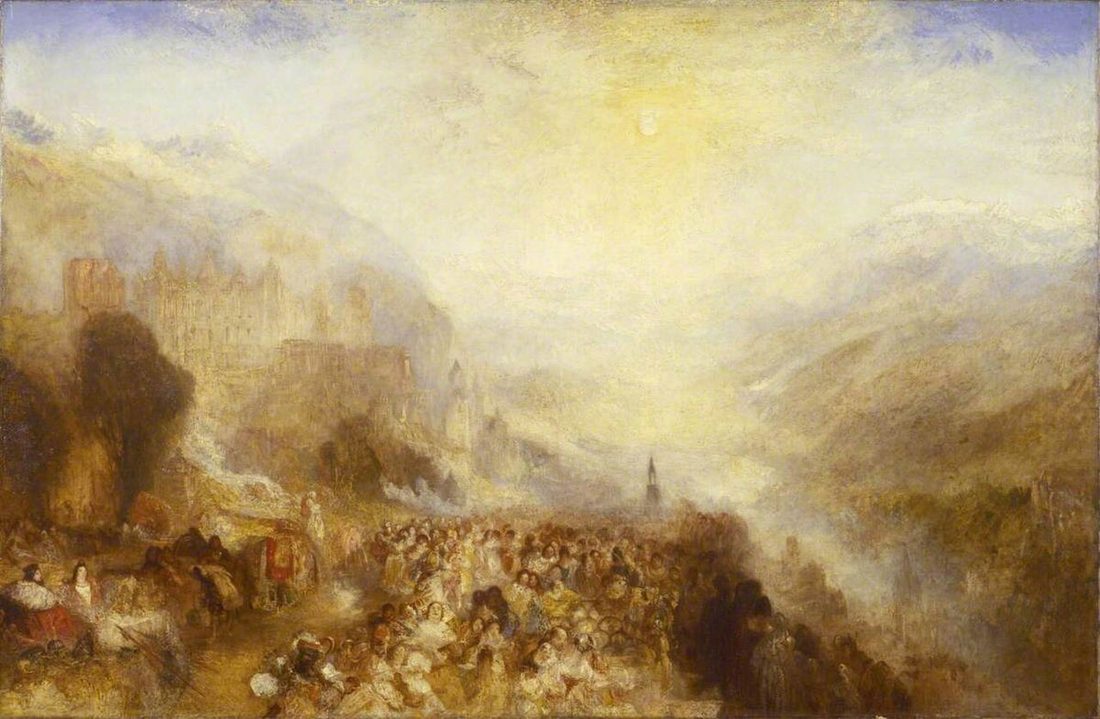
A castle rises above a crowd in historical costume under a hazy sky, painted on a canvas two metres wide. The name Heidelberg is traditional, and Tate now catalogues the picture more cautiously.
_-_Heidelberg_-_N00518_-_National_Gallery.jpg)
The painting
The canvas measures 132.1 by 201.9 centimetres, a large picture two metres wide from the last decade of Turner's working life. Tate dates it to about 1844 to 1845. It came to the nation with the Turner Bequest in 1856, and Turner never exhibited it, so there is no Royal Academy title or catalogue verse to explain it.
| Artist | Joseph Mallord William Turner (1775–1851) |
|---|---|
| Date | 1844 |
| Medium | Oil paint on canvas |
| Dimensions | support: 1321 x 2019 mm |
| Collection | Tate (accepted by the nation as part of the Turner Bequest 1856) |
| Accession number | N00518 |
A great castle occupies the centre, raised above a town and a broad valley, with pale mountains behind. The foreground is crowded with figures in historical costume, gathered near a richly dressed couple at the lower left. The whole scene is washed in warm, hazy light, so that architecture and crowd dissolve into one another at the edges.
A traditional title
The name Heidelberg was attached by others, when the Bequest was catalogued after Turner's death, and there is no record of the painter using it. Tate now lists the work as Castle in an Alpine Valley, called Heidelberg. The change reflects a longstanding problem: the picture shows snow-capped peaks, which Heidelberg lacks, and no obvious sign of the Neckar.
The foreground couple has usually been read as Frederick V, Elector Palatine, and Elizabeth Stuart, daughter of James I, who married in 1613. David Hill, emeritus professor at Leeds, argues that the male figure belongs to an earlier Renaissance type, and links the composition to a sketch and a draft poem of about 1841.
Turner at Heidelberg
Whatever the canvas shows, Turner knew Heidelberg well. He drew the town and castle in 1833, in the Heidelberg up to Salzburg sketchbook, and again in 1841, in the Berne, Heidelberg and Rhine sketchbook. A third visit in 1844 filled pages of further sketchbooks, including the Spires and Heidelberg book and the On the Neckar book.
The 1844 material in the Bequest ranges from pencil notes in small sketchbooks to larger sheets worked with watercolour and pen, showing the castle from the east, the south and the Hirschgasse. Together with the earlier visits they give a detailed record of the town from almost every direction, which makes the topography of the oil all the more puzzling.
The Heidelberg watercolours
The finished watercolours tell the Heidelberg story more directly. Heidelberg with a Rainbow, an afternoon view now in a private collection, was engraved by Thomas Abiel Prior and published in 1846. A second view, Heidelberg, Sunset, with the moon rising, is at Manchester Art Gallery, and a looser third version, probably of about 1846, is in Edinburgh.
Behind them sit colour studies in the Bequest, among them a large study of about 1841 nearly seventy centimetres wide and Heidelberg, Moonlight, a sample study of 1841 to 1842. The term sample study links it to the selling practice Turner used with his dealer Thomas Griffith, offering collectors a subject before working up the finished sheet.
Where to see it
The painting belongs to Tate and is catalogued as N00518. Displays at Tate Britain change, so it is sensible to check the collection page before making a special visit. The 1844 sketches and the colour studies of Heidelberg can be viewed by appointment in the Prints and Drawings Room there.
Questions
Is the painting really of Heidelberg?
It is not certain. The title was given after Turner's death, when the Bequest was catalogued, and Tate now calls the work Castle in an Alpine Valley, called Heidelberg. The snow-capped mountains and the absence of the Neckar do not match the town, although Turner sketched Heidelberg on three separate visits, in 1833, 1841 and 1844.
Who are the figures in the foreground?
They have traditionally been identified as Frederick V, Elector Palatine, and Elizabeth Stuart, the daughter of James I, whose marriage in 1613 brought an English princess to Heidelberg. That reading has been questioned. The historian David Hill has pointed out that the male figure looks like an earlier Renaissance prince, and the subject remains open.
Did Turner paint Heidelberg in watercolour?
Yes, several times. Heidelberg with a Rainbow, in a private collection, was engraved by Thomas Abiel Prior in 1846. Heidelberg, Sunset, with the moon rising, is at Manchester Art Gallery, and another finished view is in Edinburgh. Tate holds the preparatory colour studies and a sample study, Heidelberg, Moonlight, among the sheets of the Turner Bequest.