Oil on canvas · c. 1828 · Tate
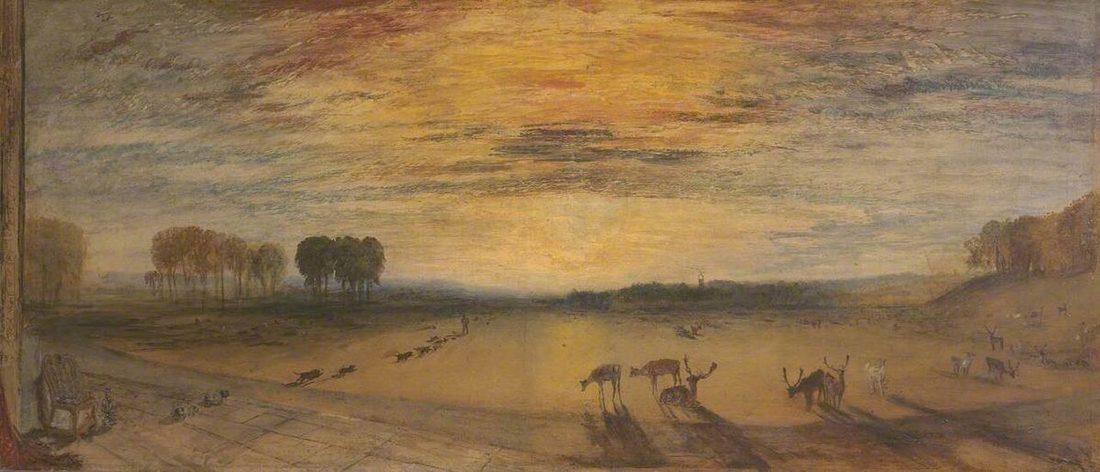
Petworth Park: Tillington Church and Lord Egremont's Dining Room
A very wide, very low landscape made to fit a specific wall in a specific house, with dogs running at the viewer and the sun going down behind a church tower.
_-_Petworth_Park,_Tillington_Church_in_the_Distance_-_N00559_-_National_Gallery.jpg)
A painting shaped by a room
The canvas is much wider than it is tall, which is not a compositional preference but a fitting. Turner produced four landscapes of this unusual shape to sit in the panelling of the Carved Room at Petworth House, above the doors, and the proportions were dictated by the space they had to occupy.
| Artist | Joseph Mallord William Turner (1775–1851) |
|---|---|
| Date | 1828 |
| Medium | Oil paint on canvas |
| Dimensions | support: 600 x 1457 mm frame: 930 x 1707 x 155 mm |
| Collection | Tate, London |
| Accession number | N00559 |
| Credit line | Accepted by the nation as part of the Turner Bequest 1856 |
Working to a fixed shape forced decisions. With almost no vertical room he could not use the framing masses that organise most of his landscapes, so the composition runs sideways instead: a low sun near the centre, ground falling away left and right, and interest distributed along the horizontal rather than stacked in depth.
Lord Egremont
George Wyndham, the third Earl of Egremont, was among the most important patrons of Turner's whole middle career. He bought pictures, commissioned others, and let artists stay at Petworth for extended periods with an informality quite unusual for the period, which clearly suited a painter who disliked being managed by anyone.
Turner worked at Petworth repeatedly through the late 1820s and 1830s, and the body of work he made there is distinctive: loose, light-filled interiors and park views, much of it never exhibited. The house gave him a subject, a studio and an audience of one who did not require him to explain himself.
The park and the sun
The view looks west across the park Capability Brown had laid out, with the tower of Tillington church breaking the skyline near the setting sun. Deer graze in the middle distance, and in the foreground a group of dogs bound towards the viewer, which is the only rapid movement in an otherwise still picture.
Cricketers appear in one of the companion panels, and taken together the four give an unusually relaxed account of an English estate in the late 1820s. There is no weather event, no catastrophe and no classical apparatus anywhere in the set, which makes them an outlier in his exhibited output.
What he made there
The Petworth work divides into what was exhibited and what was not. The park panels were made for the house; the interiors, done rapidly in gouache on blue paper, were private studies of rooms and the people in them, and they were unknown outside the studio until the Bequest opened.
The version at Petworth
A closely related version of this composition remains at Petworth House itself, in the Carved Room, while the canvas described here is at Tate. The relationship between the two has been studied at length, and the short answer is that Turner worked the subject more than once for the same wall.
Where to see it
This painting is at Tate in London as part of the Bequest. Petworth House, now in the care of the National Trust, retains its own Turners in the rooms they were made for, which is a rare thing: the paintings can be seen in the light and the position the painter was working to.
Questions
Are the Petworth panels still at Petworth?
Closely related versions remain in the Carved Room at Petworth House, now in the care of the National Trust, hanging in the positions they were fitted for. The canvases described here are at Tate as part of the Bequest, so Turner worked these subjects more than once for the same wall.
Why is the painting such an unusual shape?
Because it was made to fit a wall. Turner produced four landscapes of this long, low format to sit in the panelling of the Carved Room at Petworth House, above the doors, so the proportions were dictated by the space and not chosen. With almost no vertical room the composition had to run sideways.
Who was Lord Egremont?
George Wyndham, third Earl of Egremont, one of the most important patrons of Turner's middle career. He bought and commissioned paintings and let artists stay at Petworth for long periods with unusual informality, which clearly suited a painter who disliked being managed. Turner worked there repeatedly in the late 1820s and 1830s.