Oil on canvas · c. 1828 · Tate
Chichester Canal: Turner's Quiet Petworth Panel of a Failed Canal
A ship sitting motionless on flat water with the sun directly behind it. Almost nothing is described, and it was painted to hang above a door.
.jpg)
The picture
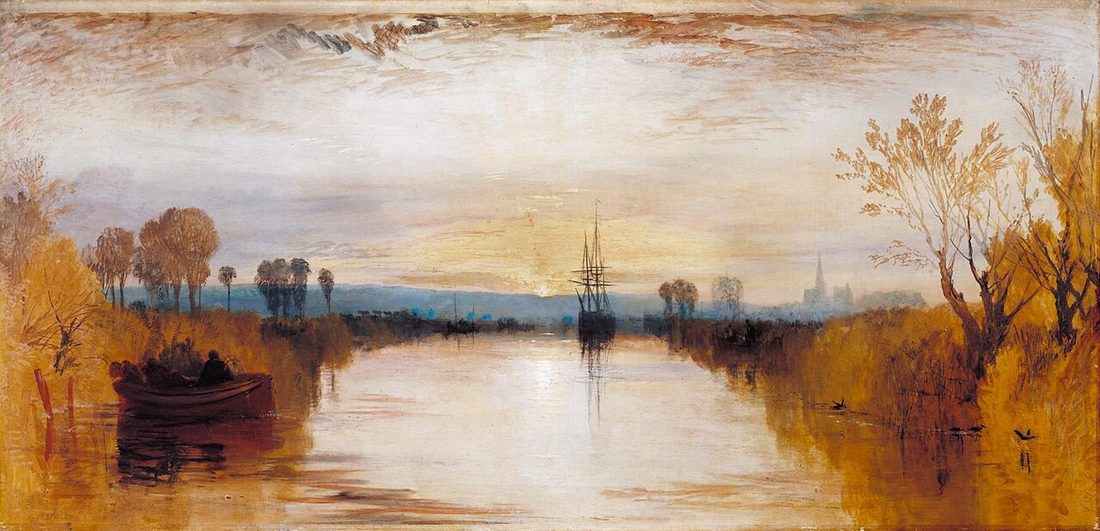
A single vessel with a tall mast sits becalmed on still water, dead centre, with the sun low and directly behind it. The banks are barely indicated, a few cattle and figures occupy the left, and the whole surface is a graded wash of yellow and rose with very little drawing anywhere in it.
| Artist | Joseph Mallord William Turner (1775–1851) |
|---|---|
| Date | 1828 |
| Medium | Oil paint on canvas |
| Dimensions | support: 654 x 1346 mm frame: 932 x 1630 x 155 mm |
| Collection | Tate, London |
| Accession number | N00560 |
| Credit line | Accepted by the nation as part of the Turner Bequest 1856 |
For a picture of around 1828 this is remarkably reduced indeed. The sun is doing all of the structural work, the ship exists mainly as a dark vertical to measure the light against, and the treatment anticipates the late canvases by a decade and a half without being late work itself.
The canal was a real scheme
The Portsmouth and Arundel Canal, which included the Chichester branch, opened in 1823 as part of an inland route intended to let vessels avoid the Channel. Lord Egremont was a major investor. The scheme never carried the traffic its backers hoped for and was a commercial disappointment within a few years.
That context gives the stillness an edge it would not otherwise carry at all. A becalmed ship on an underused waterway, painted for the very man who had put money into the scheme, can be read as tactful or as quietly pointed, and Turner left nothing behind to indicate which he intended.
One of the Petworth panels
Like Petworth Park, this belongs to the group of long low landscapes Turner made for the Carved Room at Petworth House, so the format is a fitting and not a choice. The four subjects together range across the estate and the county, mixing the Earl's park with local industry and topography.
The cattle and the figures
A few animals and one or two people occupy the left bank, painted with a couple of strokes each. They are there to establish that the far side of the water is land instead of sky, which in a picture this flat is a real structural problem, and they solve it with the minimum possible means.
Why it looks so modern
The picture is regularly reproduced in accounts of Turner as a precursor of later painting, and the reason is the sun. Placing the light source at the centre and letting it flatten everything in front of it is a device that gives the canvas almost no depth cues, which reads as radical.
The caution is the same one that applies to Norham Castle. This is a specific waterway near a specific house, made to a commission, at a scale and shape set by a room. The reduction is a response to those constraints and to the low sun, not a programme about the nature of painting.
Where to see it
The canvas is at Tate in London, part of the Turner Bequest. A closely related version hangs at Petworth House itself, where the National Trust keeps the Carved Room panels in place, so both the studio version and the fitted one can be seen, though not in the same building.
Questions
Is the ship in the painting actually on the canal?
The vessel's tall mast has prompted the observation that it looks more like a sea-going ship than canal traffic, and the point has been made in the literature more than once. Turner was capable of drawing either accurately, so the choice reads as a decision about the vertical he needed instead of an error.
Was the Chichester Canal a success?
No. The Portsmouth and Arundel Canal, which included the Chichester branch, opened in 1823 as part of an inland route meant to let vessels avoid the Channel, and Lord Egremont was a major investor. It never carried the traffic its backers had hoped for and was a commercial disappointment within a few years.
Why does the painting look so much like his late work?
Because the sun is placed at the centre and does all the structural work, flattening everything in front of it and leaving almost no depth cues. The effect anticipates the canvases of the 1840s by a decade and a half, but it is a response to a low sun, a fitted shape and a commission.