Watercolour · c. 1813 · Private collection
Turner at Pevensey: The Bay, the Castle and John Fuller's Sussex Views
Turner knew Pevensey from pencil and chalk studies made on the Sussex coast, and from the watercolours he later painted for the landowner John Fuller. The bay, the Roman walls and the castle ruins run through all of it.
The place
Pevensey sits at the western end of a wide bay in East Sussex, with Beachy Head closing the view to the south-west. The castle stands inside the walls of a Roman shore fort known as Anderitum, and the Norman castle was built within that older circuit. By Turner's time the site was a crumbling, partly overgrown ruin beside the marshes.
| Artist | Joseph Mallord William Turner (1775–1851) |
|---|---|
| Date | 1813 |
| Medium | Watercolour over pencil, heightened with bodycolour, with scratching out and stopping out |
| Dimensions | 375 x 563 mm |
| Collection | Private collection |
The sketches in the Turner Bequest
The Tate holds a run of pencil and chalk studies of Pevensey from the Herstmonceux and Pevensey sketchbook, catalogued as c.1806 to 1810. Many of its pages were prepared with a buff wash before he drew. The subjects include the castle walls, the north tower and gatehouse, the village, trees on the marsh and the bay below Galley Hill.
One sheet shows the west wall running from the north tower to the gatehouse, with the moat below and the village of Westham and its church beyond. Other studies look along the coast from Galley Hill towards Pevensey Bay, or record a boat drawn up on the beach. The exact dating of the Sussex visit is still discussed by scholars.
John Fuller of Rosehill
The finished Sussex work came through John Fuller of Rosehill, now Brightling Park, a landowner who was High Sheriff of Sussex for 1796 to 1797 and MP for East Sussex from 1801 to 1812. Around 1810 he commissioned four watercolours and an oil painting of Rosehill Park from Turner, and he then commissioned further local subjects.
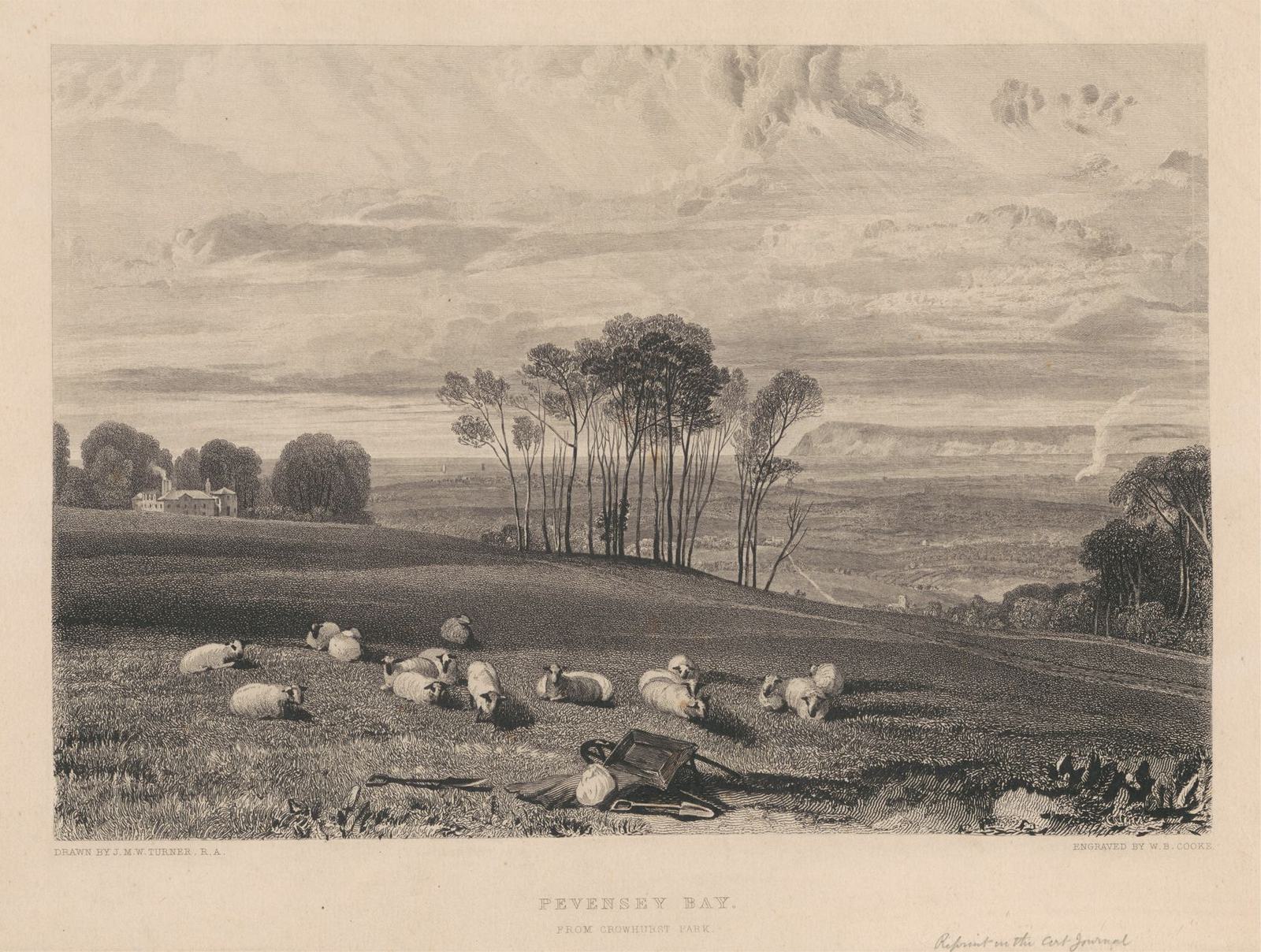
In 1815 Fuller agreed to support engravings of the watercolours by William Bernard Cooke. The plates appeared under the title Views in Sussex, and five were published together in 1820 with letterpress by the painter Ramsay Richard Reinagle. The Tate dates its etching and engraving of the Pevensey Bay plate to 1816, before that issue.
Pevensey Bay from Crowhurst Park
The watercolour Pevensey Bay from Crowhurst Park, dated about 1813, looks across the grounds of Crowhurst Park towards the bay and Beachy Head. It measures 375 by 563 millimetres and is worked in watercolour over pencil, with bodycolour, scratching out and stopping out. Sheep rest in the foreground, and Martello towers stand along the distant shore.
The sheet descended in Fuller's family to Sir Alexander Fuller-Acland-Hood, 1st Baron St Audries, whose Turner watercolours were sold at Christie's on 4 April 1908. It was bought through Agnew's and stayed with one family for more than a century before being offered at Sotheby's in 2018. The Tate's catalogue records it in a private collection.
The castle watercolour
A separate finished watercolour of Pevensey Castle, also in a private collection, is based on a pencil drawing of the ruins now in the Tate. Cooke did not engrave it for Views in Sussex. The scholar Eric Shanes has suggested it might have been the last work Turner made for Fuller, who held the ruins in high regard.
Where to see it
Neither finished Pevensey watercolour is on public display, since both belong to private collections. The Tate's sketches and its impressions of Cooke's engraving can be seen by appointment in the Prints and Drawings Room at Tate Britain in London. The castle itself is a scheduled monument in the care of English Heritage and is open to visitors.
Questions
Did Turner paint Pevensey Castle?
Yes. A finished watercolour of Pevensey Castle, now in a private collection, is based on one of his pencil drawings of the ruins held by the Tate. It was not engraved for Views in Sussex. Turner also made many pencil and chalk studies of the castle walls, towers and gatehouse in a Sussex sketchbook dated to about 1806 to 1810.
Who was John Fuller?
John Fuller of Rosehill, now Brightling Park, was a Sussex landowner, High Sheriff of Sussex for 1796 to 1797 and MP for East Sussex from 1801 to 1812. He commissioned watercolours of local subjects from Turner and supported William Bernard Cooke's engravings of them, which were published as Views in Sussex. He died in 1834.
Where can Turner's Pevensey sketches be seen?
They belong to the Turner Bequest at the Tate, which the nation accepted in 1856. Works on paper that are not on display can be seen by appointment in the Prints and Drawings Room at Tate Britain. The Tate also holds an etching and a line engraving of Pevensey Bay from Crowhurst Park, both dated 1816.