Oil on canvas · Exhibited 1834 · Victoria and Albert Museum
St Michael's Mount, Cornwall: Turner's Oil Shown at the RA in 1834
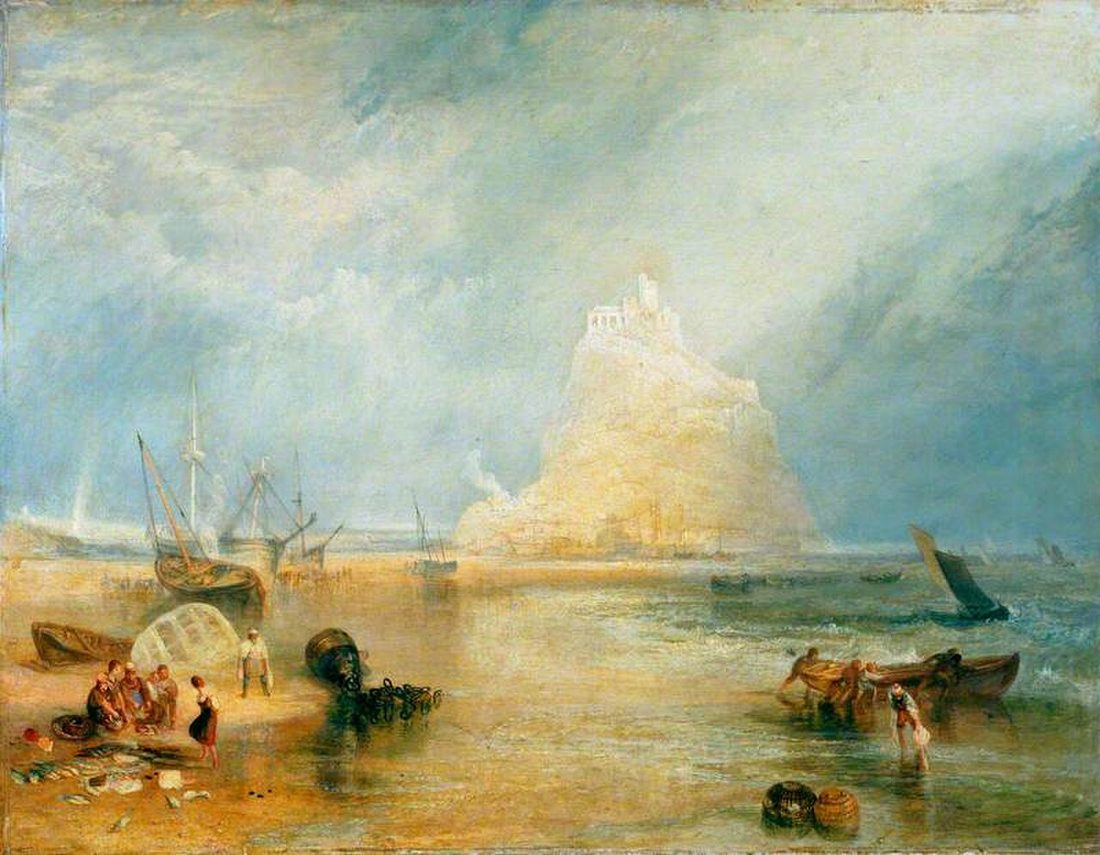
The tide is out, the sands are busy with fishermen, and the Mount rises pale and bright out of a hazy sky. Turner had been drawing this view for more than twenty years.
.jpg)
The painting
The Mount stands in the middle distance, its castle catching the light, while a band of cloud and rain darkens the sky to the right. The tide is out. On the wet sands in the foreground fisherfolk work among beached boats and baskets, and to the right a group of men haul a boat through the shallows.
| Artist | Joseph Mallord William Turner (1775–1851) |
|---|---|
| Date | 1834 |
| Medium | Oil on canvas |
| Dimensions | 61 × 77.4 cm |
| Collection | Victoria and Albert Museum |
| Accession number | FA.209[O] |
The V&A describes the subject as a medieval monastic site on an island whose harbour is joined to the mainland by a causeway at low tide. The canvas is modest in size, 61 by 77.4 centimetres. According to the museum, it repeats the view of a watercolour of about 1812 but makes the Mount noticeably taller.
A subject Turner returned to
Turner drew the Mount on his West Country tour of 1811. The Turner Bequest at Tate holds a long run of pencil sketches from that year, taken from the causeway, from Marazion, from the coast near Longrock and from Gulval, along with pages of historical notes on the Mount in his own hand.
The watercolour of about 1812 was engraved in 1814 for the Picturesque Views on the Southern Coast of England. Two decades later he returned to the subject for an edition of Milton's Poetical Works published in 1835, where the plate, engraved by W. Miller, appears as St Michael's Mount, with the shipwreck of Lycidas.
A further watercolour of about 1836 was made for Picturesque Views in England and Wales and engraved in 1838 as Mount St Michael, Cornwall. The Bequest also contains a large colour study catalogued as St Michael's Mount from near Marazion, dated about 1828, which shows how often the motif stayed in his working stock.
The Academy exhibition of 1834
The oil was shown at the Royal Academy in 1834 as number 317. Reviews were divided in the usual way. Arnold's Magazine counted it among the most conspicuous pictures in the exhibition, while The Spectator, setting Turner beside Augustus Wall Callcott, found his work unsubstantial and visionary where Callcott's was opaque and heavy.
The Morning Post, reviewing it in July 1834, thought it a favourable specimen of the painter but preferred his earlier manner. Twenty years later the German art historian Gustav Waagen, writing in 1854, praised the bold, precipitous rock and the way it is lit, which in his judgement gave the picture a poetical charm.
John Sheepshanks
The painting was bought by the collector John Sheepshanks, who gave it to the museum at South Kensington in 1857 as part of the Sheepshanks Gift. The museum's own record gives the credit line simply as given by John Sheepshanks, 1857, and the picture has remained in the national collection at South Kensington ever since.
Where to see it
The painting is at the Victoria and Albert Museum in London, museum number FA.209[O], credited as given by John Sheepshanks in 1857. The pencil sketches from 1811 and impressions of the Southern Coast and England and Wales engravings are in the Tate collection, which makes a comparison of the different versions straightforward in London.
Questions
Is the Mount painted accurately?
Not literally. The V&A catalogue entry notes that the oil takes the same view as Turner's watercolour of about 1812, engraved for the Southern Coast series, but exaggerates the height of the Mount. The result gives the rock far more presence against the open sky than it has from the shore, and it dominates the whole composition.
When was the painting exhibited and who owned it?
It was shown at the Royal Academy in 1834 as number 317. The collector John Sheepshanks acquired it and gave it to the museum at South Kensington in 1857, and it is now in the Victoria and Albert Museum. Critics in 1834 were divided, some admiring it and others finding it too visionary.
Did Turner make other versions of St Michael's Mount?
Several. There are pencil sketches from 1811, a watercolour of about 1812 engraved in 1814 for the Southern Coast series, an illustration for Milton's Poetical Works published in 1835, and a watercolour of about 1836 engraved in 1838 for the England and Wales series. The oil of 1834 sits in the middle of that sequence.