Oil on canvas · Exhibited 1802 · Tate
The Tenth Plague of Egypt: Turner's 1802 Biblical History Painting
Turner exhibited this the year he became a full Academician at twenty-six. It is a landscape painter making a formal claim on the highest category of picture.
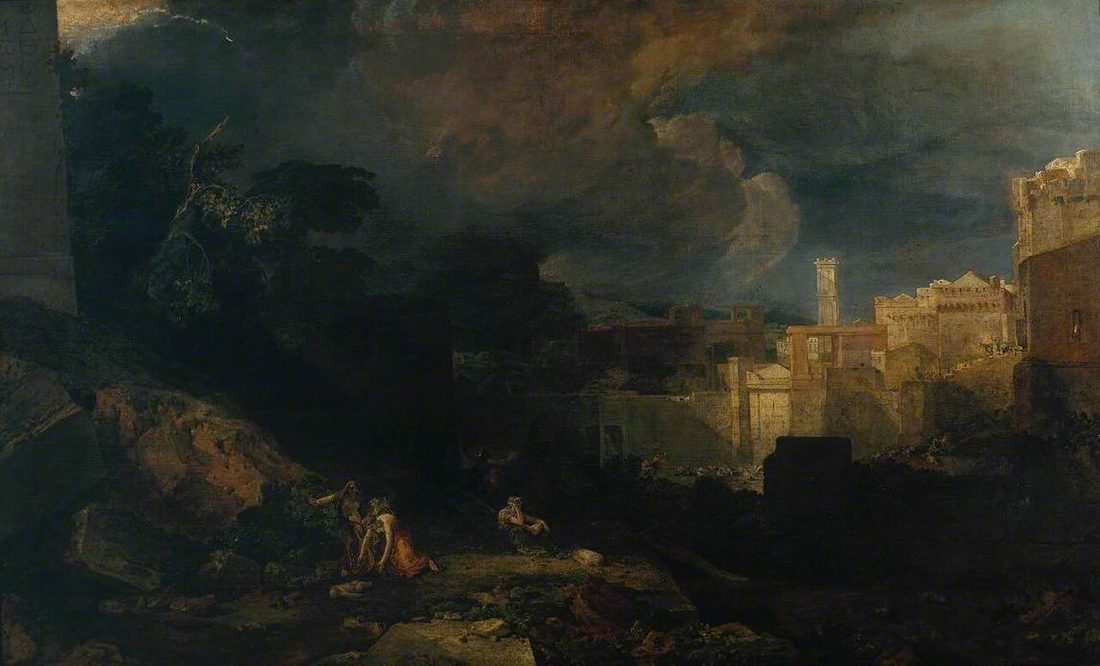
_-_The_Tenth_Plague_of_Egypt_-_N00470_-_National_Gallery.jpg)
The subject
The tenth plague is the death of the firstborn, the last of the afflictions visited on Egypt in the book of Exodus. Turner shows the aftermath instead of the event: figures collapsed in grief across a foreground of heavy shadow, Egyptian architecture behind them, and a storm-darkened sky over the whole scene.
| Artist | Joseph Mallord William Turner (1775–1851) |
|---|---|
| Date | 1802 |
| Exhibited | Royal Academy, 1802 |
| Medium | Oil paint on canvas |
| Dimensions | support: 1435 x 2362 mm |
| Collection | Tate, London |
| Accession number | N00470 |
| Credit line | Accepted by the nation as part of the Turner Bequest 1856 |
Nothing supernatural is depicted anywhere in it. There is no angel, no visible agency and no moment of striking, which leaves a picture about consequence and grief rather than about divine action. That restraint is notable in a period when biblical subjects were routinely painted with the miracle fully in view.
A claim on history painting
The timing is really the point here. Turner was elected a full Academician in February 1802 and exhibited this canvas in the same year, and a biblical subject from Exodus sat squarely in the highest category the Academy recognised. A landscape painter showing one was making an argument about his own standing.
He had already done the same thing with classical subjects, and would keep doing it for decades. What makes the biblical pictures different is that they carried the additional weight of scripture, which placed them beyond any argument about whether the subject was serious enough to deserve a large canvas.
The models
The organisation owes a good deal to Nicolas Poussin, whose biblical and classical histories were the standard for the type, and whose work Turner knew well from British collections and from engravings. The heavy foreground shadow, the architectural backdrop and the grouped mourning figures all belong to that same tradition.
He later lectured on Poussin's handling of light in his own Academy courses, so the interest was analytical as much as it was compositional. Turner tended to study the painters he borrowed from rather than simply copying them, and the pattern here is the same one he followed with Claude Lorrain.
The fifth plague confusion
Turner had exhibited The Fifth Plague of Egypt in 1800, and the two pictures are regularly confused with each other, not least because the fifth plague is murrain on cattle while the canvas carrying that title appears to show hail and fire. The mislabelling is Turner's own and was never corrected.
Egypt without Egypt
Turner never went to Egypt, and the architecture here is assembled from prints and from other painters rather than observed. That was entirely standard: a biblical subject was expected to be constructed in the studio, and no contemporary reviewer would have thought of it as a deficiency in the picture.
Where to see it
Tate holds the picture in London; it came with the Turner Bequest. It belongs with Dido Building Carthage and with Ulysses Deriding Polyphemus as evidence of a long and sustained campaign, spread across some thirty years, to have landscape admitted to the rank that the Academy reserved for narrative painting.
Questions
Why paint a biblical subject at all?
Because the Royal Academy ranked narrative subjects drawn from scripture, from myth and from classical literature above landscape, and a painter who wanted landscape taken seriously had to demonstrate that he could work at that level. Turner exhibited this in 1802, the year he was elected a full Academician at twenty-six.
What is the tenth plague?
The death of the firstborn, the last of the afflictions visited on Egypt in the book of Exodus. Turner paints the aftermath instead of the event itself: figures collapsed in grief across a shadowed foreground with Egyptian architecture behind them, and no angel or visible agency anywhere in the picture.
Why is it confused with The Fifth Plague of Egypt?
Turner exhibited a painting titled The Fifth Plague of Egypt in 1800, and the two are regularly mixed up. It does not help that the fifth plague is murrain on cattle while the canvas carrying that title appears to show hail and fire. The mislabelling is Turner's own and was never corrected.